
marcus
Affiliate Marketing With Ai – Direct Method
🔍 Affiliate Marketing Models


✅ Standard Affiliate Blogging
-
Long-term SEO traffic
-
Helpful articles, product roundups
-
Naturally embedded affiliate links
-
Slower to build but sustainable
⚡ Direct Response AI-Powered Affiliate Marketing
-
Focus on immediate clicks, leads, and sales
-
Use persuasive content, optimized funnels
-
Rapid testing (PPC, viral traffic)
-
Faster ROI, scalable with AI tools
📊 Digital Advertising & Affiliate Market Trends
📈 Digital Ad Spend
-
2023: Crossed $600B globally
-
2024: Projected $667.6B
-
2025: Forecast $730B+
-
2026: Expected $800B+
-
2030: Estimated to reach $1.16 trillion
🌐 Affiliate Marketing Market Size
-
2024 Estimates: $15.7B – $20B
-
2027 Projection: $27.78B
-
2030 Projection: $36.9B
-
CAGR: 8% to 18.6%
💰 Affiliate Income Insights
-
Many affiliates earn under $10K/year
-
Only ~1% make 6–7 figure monthly incomes
-
Ad spend can reach $120 per click in some niches!
🚀 8-Step AI Affiliate Blueprint
1. Start With Direct Solution Niche
-
Avoid vague blogging — go for direct-to-profit ideas
-
Example: Dry Towels niche with video explainer
-
Focus: Solving urgent problems
2. Get A Solid Easy Domain Name
-
Example: www.GoHubSite.com
-
Tips:
-
Catchy, brandable
-
Optionally buy domains with backlinks
-
Easy to remember and type
-
3. Use a Minimal WordPress Theme
-
Clean, responsive (mobile-first) layout
-
Built with NicePage, WordPress
-
AI-generated logo
-
No clutter – optimized for conversions
4. Build High-Converting Pages
-
🔹 Landing Page (Opt-in/Pitch Page)
-
🔹 Thank You Page
-
Use strong CTAs, giveaways, lead magnets (guides, eBooks)
-
Set permalink structure, page settings properly
5. Deploy the Traffic Plan
-
🧪 Start with PPC to test ideas fast
-
Scale with:
-
SEO (organic traffic)
-
Social media
-
Short-form video content
-
6. Add Focused Deliberate Content
-
Support PPC with SEO-driven blog posts
-
Content types:
-
Product comparisons
-
Buyer guides
-
“Problem-Solution” posts
-
-
Goal: Build daily earning posts
7. Scale Your Traffic
-
Don’t get stuck analyzing — GO ALL IN
-
Reinforce what works
-
Diversify channels but stay focused on what converts
-
Use AI to produce content faster
8. Test & Track Everything
-
Re-test your:
-
Pages vs. Posts
-
Opt-in copy
-
Permalinks and layouts
-
-
Optimize based on conversions and ROI
-
Tools: Heatmaps, A/B testing, analytics dashboards
🛠 Tools & Platforms Mentioned
-
WordPress + NicePage
-
AI Logo Generators
-
PPC Ad Networks
-
Analytics & Tracking Tools
-
Lead Magnet Creators (PDFs, Book covers)
Using Ai Systems To Make Money
CLICK HERE TO JOIN AI PROFIT SCOOP AND LEARN FROM MARCUS
Get A High Ticket Niche – Work With Marcus Here
CLICK HERE TO JOIN AI PROFIT SCOOP AND LEARN FROM MARCUS
Get A High Ticket Niche – Work With Marcus Here
Monetize AI: A Beginner’s Guide to Side Hustles, Tools & Building Smart Systems
“The money isn’t in doing more — it’s in making your time count for more.”
🎯 FOR THE PURPOSE OF…
If you’re a beginner, your first step is simple:
👉 START WITH LEARNING AI
Get comfortable with the top tools for research and productivity:
-
Gemini – For deep research and integration with Google Docs & Sheets
-
Notebook LM – Turn your notes into smart Q&A summaries
-
Claude – Summarizes massive documents lightning fast
💡 What info do I want — and why?
Mastering research and organization gives you an edge in content creation, idea validation, and side hustle execution.
💼 33 Online Side Hustles You Can Start With AI
Whether you’re a writer, creator, or coach, these AI tools make it easier and faster to launch.
| Hustle | Recommended Tools |
|---|---|
| 1. Content Writing | ChatGPT / Jasper AI |
| 2. Copywriting | Copy.ai / Writesonic |
| 3. Editing & Proofreading | Grammarly / Hemingway Editor |
| 4. Ghostwriting | ChatGPT / Sudowrite |
| 5. Translation | DeepL / Google Translate |
| 6. Scriptwriting | ChatGPT / ScriptBook |
| 7. eBook Writing | Sudowrite / Scrivener |
| 8. Programming | GitHub Copilot / Codeium |
| 9. Web Development | Framer AI / Durable.co |
| 10. App Development | Adalo / Glide |
| 11. Tech Support | ChatGPT / Tidio AI |
| 12. Automation | Zapier AI / Make |
| 13. Graphic Design | Canva AI / Adobe Firefly |
| 14. Video Editing | Pictory / Runway ML |
| 15. Animation | Animaker / Kaiber |
| 16. UI/UX Design | Uizard / Figma |
| 17. Digital Art | Midjourney / Kittl |
| 18. Social Media | Ocoya / Predis.ai |
| 19. SEO Services | Surfer SEO / NeuronWriter |
| 20. Affiliate Marketing | ChatGPT / Systeme.io |
| 21. Dropshipping | Sell The Trend / AutoDS |
| 22. Email Marketing | MailerLite / Copy.ai |
| 23. Ad Campaigns | AdCreative.ai / Madgicx |
| 24. Online Tutoring | TutorAI / MagicSchool.ai |
| 25. Career Coaching | Rezi / Kickresume |
| 26. Business Coaching | ChatGPT / Mindsmith |
| 27. Fitness Coaching | FitCoach AI / TrainAI |
| 28. Life Coaching | Mindsera / ChatGPT |
| 29. Print-on-Demand | Canva / Kittl + Printful |
| 30. Stock Photography | Leap AI / Shutterstock.AI |
| 31. Course Creation | Teachable / Kajabi AI |
| 32. YouTube Automation | Pictory / Opus Clip |
| 33. Blogging / Niche Sites | KoalaWriter / SEOwriting.ai |
CLICK HERE TO JOIN AI PROFIT SCOOP AND LEARN FROM MARCUS
Get A High Ticket Niche – Work With Marcus Here
🧱 BUSINESS BUILDING FRAMEWORK
Once you pick your side hustle, follow this simple business system:
-
Choose a Niche
-
Pick your Business Model (affiliate, product, SaaS, service)
-
Set up Domain & Hosting
-
Build your Website / Landing Page
-
Develop your Branding
-
Create Content (blogs, videos, products)
-
Drive Traffic (SEO, ads, social)
-
Start Email List Building
-
Create Offers (digital/physical)
-
Build Funnels
-
Set up Payment Systems
-
Use a CRM or Chatbot
-
Add Analytics & Tracking
-
Choose a Monetization Strategy
-
Set up Automation
-
Do Marketing & Promotions
-
Cover Legal Essentials
-
Test & Optimize
-
Scale Up smartly
-
Build a Community
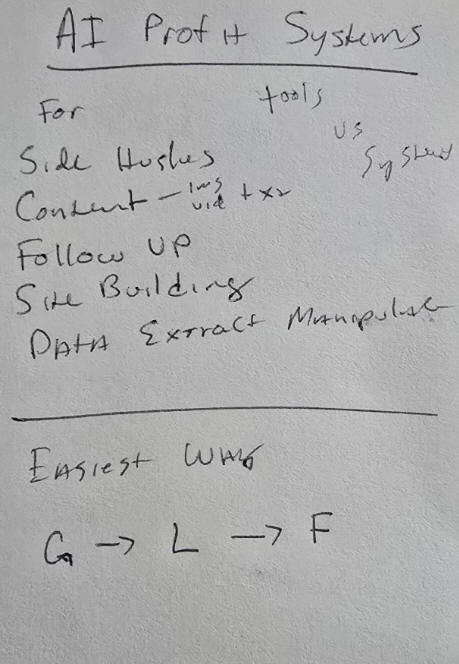
⚙️ Tools vs. Systems
-
Tools = GPT, Canva, Pika Labs, Claude, Zapier
-
Systems = Funnels, Email Sequences, Automation
🔁 Flow Model: G → L → F
G = Get Attention (Content, Video, Posts)
L = Capture Leads (Email opt-ins, Freebies)
F = Follow-Up (Emails, Offers, Affiliate Funnel)
📦 Use Case Examples
-
AI-Powered Funnels (generate everything from landing pages to emails)
-
Lead Generation with AI Opt-ins
-
Auto Blog Builders for Niches
-
AI Email Sequences from ChatGPT
-
CSV → Blog Posts
-
Transcript → SEO Posts
-
Data Sheets → Category Clusters
CLICK HERE TO JOIN AI PROFIT SCOOP AND LEARN FROM MARCUS
Get A High Ticket Niche – Work With Marcus Here
💸 Side Hustle System Stacks
| System | Stack |
|---|---|
| Printables | Canva + ChatGPT → Etsy |
| YouTube Shorts | ChatGPT + Pictory |
| Pinterest Traffic | Midjourney + Tailwind |
| Affiliate Funnels | Systeme.io + Claude |
| Email Follow-up | ChatGPT + ConvertKit |
| Comment Replies | Scrape + GPT Templates |
| Auto Site Creation | KoalaWriter + WordPress |
🌐 Site Building Ideas
-
1-Page Lead Magnet Sites
-
AI-Powered Niche Blogs
-
Product Comparison Pages
-
Tools & Calculators
-
Lead Capture Pages
🧠 Data System Ideas
-
CSV to Blog Generator
-
Transcripts to Articles
-
SEO Sheet to Site Map
🧰 Top AI Tools for Beginners
| Tool | Why It’s Great |
|---|---|
| ChatGPT Plus | Writing, ideas, coding, DALL·E image gen |
| Claude | Summarizes long docs instantly |
| NotebookLM ⭐ | Turns your notes into planning tools |
| Gemini | Deep research, Google integration |
| Perplexity AI | Real-time research with sources |
🎬 Best AI Video Tools
| Tool | Why It’s Great |
|---|---|
| Pictory | Turn text/blogs into videos |
| HeyGen | AI avatars with voice sync |
| Lumen5 | Make videos from blog posts |
| Descript | Edit video like text |
| Synthesia | Pro AI presenter videos |
Also: ElevenLabs, Hedra, InVideo
🎨 Best AI Image Tools
| Tool | Why It’s Great |
|---|---|
| Canva AI | Easiest for beginners, templates + AI tools |
| DALL·E in ChatGPT | Instant text-to-image |
| Adobe Firefly | Commercial-use image generation |
| Midjourney | Stunning, artistic visuals |
| Leonardo AI | Great for fantasy art, gaming, social media |
🔁 What to Do Next
-
Pick 1-3 tools that fit your current side hustle
-
Build a simple G → L → F system
-
Focus on systems over just tools
-
Stack small wins into compound profit
💥 The real game isn’t working harder. It’s compounding smarter systems using AI.
AI Profit Systems: Beyond Tools to Complete Business Solutions
In today’s rapidly evolving digital landscape, the distinction between using AI tools versus implementing AI systems can make all the difference in your online business success. While many entrepreneurs chase after the latest AI tool releases, those who truly understand how to build comprehensive AI systems are the ones creating sustainable, profitable businesses.
Tools vs. Systems: Understanding the Difference
Let’s start by clarifying some important definitions:
- System: A set of things working together as parts of a mechanism or interconnecting network
- Process: A series of actions or steps taken to achieve a particular end
- Tool: A device or implement used to carry out a particular function
The problem many entrepreneurs face is relying on individual AI tools without understanding how to integrate them into a complete business system. Just like standing on a stool won’t get you to the top shelf, using an isolated AI tool won’t get you to your business goals without the proper framework around it.
The GLF Method: The Foundation of Profitable AI Systems
At the core of any successful AI profit system is what I call the GLF method:
- G – Get Attention/Generate Traffic: Attract your target audience
- L – Leads: Convert that traffic into leads you can follow up with
- F – Follow-Up: Nurture relationships and convert leads into customers
This simple framework forms the backbone of virtually any online business model. With AI, we can now enhance and automate each step of this process more effectively than ever before.
Starting with Market Research: The First Critical Step
Before diving into AI tools or content creation, successful entrepreneurs start by thoroughly understanding their market:
- Use AI tools like Google’s Gemini with deep research capabilities
- Deploy Notebook LM to organize findings and generate mind maps
- Identify specific pain points, questions, and desires of your target audience
- Understand commercial intent and potential monetization strategies
AI excels at research, giving you a significant advantage in understanding your market deeply and quickly. This research phase isn’t just preliminary work—it’s the foundation upon which everything else is built.
Online Side Hustles vs. Business Models
Your approach to AI systems will vary depending on whether you’re building a side hustle or a complete business:
Side Hustles (One-and-Done Tasks):
- Content writing
- Copywriting
- Editing and proofreading
- Ghost writing/ebook writing
- Programming and coding
- Web development
- App development
- Tech support
- Automation and scripting
- Graphic design
- Video editing
- Animation and motion graphics
Business Models (Ongoing Systems):
- Content websites
- Affiliate marketing
- SaaS (Software as a Service)
- Digital product creation
- Coaching and consulting
- Membership sites
- E-commerce
- Digital marketing agencies
The key difference is that side hustles typically involve one-off tasks, while businesses require ongoing systems and processes. However, many successful entrepreneurs start with side hustles and gradually develop them into full-fledged businesses.
CLICK HERE TO JOIN AI PROFIT SCOOP AND LEARN FROM MARCUS
Get A High Ticket Niche – Work With Marcus Here
Practical Steps to Build Your AI System
1. Start with Learning AI
Begin by familiarizing yourself with AI tools that can help you learn about your chosen niche or skill. Tools like Notebook LM, Gemini, and ChatGPT are excellent for this purpose.
2. Define Your Purpose
Be crystal clear about your objectives:
- Are you building a side hustle or a business?
- What specific niche are you targeting?
- What problems are you solving?
- How will you monetize your solution?
3. Choose Your Business Model
Only after understanding your market should you select the appropriate business model. This could be affiliate marketing, selling your own products, offering services, or a combination.
4. Set Up Your Foundation
- Register a domain name and web hosting
- Create a website or landing page using AI assistance
- Develop your branding (logo, colors, voice)
- Create initial content
5. Focus on Lead Generation
The most valuable asset in any online business is your audience. Create compelling lead magnets that solve specific problems in your niche:
- Guides and templates
- Checklists
- Free tools
- Mini-courses
- Reports and case studies
6. Implement Follow-Up Systems
Use AI to create effective follow-up sequences:
- Email marketing sequences
- Social media content calendars
- Content creation schedules
- Community engagement
7. Monitor, Test, and Optimize
Track key metrics and use AI to analyze your results:
- Visitor-to-lead conversion rates
- Lead-to-customer conversion rates
- Customer lifetime value
- Content performance
- Traffic sources and quality
Building Your AI Tool Stack
Different tasks require different AI tools. Here’s a recommended stack for beginners:
Learning and Research
- ChatGPT for general information and content outlines
- Claude for handling large document analysis
- Notebook LM for organizing research and generating mind maps
- Gemini for deep web research
Content Creation
- ChatGPT for writing and editing
- Claude for more nuanced, human-like content
- Leonardo.ai or Midjourney for image generation
- ChatGPT’s image generation for text-on-image content
Marketing and Automation
- Email marketing tools with AI capabilities
- Social media scheduling with AI optimization
- AI-powered analytics tools
- CRM systems with AI integration
The Value of Building Systems Over Using Tools
The most successful online entrepreneurs understand that:
- Value comes from knowledge: What you learn becomes your most valuable asset
- Specific value creation: You either provide significant value to a small group or modest value to a large group
- Feedback is crucial: Building systems that collect and implement user feedback creates continuous improvement
- Helping first sells better: Focus on genuinely helping your audience before trying to sell anything
CLICK HERE TO JOIN AI PROFIT SCOOP AND LEARN FROM MARCUS
Get A High Ticket Niche – Work With Marcus Here
Vintage Marcus – The One Thing You Need To Succeed Online
CLICK HERE TO JOIN AI PROFIT SCOOP AND LEARN FROM MARCUS
Get A High Ticket Niche – Work With Marcus Here
THE POWER OF INFLUENCE
Key Insights on Internet Marketing Success
💡 CORE CONCEPT: INFLUENCE IS EVERYTHING
“Internet marketing is all broken down into influence. You are paid in direct proportion to either:
- The amount of people you influence
- The manner in which you influence them”
THE REALITY CHECK
- Less than 0.1% of people do what it takes to succeed
- People say they want to “be their own boss” but then ask “tell me exactly what to do”
- No one calls to tell you what to do each morning – you must decide for yourself
- Success requires taking personal responsibility for your actions and decisions
THE SKILL THAT MATTERS: INFLUENCE
- Not About Technology: Success isn’t about websites, design, web hosting, or autoresponders
- Words Matter: The right words on the right platform can transform results
- Example: Magic business ad change from “Magic, Balloons, Comedy and Fun” to “Make Your Child’s Party Unforgettable” = 4× increase in bookings
- Medium Doesn’t Matter: Whether it’s:
- Email marketing
- Facebook/social media
- YouTube
- Pinterest/visual platforms
- Search engine marketing
The core skill remains the same: INFLUENCE
PAY ATTENTION
“So few people pay attention – that’s your number one skill”
- The internet tells you exactly what works – just look at what’s getting results
- Study what people search for (Google AdWords Planner)
- Analyze what gets engagement on social platforms
- Notice trends early (like solar eclipse glasses) and act on them
KNOW YOUR AUDIENCE
- The more you know about your visitors, the better
- Understand their search patterns, interests, and pain points
- Example: Finding “cost of braces” (low-competition keyword) instead of “dental insurance” (high-competition)
- People interpret messages how they want to – your job is to frame it so they interpret favorably
TAKE RISKS, TEST & TRY
- Everything worthwhile requires some risk
- It doesn’t cost much to test and try new approaches
- Failures aren’t permanent – they’re learning experiences
- Example: First ad cost $170 (major investment at the time) but returned $1000
MONEY MINDSET
- Many people have hangups and myths about money
- Money is just a measurement of what the community owes you vs. what you owe the community
- No one cares about your financial situation but you – this is liberating
- Focus on the practical steps to reach your income goals (e.g., $100k/year = $274/day)
ACTION FRAMEWORK
- Set specific income goals
- Break down to daily targets
- Choose the right audience/niche
- Learn to influence through the right words
- Pay attention to results and adapt
- Take consistent daily action
REMEMBER:
“It’s all about influence and you’ve got to realize how our society is. Our society, the Internet Society, wants things fast. We buy titles of books, we don’t buy pages.”
“If I lost everything, as I’ve done many times, if I was broke tomorrow, what would I do? I’d do the same thing I’m doing right now because it works.”
CLICK HERE TO JOIN AI PROFIT SCOOP AND LEARN FROM MARCUS
Get A High Ticket Niche – Work With Marcus Here
Download Reports From Marcus Trainings :)
here is a sample of helpful marketing and money getting reports from ai profit scoop.
Direct Response Marketing Glossary
Affiliate Marketing with PPC–300 Click Test_NEW
we have tons of these on every topic as well as TONS of videos and trainings in the new ai profit scoop 🙂 keep an eye out.
Not Yet In Ai Profit Scoop – Click Here To Join Now
post a comment below to what you want marcus to teach next – we are making a FULL video archive.
One Product Niches = HUGE Profits
| Product | Problem | Solution | Estimated Price |
|---|---|---|---|
| Magnetic Eyeglass Holder | Lost or misplaced reading glasses | Clips to shirt and holds glasses magnetically when not in use | $14.99 |
| Collapsible Water Bottle with Purifier | Bulky water bottles and unsafe drinking water | Compact, foldable bottle that filters water on the go | $24.99 |
| Microwave Bacon Cooker | Messy, greasy bacon preparation | Cooks bacon quickly while draining fat into trap below | $19.99 |
| Wearable LED Book Light | Reading in bed without disturbing others | Hangs around neck with adjustable light beams | $16.99 |
| Instant Screen Door | Need for fresh air without letting insects in | Magnetic closure screen that opens and closes automatically | $29.99 |
| Portable Car Door Step | Difficulty accessing roof racks on tall vehicles | Hooks onto door latch providing a stepping platform | $34.99 |
| Expandable Garden Hose | Heavy, tangled garden hoses | Lightweight hose that expands with water pressure, contracts when empty | $39.99 |
| Cordless Power Scrubber | Difficult bathroom cleaning | Battery-powered rotating brush for effortless scrubbing | $49.99 |
| Microwave Pasta Cooker | Pasta boil-overs and draining difficulties | All-in-one cooker with straining lid | $14.99 |
| Drill Attachment String Trimmer | Expensive power lawn tools | Attaches to regular drill for quick lawn edging | $24.99 |
| Dashboard Sticky Pad | Phone sliding while driving | Non-slip surface holds items in place without adhesive | $12.99 |
| Rapid Egg Cooker | Inconsistent boiled egg results | Cooks up to 6 eggs perfectly every time | $19.99 |
| Motion Sensor Cabinet Lights | Dark cabinet interiors | Self-adhesive LED lights that activate when cabinet opens | $24.99 |
| Plastic Bag Sealer and Cutter | Food spoilage from open bags | Reseals plastic bags and cuts new openings | $14.99 |
| Sock Sorter and Folder | Mismatched socks and messy drawers | Quickly pairs and folds socks into neat bundles | $19.99 |
| Hands-free Hair Dryer Holder | Tired arms during hair drying | Flexible positioning stand holds dryer at any angle | $29.99 |
| Waterproof Phone Pouch | Phone damage from water exposure | Sealed pouch with lanyard for swimming or rain | $14.99 |
| Multi-purpose Vegetable Chopper | Time-consuming food prep | All-in-one dicer, slicer with container | $24.99 |
| Wearable Nail Polish Holder | Spilled nail polish during application | Ring that securely holds nail polish bottle | $9.99 |
| Portable Doorbell | No doorbell for apartments or travelers | Wireless system that can be set up anywhere temporarily | $29.99 |
| Windshield Wiper Restorer | Streaky, worn windshield wipers | Tool that resharpens and cleans existing wipers | $14.99 |
| Microfiber Hair Towel Wrap | Long hair drying time | Quick-drying absorbent towel with secure fastener | $19.99 |
| Electronic Pulse Massage Gloves | Hand and wrist pain | Battery-powered massage with multiple settings | $39.99 |
| TV Remote Finder | Lost remote controls | Beeping locator activated by clapping or app | $24.99 |
| Arthritis Jar Opener | Difficulty opening tight jar lids | Leverage-based opener requiring minimal hand strength | $19.99 |
| Adjustable Furniture Risers | Limited under-bed storage | Stackable risers to elevate bed for extra space | $24.99 |
| Flexible Inspection Mirror | Inability to see in tight spaces | Extendable mirror with LED lights | $16.99 |
| Odor-Eliminating Toilet Spray | Bathroom odors | Pre-spray that traps odors before they escape | $14.99 |
| Self-Cleaning Pet Hair Roller | Pet hair on furniture and clothing | Roller with self-cleaning base for continuous use | $24.99 |
| Grout Renewal Pen | Stained, discolored grout lines | Precision applicator with waterproof formula | $12.99 |
| Kitchen Sink Splash Guard | Water splashing during dishwashing | Silicone guard that attaches to sink edge | $14.99 |
| Magnetic Wristband for Tools | Lost screws and nails during projects | Wearable band that holds metal parts magnetically | $16.99 |
| Air Pump Toilet Plunger | Ineffective traditional plungers | Pressurized air system for powerful clog removal | $29.99 |
| Microwave Cooking Cover | Food splatters in microwave | Adjustable vent cover for steam release | $12.99 |
| Personal Cooling Device | Overheating in hot environments | Portable air conditioner worn around neck | $39.99 |
| Bedsheet Fasteners | Sheets coming loose from mattress | Clips that secure sheets tightly in place | $14.99 |
| Car Headrest Hooks | Bags falling over in car | Hooks onto headrest posts for hanging items | $9.99 |
| Shoe Deodorizer | Smelly shoes | Activated charcoal inserts that absorb odors | $14.99 |
| Sliding Drawer Organizers | Messy, cluttered drawers | Adjustable dividers for customized organization | $19.99 |
| Reusable Stretch Lids | Plastic wrap waste and poor sealing | Silicone covers that stretch to fit any container | $19.99 |
| Handheld Vacuum Sealer | Food spoilage and freezer burn | Portable device that vacuum seals any bag | $29.99 |
| Drywall Repair Kit | Difficult wall hole repairs | All-in-one patch system with tools | $19.99 |
| Extendable Duster | Dust in hard-to-reach places | Flexible, extendable handle for high spots | $16.99 |
| Stove Gap Covers | Food falling between stove and counter | Silicone strips that cover the gap | $14.99 |
| Rust Stain Remover | Stubborn rust stains on fixtures | Chemical-free formula for porcelain and ceramic | $12.99 |
| Foldable Step Stool with Handle | Reaching high cabinets safely | Compact stool that supports up to 300 lbs | $24.99 |
| Portable Clothes Steamer | Wrinkled clothing while traveling | Handheld steamer that works without ironing board | $29.99 |
| Adjustable Furniture Sliders | Difficulty moving heavy furniture | Low-friction pads that work on any floor surface | $19.99 |
| Digital Measuring Spoon | Inaccurate recipe measurements | Spoon with built-in digital scale for precision | $24.99 |
| Paint Touch-up System | Mismatched paint for wall repairs | Color-matching system with storage containers | $29.99 |
| Mini Chainsaw | Difficult branch cutting | One-handed, lightweight electric chainsaw | $79.99 |
| Wireless Doorbell Camera | Package theft and security concerns | Doorbell with camera and smartphone alerts | $99.99 |
| Sink Caddy with Dispenser | Cluttered sink area | Organizer with built-in soap dispenser | $19.99 |
| Furniture Scratch Repair Kit | Visible scratches on wood furniture | Markers and wax sticks that match wood tones | $14.99 |
| Toilet Bowl Night Light | Night bathroom trips in the dark | Motion-activated LED with multiple colors | $19.99 |
| Headlight Restoration Kit | Foggy, yellowed headlights | Complete system to restore clarity | $24.99 |
| Heat-Resistant Countertop Mat | Countertop damage from hot items | Silicone mat that protects surfaces | $19.99 |
| Portable Door Lock | Hotel room security concerns | Additional lock that works on any door | $19.99 |
| Pet Grooming Gloves | Difficult pet hair removal during shedding | Gloves with built-in brushing nodules | $16.99 |
| Self-Wringing Mop System | Heavy, messy traditional mops | Bucket with wringer and microfiber mop head | $39.99 |
| Cordless Heated Clothes Iron | Limited mobility with corded irons | Battery-powered iron for anywhere use | $49.99 |
| Clip-on Pot Strainer | Bulky colanders taking up space | Silicone strainer that attaches directly to pots | $14.99 |
| Adjustable Tablet Holder | Uncomfortable viewing angles in bed | Flexible stand that works in any position | $29.99 |
| Electric Callus Remover | Rough, calloused feet | Rotating buffer with multiple attachments | $24.99 |
| Multi-purpose Scissors | Need for multiple kitchen tools | Scissors with built-in bottle opener and other tools | $19.99 |
| Car Seat Belt Adjuster | Uncomfortable seat belt positioning | Clip that repositions belt away from neck | $12.99 |
| Foot Alignment Socks | Toe pain and alignment issues | Specialized socks that separate and align toes | $19.99 |
| Flexible Phone Holder | Holding phone during videos/calls | Gooseneck mount that can be positioned anywhere | $24.99 |
| Pan Lid Organizer | Cluttered cabinet with falling lids | Rack that stores lids vertically and accessibly | $16.99 |
| Wallet Multi-tool Card | Bulky tools for emergencies | Credit card sized tool with multiple functions | $14.99 |
| Automatic Jar Opener | Difficulty opening jars with one hand | Electric opener that works with button press | $29.99 |
| Compression Travel Bags | Bulky luggage with limited space | Space-saving bags that compress without vacuum | $19.99 |
| Dryer Vent Cleaner | Lint buildup causing fire hazard | Vacuum attachment for deep vent cleaning | $24.99 |
| Pain Relief Roll-on | Localized muscle and joint pain | Topical analgesic with cooling effect | $14.99 |
| Window Track Cleaner | Dirt in hard-to-clean window tracks | Specialized tool with microfiber pads | $16.99 |
| Magnetic Eyeglass Repair Kit | Tiny screws lost during repairs | Kit with magnetic storage and precision tools | $12.99 |
| Ultrasonic Pest Repeller | Insect and rodent infestations | Plug-in device using sound waves to repel pests | $29.99 |
| Car Windshield Defogger | Foggy windshield reducing visibility | Special cloth that prevents and removes fog | $14.99 |
| Magnetic Key Holder | Misplaced house keys | Wall-mounted cloud-shaped magnetic holder | $16.99 |
| Waterproof Shower Notepad | Forgotten ideas while showering | Notepad that can be written on when wet | $12.99 |
| Under-Sink Cabinet Organizer | Cluttered, hard-to-reach items | Sliding drawer system that maximizes space | $29.99 |
| Drain Snake with Hair Catcher | Clogged drains from hair buildup | Tool that removes clogs and catches hair | $14.99 |
| Grip-Enhancing Jar Opener | Slippery jar lids | Non-slip material that increases grip surface | $9.99 |
| Portable Seat Cushion | Back pain from prolonged sitting | Ergonomic cushion with support and portability | $24.99 |
| Mixer Splash Guard | Mess from stand mixer splatter | Silicone shield that prevents ingredient spray | $19.99 |
| Peel-and-Stick Caulk Strips | Difficult, messy caulk application | Pre-formed strips that adhere to baseboards | $14.99 |
| Flexible Grabber Tool | Retrieving items from tight spaces | Extendable tool with LED light and grip head | $19.99 |
| Reusable Fire Starter Sticks | Difficult fire starting | Waterproof sticks that light easily and reuse | $16.99 |
| Hose Spray Bottle Attachment | Inefficient plant watering | Bottle that attaches to hose with measured feed | $14.99 |
| Furniture Pet Hair Brush | Embedded pet hair in upholstery | Specialized brush with rubber bristles | $16.99 |
| Collapsible Silicone Funnel | Storage space for kitchen tools | Funnel that flattens for compact storage | $12.99 |
| Anti-Fatigue Standing Mat | Foot and back pain from standing | Cushioned mat with massage points | $39.99 |
| Picture Hanging Tool | Crooked picture frames | All-in-one tool with level and nail positioning | $19.99 |
| Flexible Ice Cube Tray | Difficult ice removal | Silicone tray with cover that flexes for release | $14.99 |
| Phone Cord Protector | Frayed charging cables | Reinforced covers for cable stress points | $9.99 |
| Car Cup Holder Adapter | Oversized drinks don’t fit | Expandable insert for various container sizes | $14.99 |
| Shower Callus Remover | Wet, slippery foot care products | Waterproof electric remover for shower use | $29.99 |
| Faucet Extender for Kids | Children can’t reach sink faucets | Plastic chute that brings water closer to edge | $12.99 |
| Pocket Lint Roller | Lint and pet hair on clothing | Compact roller with protective cover | $9.99 |
| Adjustable Furniture Felt Pads | Floor scratches from furniture | Self-adhesive pads with adjustable thickness | $14.99 |
| Product | Problem | Solution | Price | Target Niche |
|---|---|---|---|---|
| Smartphone camera lens attachments | Limited smartphone photography capabilities | Add-on lenses that enhance photo quality and options | $24.99 | Photography enthusiasts, social media content creators |
| Posture corrector back brace | Poor posture from desk work | Support brace that trains better posture habits | $29.99 | Office workers, remote employees, gamers |
| Weighted anxiety blanket | Anxiety, insomnia, and restlessness | Evenly distributed weight for calming pressure | $79.99 | Anxiety sufferers, poor sleepers, sensory processing needs |
| Portable power station for camping | No electricity when outdoors | Rechargeable battery pack with multiple outputs | $149.99 | Campers, outdoor enthusiasts, emergency preparedness |
| Door draft stopper | Cold air infiltration under doors | Insulating barrier that blocks drafts | $19.99 | Homeowners, renters in older buildings, energy savers |
| Pelvic floor trainer | Weak pelvic floor muscles | Exercise device with app feedback | $39.99 | Postpartum women, aging adults, prostate recovery |
| Sleep sound machine | Difficulty falling asleep due to noise | Device generating white noise or nature sounds | $44.99 | Light sleepers, parents of infants, urban dwellers |
| Eyelid scrub for blepharitis | Chronic eyelid inflammation | Specialized cleanser for eyelid hygiene | $14.99 | People with blepharitis, dry eye sufferers, contact lens wearers |
| Migraine ice hat | Debilitating migraine pain | Wearable cold compress that covers head | $34.99 | Migraine sufferers, people with chronic headaches |
| Portable espresso maker | No access to quality coffee while traveling | Hand-powered espresso machine | $69.99 | Coffee enthusiasts, travelers, outdoor adventurers |
| Reusable beeswax food wraps | Plastic waste from food storage | Sustainable alternative to plastic wrap | $19.99 | Eco-conscious consumers, zero-waste households |
| Sunrise alarm clock | Difficulty waking up in dark mornings | Light that gradually brightens before alarm | $49.99 | Heavy sleepers, seasonal depression sufferers, shift workers |
| Bluetooth item tracker | Frequently misplaced important items | Small tag that helps locate lost objects | $29.99 | Forgetful people, busy parents, seniors |
| Compression travel socks | Swollen legs and DVT risk during flights | Graduated pressure socks for circulation | $24.99 | Frequent flyers, seniors, people with circulation issues |
| Phone sanitizer box | Germs and bacteria on mobile devices | UV-C light chamber for disinfection | $59.99 | Germaphobes, healthcare workers, parents with young children |
| Insect bite suction tool | Itching and swelling from bug bites | Device that extracts insect venom | $9.99 | Outdoor enthusiasts, families with young children, allergy sufferers |
| Bluetooth-enabled luggage tracker | Lost luggage during travel | GPS locator that connects to smartphone | $49.99 | Frequent travelers, business professionals |
| Avocado slicer and pit remover | “Avocado hand” injuries from pit removal | All-in-one tool for safe preparation | $12.99 | Avocado lovers, health-conscious eaters, meal preppers |
| Anti-snoring tongue retainer | Disruptive snoring | Device that positions tongue to open airway | $24.99 | Snorers and their partners, people with mild sleep apnea |
| Multi-position tablet holder | Hand fatigue from holding tablets | Adjustable stand for hands-free viewing | $34.99 | Digital readers, movie watchers, recipe followers |
| Mail slot catcher basket | Mail scattered on floor under door | Bag that attaches to collect incoming mail | $16.99 | Apartment dwellers, home office workers, pet owners |
| Car windshield sun reflector | Overheated car interior from sun exposure | Reflective shield that blocks UV rays | $14.99 | Car owners in hot climates, parents with children in car seats |
| Hot water bottle with soft cover | Localized pain and cold discomfort | Reusable heat therapy source | $19.99 | People with menstrual cramps, chronic pain sufferers, cold sleepers |
| Filtered shower head for hard water | Mineral buildup damaging hair and skin | Shower head with built-in filter system | $39.99 | People in hard water areas, those with sensitive skin, hair care enthusiasts |
| Drawer divider organizers | Cluttered, disorganized drawers | Adjustable inserts that create sections | $19.99 | Organizing enthusiasts, small space dwellers, minimalists |
| Motion-activated bed light strip | Difficulty navigating at night | Under-bed lights that activate when feet touch floor | $29.99 | Seniors, parents of young children, midnight bathroom users |
| Herb scissors with multiple blades | Time-consuming herb chopping | Multi-blade scissors for quick cutting | $16.99 | Home cooks, herb gardeners, meal preppers |
| Squatting toilet stool | Difficult bowel movements | Footstool that promotes natural positioning | $24.99 | People with digestive issues, health-conscious individuals |
| Fabric defuzzer | Pilling on clothes and upholstery | Electric tool that removes pills and fuzz | $14.99 | Fashion-conscious consumers, sweater wearers, quality furniture owners |
| Keyboard vacuum cleaner | Debris trapped between keyboard keys | Mini vacuum with specialized attachments | $19.99 | Office workers, gamers, computer professionals |
| Produce preservation bags | Fruits and vegetables spoiling quickly | Specially designed bags that extend freshness | $12.99 | Health-conscious shoppers, budget-minded families, farmers market shoppers |
| Ear irrigation system | Excessive earwax buildup | Safe flushing system for home ear cleaning | $34.99 | People prone to earwax issues, hearing aid users, swimmers |
| Blackout eye mask with headphones | Light and noise disrupting sleep | Combined solution for sensory sleep disturbances | $29.99 | Light sleepers, travelers, shift workers |
| Elevated laptop cooling stand | Overheating laptops and poor ergonomics | Stand with built-in fans and ergonomic height | $39.99 | Remote workers, gamers, power users of laptops |
| Refrigerator odor absorber | Lingering food smells in refrigerator | Activated charcoal filter that eliminates odors | $14.99 | Food enthusiasts, families, apartment dwellers |
| Splatter guard for cooking | Oil splatters during frying | Mesh cover that contains splashing | $16.99 | Home cooks, neat freaks, small kitchen owners |
| Furniture feet floor protectors | Scratched floors from furniture movement | Soft pads that attach to furniture legs | $9.99 | Hardwood floor owners, renters, furniture movers |
| Microdermabrasion facial scrubber | Dull skin requiring exfoliation | Electronic device for deep skin renewal | $39.99 | Skincare enthusiasts, aging skin sufferers, acne-prone individuals |
| Gutter cleaning tool extension | Dangerous ladder use for gutter cleaning | Extended tool that attaches to garden hose | $34.99 | Homeowners, seniors, safety-conscious individuals |
| Vacuum compression storage bags | Bulky seasonal items taking up space | Bags that reduce volume by removing air | $24.99 | People with limited storage, seasonal clothing owners, travelers |
| Mushroom growing kit | Limited access to specialty mushrooms | Self-contained system for home cultivation | $29.99 | Foodies, gardeners, cooking enthusiasts |
| Long-reach lightbulb changer | Difficulty changing high ceiling bulbs | Extendable pole with bulb gripper | $19.99 | Homeowners with high ceilings, seniors, short individuals |
| Wall outlet shelf | No surface space near outlets for devices | Small shelf that attaches to outlet plate | $14.99 | Smart home device users, small space dwellers, tech enthusiasts |
| Hair clog prevention drain cover | Shower drains clogged with hair | Specialized cover that catches hair | $12.99 | Long-haired individuals, pet owners, rental property owners |
| Electronic pulse massager | Muscle pain and tension | TENS unit for drug-free pain relief | $44.99 | Athletes, chronic pain sufferers, physical therapy patients |
| Collapsible measuring cups | Storage space for kitchen tools | Silicone cups that flatten when not in use | $19.99 | Small kitchen owners, RV/van lifers, minimalist cooks |
| Kitchen sink edge organizer | Wet, messy counters from dish washing | Caddy that holds soap and sponges | $16.99 | Neat freaks, small kitchen owners, frequent dish washers |
| Handheld label maker | Disorganized storage without identification | Portable device that prints custom labels | $29.99 | Organizational enthusiasts, home office workers, crafters |
| Self-watering plant globes | Plants dying when owner away | Glass bulbs that slowly release water | $14.99 | Plant owners, frequent travelers, forgetful waterers |
| Compact folding travel steamer | Wrinkled clothing while traveling | Portable device that removes wrinkles without ironing | $34.99 | Business travelers, fashion-conscious individuals, wedding parties |
| Smartphone camera stabilizer | Shaky video footage on phones | Handheld gimbal that smooths movement | $29.99 | Social media content creators, parents, travelers |
| Compost bin with charcoal filter | Food waste odors in kitchen | Sealed container with odor-absorbing filter | $39.99 | Eco-conscious consumers, gardeners, apartment dwellers |
| Knee pillow for side sleepers | Hip and back pain from side sleeping | Ergonomic cushion that aligns spine | $24.99 | Side sleepers, pregnant women, people with back pain |
| Voice amplifier for teachers | Vocal strain from projecting voice | Wearable microphone and speaker system | $49.99 | Teachers, tour guides, public speakers |
| Car upholstery cleaner extractor | Deep stains in vehicle interiors | Device that sprays solution and vacuums dirt | $129.99 | Car enthusiasts, parents with young children, pet owners |
| Bottle brush for narrow containers | Difficulty cleaning inside bottles | Long, flexible brush for tight spaces | $12.99 | Water bottle users, parents with baby bottles, smoothie drinkers |
| Plant soil moisture meter | Uncertainty about when to water plants | Probe that measures soil moisture level | $14.99 | Plant enthusiasts, new gardeners, rare plant collectors |
| Salad dressing mixer bottle | Oil and vinegar separating in dressings | Container with built-in mixing mechanism | $16.99 | Health-conscious eaters, home cooks, meal preppers |
| Emergency car window breaker | Being trapped in vehicle during emergency | Tool that quickly breaks glass and cuts seatbelts | $9.99 | Safety-conscious drivers, parents, new car owners |
| Air vent deflector | Direct airflow causing discomfort | Attachment that redirects air conditioning flow | $14.99 | Office workers, sensitive individuals, homeowners |
| Heated mouse pad | Cold hands during computer use | USB-powered warming pad for mouse hand | $29.99 | Office workers in cold environments, gamers, people with circulation issues |
| Tongue cleaner | Bad breath from tongue bacteria | Specialized tool for removing tongue coating | $9.99 | Oral hygiene enthusiasts, people with halitosis concerns |
| Seat gap filler for cars | Items falling between car seats | Foam insert that blocks the gap | $19.99 | Commuters, rideshare drivers, neat freaks |
| Wrist support for computer use | Carpal tunnel from keyboard use | Ergonomic pad that aligns wrists | $24.99 | Office workers, programmers, writers |
| Reusable silicone ear plugs | Noise disruption during sleep or focus | Comfortable plugs that block sound | $12.99 | Light sleepers, students, concert goers |
| Drip irrigation kit for container gardens | Inconsistent watering of potted plants | Water-saving system with timer | $29.99 | Urban gardeners, water conservationists, busy plant owners |
| Drying rack for herbs | Herbs spoiling before use | Multi-tier system for air drying herbs | $19.99 | Home cooks, gardeners, culinary enthusiasts |
| Pet grooming vacuum attachment | Loose pet hair during brushing | Brush that connects to vacuum cleaner | $34.99 | Pet owners with shedding animals, allergy sufferers |
| Thumb-controlled tape dispenser | Two-handed tape dispensing | One-handed operation with thumb control | $16.99 | Gift wrappers, crafters, shipping professionals |
| Child cabinet locks with magnetic key | Children accessing dangerous items | No-drill locks opened with magnetic key | $24.99 | Parents of young children, grandparents, childcare providers |
| Letter board with changeable letters | Desire for customizable home messaging | Board with slots for interchangeable letters | $29.99 | Home decor enthusiasts, social media users, small business owners |
| UV sanitizing wand | Germs on high-touch surfaces | Portable light that kills bacteria | $49.99 | Germaphobes, travelers, immunocompromised individuals |
| Window bird feeder | Limited nature viewing in urban areas | Clear feeder that attaches to window | $24.99 | Bird watchers, nature lovers, apartment dwellers |
| Reusable K-cup coffee filter | Waste and expense of disposable pods | Refillable pod for single-serve machines | $12.99 | Coffee drinkers, environmentally conscious consumers |
| Smartphone radiation shield | Concerns about EMF exposure | Case insert that blocks radiation | $19.99 | Health-conscious tech users, pregnant women |
| No-touch door opener tool | Germ exposure on public door handles | Keychain tool for touching surfaces | $9.99 | Germaphobes, immunocompromised individuals, healthcare workers |
| Curved shower rod | Shower curtain sticking to body | Outward-curving rod for more space | $34.99 | Small bathroom owners, claustrophobic individuals |
| Travel neck support pillow | Neck pain during travel sleeping | Ergonomic cushion for upright sleeping | $29.99 | Frequent travelers, commuters, road trippers |
| Garlic peeler tube | Sticky fingers from peeling garlic | Silicone tube that removes skin with rolling | $7.99 | Home cooks, culinary enthusiasts, time-conscious chefs |
| Microwave pasta cooker | Boil-overs and multiple dishes for pasta | All-in-one container with straining lid | $19.99 | College students, busy parents, small kitchen owners |
| Heated eye mask | Eye strain and dry eyes | Warm compress with temperature control | $24.99 | Office workers, digital device users, dry eye sufferers |
| Fingertip pulse oximeter | Need to monitor blood oxygen levels | Clip-on device for quick readings | $34.99 | Those with respiratory conditions, athletes, seniors |
| Stainless steel odor-removing soap bar | Lingering food odors on hands | Metal “soap” that neutralizes smells | $14.99 | Cooks, gardeners, pet owners |
| Milk frother for coffee | Desire for café-style drinks at home | Battery-powered whisk for foam creation | $19.99 | Coffee enthusiasts, home baristas, café drink lovers |
| Snap-on strainer for pots | Bulky colanders taking up space | Flexible strainer that attaches to any pot | $16.99 | Small kitchen owners, pasta lovers, minimalists |
| Boot dryer | Wet, smelly footwear | Electric device that circulates warm air | $39.99 | Outdoor enthusiasts, winter sports participants, work boot wearers |
| Baby food freezer tray | Cost of commercial baby food | Portioned tray for homemade food storage | $14.99 | New parents, health-conscious caregivers, budget-minded families |
| Digital body fat caliper | Difficulty tracking body composition | Electronic tool for precise measurements | $24.99 | Fitness enthusiasts, dieters, personal trainers |
| Closet hanging organizer | Limited storage space for accessories | Multi-pocket system that hangs from rod | $19.99 | Fashion enthusiasts, small space dwellers, accessory collectors |
| Refrigerator door closer alarm | Energy waste from open refrigerator | Alarm that sounds when door left open | $14.99 | Energy-conscious consumers, parents of children, forgetful individuals |
| Anti-fog glasses cloth | Fogged glasses from masks or temperature changes | Special cloth with anti-fog coating | $9.99 | Eyeglass wearers, healthcare workers, winter sports enthusiasts |
| Compact emergency phone charger | Phone battery dying away from outlets | Single-use or mini power bank for emergencies | $29.99 | Travelers, outdoor enthusiasts, emergency preparedness |
| Laptop privacy screen | Visual data theft in public places | Filter that limits viewing angle of screen | $34.99 | Business professionals, remote workers in public spaces, travelers |
| Bluetooth shower speaker | No music or podcast access while showering | Waterproof speaker with wireless connection | $29.99 | Music lovers, podcast listeners, multitaskers |
| Baby food maker and processor | Time-consuming baby food preparation | All-in-one steamer and blender for baby meals | $69.99 | New parents, health-conscious caregivers, busy families |
| Rubber broom for pet hair | Pet hair embedded in carpet | Electrostatic rubber bristles that attract hair | $24.99 | Pet owners, allergy sufferers, carpet owners |
| Rolling tube squeezer | Wasted product in tubes | Device that pushes contents to opening | $9.99 | Budget-conscious consumers, skincare enthusiasts, artists |
| Muffin top baking pan | Only wanting the top part of muffins | Specialized pan that creates only tops | $19.99 | Baking enthusiasts, texture-focused eaters, unique gift givers |
| Pickle grabber tool | Difficulty retrieving pickles from jars | Long tool with prongs for lifting items | $12.99 | Pickle lovers, people with large hands, elderly with dexterity issues |
| Temperature-regulating mattress pad | Overheating or feeling cold during sleep | Material that balances body temperature | $89.99 | Hot sleepers, menopausal women, couples with different temperature preferences |
Anticipatory Marketing – Vintage Marcus Videos :)
April 2025 we will be adding a “vintange marcus” secton to ai profit scoop where we will be loading TONS of marcus old videos on affiliate marketing and making money which are more relevant now than ever… PLUS you get personal help support, weekly live calls, plugins, and more.
Just Imagine If You Saw This And Took Action Back in 2014 When It Was Made
Click Here To Join Ai Profit Scoop Now
more vintage marcus 🙂
Click Here To Join Ai Profit Scoop Now
more vintage marcus 🙂
Click Here To Join Ai Profit Scoop Now
Beyond AI SEO – Getting Massive Traffic With Google AI
MASSIVE TRAFFIC WITH AI
Part 1: The Foundation – Understanding Before Scaling
1.1 Deep Research: Human Insight First
- Why Critical: AI needs direction! Understand Audience (Pain Points, Language), Find Unique Angles/Gaps, Build E-E-A-T (Expertise, Authoritativeness, Trustworthiness).
- Methods: Audience analysis (forums, reviews, surveys), Competitor deep dives, Primary source gathering (studies, data, interviews).
- AI Assist: Summarize texts (competitor content, research), Analyze feedback themes, Brainstorm initial research questions.
1.2 Keyword Research & Topic Clusters: Mapping Demand
- What: Finding & analyzing terms people search for. Foundation for SEO, PPC, Content.
- Keywords: Short-tail (broad), Long-tail (specific, high intent), Question, LSI (related terms).
- Search Intent: WHY they search (Informational, Navigational, Transactional, Commercial Investigation). Match content to intent!
- AI Assist: Brainstorm keywords (seed, long-tail), Find related terms (LSI), Analyze SERP data (titles/angles), Generate cluster ideas.
- Topic Clusters:
- Model: Pillar Page (broad topic) + Cluster Pages (subtopics).
- Linking: Internal links connect Pillar <=> Clusters.
- Benefits: SEO Topical Authority, Better UX/Navigation, Organized Content Strategy.
- AI Assist for Clusters: Help outline Pillar/Cluster content structure based on keyword groups.
1.3 Grounding AI (NotebookLM Concept)
- Concept: Base AI responses on YOUR specific research docs.
- Role: Organize sources, Ensure accuracy (fact-check AI output vs. sources), Generate source-based outlines/summaries, Find unique connections across docs.
Part 2: Generating Traffic – AI Across Channels
Overview: Main Traffic Types
- Organic Search (SEO)
- Paid Search (PPC)
- Social (Organic & Paid)
- Referral (Links from other sites)
- Direct (Typed URL, Bookmarks)
- Email (Links in emails)
2.1 Organic Search (SEO): AI as Optimization Partner
- AI Content Creation:
- Drafting (Posts, Pages): Use AI (Gemini) GUIDED by research, keywords, audience info.
- Refining: Improve clarity, tone, readability.
- Repurposing: Transcripts -> Articles, etc.
- ⚠️ HUMAN OVERSIGHT IS NON-NEGOTIABLE: Edit, Fact-Check, Add Unique Value/E-E-A-T, Ensure Brand Voice, Check Originality. NO RAW AI OUTPUT.
- AI On-Page SEO Assist:
- Metadata: Generate Title Tag & Meta Description options.
- Headings: Optimize H1, suggest H2/H3s.
- Alt Text: Generate image descriptions.
- Internal Linking: Suggest relevant links within content.
- Schema Markup: Generate basic JSON-LD (FAQ, HowTo, Article) – Needs validation.
- AI Tech SEO Assist:
- Help interpret audit reports (e.g., PageSpeed).
- Assist structuring
robots.txt,sitemap.xml– Needs expert review.
- AI Off-Page / Link Building Ideas:
- Brainstorm outreach targets (sites, influencers).
- Draft outreach email templates – Must personalize heavily.
- Advanced Off-Page Tactics:
- Domains (Auctioned/Expired):
- Concept: Acquire domains with history (links, traffic?).
- Potential: SEO boost (maybe), direct traffic capture, good name.
- ⚠️ RISKS HIGH: Penalties?, Toxic/Irrelevant Links?, Trademarks?. Google may discount value.
- ⚠️ DUE DILIGENCE VITAL: Check Backlinks (Ahrefs), History (Archive.org), Traffic, Index Status, Penalties.
- Finding: Auction sites (GoDaddy, Sedo), Marketplaces (ExpiredDomains.net).
- Press Releases (PR):
- Concept: Official announcements to media.
- Potential: Brand Awareness, Credibility, Referral Traffic. Links: Earned Media links valuable; Wire Service links often nofollow (less SEO impact).
- Keys: MUST BE NEWSWORTHY! Target relevant media. Follow standard format.
- Distribution: Wire services (costly) + Direct journalist outreach.
- AI Assist: Draft PR, Brainstorm headlines, Identify media targets (verify!), Summarize for pitches. Requires human editing/strategy.
- Domains (Auctioned/Expired):
2.2 Paid Traffic (PPC & Social Ads): AI Enhancement
- Use Platform AI: Leverage Google/Meta’s built-in bidding, audience, dynamic creative features.
- AI Ad Creative Assist:
- Generate Ad Copy Variations (Headlines, Descriptions) for A/B testing.
- Brainstorm visual concepts (images/video).
- AI Targeting Ideas: Brainstorm interests, demographics based on research.
- AI Landing Page Assist: Generate Headline/CTA variations for testing.
2.3 Social Media Traffic: AI for Content & Engagement
- AI Content Ideation: Brainstorm post ideas (polls, questions), hashtags, themes based on trends/content.
- AI Creation/Repurposing Assist:
- Blog Posts -> Social Snippets (Threads, Summaries).
- Draft social copy.
- Outline basic video scripts (Reels, TikTok).
- AI in Tools: Many tools use AI for scheduling, analysis.
2.4 Email Traffic: AI for Personalization & Efficiency
- AI Lead Magnet Ideas: Brainstorm guides, checklists, etc.
- AI Email Copywriting Assist:
- Draft Subject Lines, Body Copy, CTAs.
- Generate personalized snippets (based on segment data).
- Outline email sequences (welcome, nurture).
- AI in Platforms: Send time optimization, segmentation suggestions.
2.5 Referral & Direct Traffic: Indirect AI Influence
- Referral: Quality content (AI-assisted + Human refined) attracts links naturally.
- Direct: Consistent value & branding (AI helps maintain voice) builds loyalty -> direct visits.
Part 3: Advanced Strategy – Building Traffic-Generating Assets
3.1 Making Digital Tools for Profit
- Concept: Solve specific problems with SaaS, calculators, generators, templates, plugins.
- Traffic Link: Can be a Lead Magnet (free/freemium tool) OR the core business requiring traffic.
- AI Integration:
- Ideation: Analyze market needs, brainstorm tool ideas.
- Dev Assist: AI coding assistants (e.g., Copilot) can speed things up – ⚠️ Needs Developer Skill/Oversight!
- Marketing: Use AI for landing pages, ad copy, content marketing about the tool (see Part 2).
- Monetization: Subscription (Freemium, Tiers), One-Time, Usage-Based, Ads, Services, Affiliate.
- Considerations: Tech skill/budget, Market need, Marketing effort, Legal, Support.
Part 4: Choosing the Right AI Tools for Your Traffic Strategy
(Disclaimer: AI models and platforms evolve rapidly. Capabilities described here are based on general knowledge and features known up to my last update and specific current versions like DeepSeek Coder V2 or GPT-4o/Gemini Pro accessed via their respective platforms may have newer functionalities. Always test and verify for your specific needs.)**
While many AI models share core language capabilities, they often have different strengths, interfaces, and features. Matching the right tool to the task can significantly improve efficiency and results.
Brief Overview of Key Tools & Platforms:
- Gemini Models (Pro, Ultra via Google AI Studio / APIs / Consumer interfaces):
- Strengths: Strong reasoning, handling long context windows (good for large docs), multilingual, potentially good integration with Google ecosystem data (depending on interface/permissions), good for structured output.
- Google AI Studio: Platform to access Gemini models via API, allows prompt tuning (temperature etc.), system instructions, creating repeatable workflows, good for developers or power users needing fine-grained control or integration.
- ChatGPT (e.g., GPT-4, GPT-4o):
- Strengths: Excellent conversational ability, strong creative writing/brainstorming, multimodal (can analyze/discuss images – “text on images” capability), web Browse, Advanced Data Analysis (interpreting/visualizing data, running code), large ecosystem of integrations/plugins (depending on version/subscription).
- DeepSeek Coder V2:
- Strengths: Highly specialized and optimized for coding tasks (generation, completion, bug fixing, translation between programming languages).
Mapping AI Tools to Traffic Generation Tasks:
Here’s a general guide on which tools might excel for specific tasks (often multiple tools can do the job, this highlights potential advantages):
-
Deep Research & Synthesis:
- Gemini (Long Context): Best for summarizing very large research documents or synthesizing information across multiple lengthy sources provided in the prompt.
- ChatGPT (Web Browse & Data Analysis): Good for finding current information online, summarizing web articles, analyzing structured data from surveys (e.g., CSV uploads).
- Both: Can help identify themes in qualitative feedback if text is provided.
-
Keyword Research & Clustering:
- ChatGPT/Gemini: Both strong for brainstorming seed keywords, generating long-tail variations, identifying LSI terms, suggesting topic cluster structures based on seed ideas. ChatGPT’s web Browse might help analyze current SERP features.
-
Content Creation (Drafting):
- ChatGPT: Often preferred for creative, engaging, conversational content (blog intros/outros, social media, email). Good for generating multiple stylistic variations quickly.
- Gemini: Strong for structured, informational content (pillar pages, technical explanations, detailed guides), potentially better at maintaining logical flow over very long outputs.
-
Content Refinement & SEO Optimization:
- All (ChatGPT, Gemini): Excellent for rephrasing, grammar/style checks, adjusting tone, summarizing text.
- Both: Can generate metadata (titles, descriptions), alt text, optimize headings based on keyword input.
- Gemini AI Studio (API): Potentially useful for automating metadata/alt text generation at scale if integrated into a workflow.
-
Schema Markup Generation:
- ChatGPT/Gemini: Can generate basic JSON-LD schema, but requires careful validation by someone familiar with Schema.org.
- DeepSeek Coder V2: Might be helpful if needing to generate schema via code or integrate it programmatically.
-
Ad Copy Generation (PPC/Social):
- ChatGPT: Excels at generating creative variations, different angles, and incorporating emojis or calls-to-action suitable for various platforms. Image analysis can help analyze competitor visual ads.
- Gemini: Also strong, can generate solid, data-informed copy variations.
-
Social Media Content:
- ChatGPT (Multimodal): Ideal for generating posts commenting on images, creating text overlays conceptually for images (using DALL-E integration if available), writing engaging captions, brainstorming interactive content (polls, questions).
- Gemini: Good for repurposing long-form content into informational social snippets, drafting announcements.
-
Email Copywriting:
- ChatGPT/Gemini: Both capable of drafting subject lines, body copy, CTAs, sequence outlines. ChatGPT might lean more creative, Gemini more structured.
-
Press Release Drafting:
- ChatGPT/Gemini: Both can draft professional-sounding PRs based on provided facts, following standard formats. Requires human review for newsworthiness and accuracy.
-
Domain/Competitor Analysis Support:
- ChatGPT (Multimodal): Can analyze screenshots of competitor websites or landing pages to provide feedback on layout, content, potential CTAs.
- ChatGPT (Web Browse): Can sometimes fetch basic public data about domains or summarize readily available online analysis (less reliable than dedicated SEO tools).
-
Tool Development (Coding Assistance):
- DeepSeek Coder V2: Primary choice for complex code generation, debugging, translating codebases, understanding intricate programming logic due to its specialization.
- ChatGPT/Gemini (Coding Capabilities): Good for generating smaller code snippets, explaining code concepts, writing simple scripts, front-end logic (HTML/CSS/JS).
Key Takeaways & Synergy:
- No Single “Best” Tool: The ideal tool often depends on the specific task, desired output style, context length needed, and whether specialized features (coding, image analysis, API access) are required.
- Use Tools Together: Leverage the strengths of different models. Example: Use Gemini for deep research synthesis, ChatGPT for drafting engaging blog intros based on that research, and DeepSeek Coder V2 if building a related calculator tool.
- Prompt Engineering is Crucial: The quality of your input (clear instructions, context, examples) dramatically impacts the output quality, regardless of the tool.
- Experiment: Try similar prompts across different platforms to see which delivers results closer to your needs for specific recurring tasks.
Part 5: Implementation & Best Practices (Formerly Part 4)
- ⚠️ HUMAN OVERSIGHT IS NON-NEGOTIABLE:
- Fact-Check AI outputs rigorously.
- Edit for Brand Voice, Tone, Accuracy.
- Add Unique Value, Expertise, Experience (E-E-A-T).
- Ensure Originality (Use plagiarism checkers).
- Ethical AI Use: Be transparent, avoid harm/misinformation, respect copyright/privacy.
- Focus on USER VALUE: Use AI to enhance quality & relevance, not just quantity.
- Measure & Iterate: Use Analytics! Track performance, refine prompts & strategy based on data.
- Integrated Workflow: AI tools + Keyword tools + Analytics + CMS + Human Strategy = Success.
Conclusion
- AI offers transformative potential for traffic generation.
- Winning Formula: Strategic AI Integration + Human Insight + Deep Research + User-Centric Value.
- Use AI wisely as your co-pilot, guided by solid marketing fundamentals.
Search Engines
-
Google Search
-
Methods: SEO (Organic), PPC (Google Ads – Search)
-
AI Use: ChatGPT or Gemini for keyword ideas, content drafts, metadata, schema markup; Google Ads AI for bidding and targeting.
-
-
Bing
-
Methods: SEO (Organic), PPC (Microsoft Ads)
-
AI Use: ChatGPT or Gemini for SEO strategy and content; Ad copy for Microsoft Ads.
-
-
DuckDuckGo
-
Methods: SEO (Organic)
-
AI Use: ChatGPT or Gemini for content and keyword strategies.
-
-
YouTube (Search)
-
Methods: Video SEO, Content Marketing
-
AI Use: ChatGPT or Gemini for video topics, scripting, metadata, and engagement comments.
-
-
Pinterest (Visual Search)
-
Methods: Visual SEO, Content Marketing
-
AI Use: ChatGPT or Gemini for Pin content, keyword research, board ideas; multimodal AI for analyzing image styles.
-
-
Yandex / Baidu
-
Methods: SEO (Organic, regional focus)
-
AI Use: Gemini for multilingual content; ChatGPT or Gemini for regional SEO strategy.
-
Social Media Platforms
-
Facebook
-
Methods: Organic posting, community engagement, Meta Ads
-
AI Use: ChatGPT for ad copy, post ideas, and targeting strategies; multimodal tools for visuals.
-
-
Instagram
-
Methods: Organic visuals, community building, Meta Ads
-
AI Use: ChatGPT for captions, hashtags, story ideas, and reels; multimodal AI for analyzing trends and image styles.
-
-
LinkedIn
-
Methods: Organic professional content, thought leadership, B2B Ads
-
AI Use: ChatGPT or Gemini for articles, posts, and ad copy.
-
-
Twitter / X
-
Methods: Real-time updates, community posts, X Ads
-
AI Use: ChatGPT for tweets, threads, hashtag discovery, and ad content.
-
-
Pinterest
-
Methods: Organic pinning, content curation, Pinterest Ads
-
AI Use: ChatGPT or Gemini for pin titles, descriptions, board curation; multimodal for visuals and inspiration.
-
-
TikTok
-
Methods: Short-form video, engagement, TikTok Ads
-
AI Use: ChatGPT for video scripts, trends, and captions; Gemini for ad copy and content ideas.
-
-
Reddit
-
Methods: Community discussion, organic engagement, Reddit Ads
-
AI Use: ChatGPT or Gemini for comment threads, discussion ideas, and subreddit research.
-
-
Quora
-
Methods: Q&A authority building, Quora Ads
-
AI Use: ChatGPT or Gemini for generating in-depth answers, finding popular questions, and creating ad content.
-
-
Snapchat
-
Methods: Stories, Spotlight content, Snap Ads
-
AI Use: ChatGPT for creative video/story ideas and AR content; ad scripting.
-
-
Tumblr
-
Methods: Blogging, content curation
-
AI Use: ChatGPT or Gemini for post generation, captions, image/GIF description.
-
Content & Publishing Platforms
-
YouTube (Hosting)
-
Methods: Video content creation, channel building
-
AI Use: ChatGPT or Gemini for branding, content strategy, SEO optimization, video scripting, thumbnail text.
-
-
Medium / Substack
-
Methods: Writing articles, newsletters, SEO
-
AI Use: ChatGPT or Gemini for article drafts, headlines, email sequences, and blog optimization.
-
-
SlideShare
-
Methods: Uploading educational presentations, SEO exposure
-
AI Use: ChatGPT or Gemini for creating slide outlines, writing summaries, and optimizing descriptions.
-
Advertising Networks
-
Google Ads (Display)
-
Methods: Display advertising, retargeting, in-market targeting
-
AI Use: ChatGPT for writing ad copy, suggesting audiences, optimizing creatives; multimodal for visuals and graphics.
-
-
Native Networks (Taboola, Outbrain)
-
Methods: Native-style PPC ads, content amplification
-
AI Use: ChatGPT for writing click-worthy headlines, ad copy, and article ideas to link to.
-
-
Amazon Ads
-
Methods: Product advertising through Amazon PPC
-
AI Use: ChatGPT or Gemini for product descriptions, keyword targeting, and ad headlines.
-
Referral Sources
-
Niche Blogs / News Sites
-
Methods: Guest posting, media outreach, PR campaigns
-
AI Use: ChatGPT or Gemini for pitching email drafts, article creation, and press release writing.
-
-
Forums / Communities
-
Methods: Organic community engagement, providing value
-
AI Use: ChatGPT or Gemini for writing helpful comments, summarizing threads, generating reply ideas.
-
-
Online Directories
-
Methods: SEO citations, business profile listings
-
AI Use: ChatGPT or Gemini for writing consistent business descriptions across directories.
-
-
Partner Websites
-
Methods: Cross-promotion, link exchanges, joint ventures
-
AI Use: ChatGPT or Gemini for outreach emails, proposal creation, and co-marketing content.
-
Direct & Email Traffic
-
Direct Traffic
-
Methods: Branding, offline marketing, UX optimization
-
AI Use: ChatGPT or Gemini for refining brand messaging, headlines, and offline marketing materials.
-
-
Email Marketing
-
Methods: List building, newsletters, autoresponders
-
AI Use: ChatGPT or Gemini for writing subject lines, lead magnets, email sequences, and segment-based campaigns.
-
Code / Tool Development
-
Custom Tools
-
Methods: Building calculators, quizzes, interactive widgets
-
AI Use: DeepSeek Coder V2 for writing code; ChatGPT or Gemini for logic, UI text, documentation, and promotional content.
-
www.AiProfitScoop.com
How to Make Money Online with Google Gemini 2.0
Discover how to leverage Google Gemini 2.0’s new Canvas and Deep Research features to create landing pages, drive traffic, and make money online.
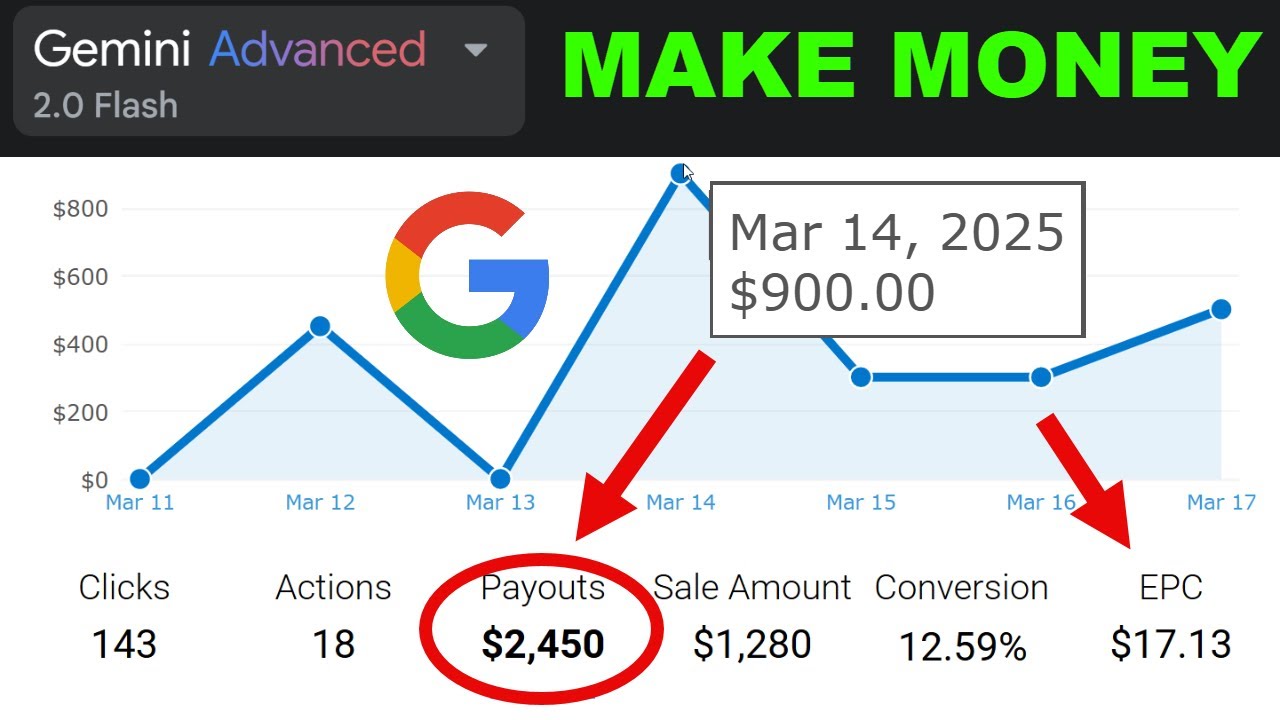
Google Gemini 2.0 has arrived, bringing powerful upgrades that can help you make money online with ease. In this post, we’ll explore how Gemini’s Canvas and Deep Research features let you create high converting landing pages, conduct thorough market analysis, and effectively promote affiliate offers. All without heavy technical knowledge. Read on to learn how to harness AI marketing tools to fill your pockets with extra income.
What Makes Google Gemini 2.0 a Game Changer?
Enhanced Canvas Feature
- Rapid Landing Page Creation: With the click of a button, Gemini 2.0’s Canvas helps you generate full landing pages instantly.
- Customizable Themes: Tailor each page with direct response designs, color themes, or specific branding elements.
- Code and Preview: Quickly download, share, or tweak the HTML code in real time.
Deep Research Capability
- Data Driven Insights: Gemini 2.0’s Deep Research scours the web, analyzing multiple sources and delivering accurate, up to date information.
- Seamless Integration: Research findings can be instantly merged into your Canvas projects to build compelling sales pages.
- Efficiency: With Deep Research and Canvas working together, you eliminate the need for multiple tools, saving time and effort.
Guide to Making Money with Google Gemini 2.0:
-
Pick a Profitable Offer
- Choose an affiliate offer or product with a solid conversion rate. For example, live chat job platforms or digital health supplements.

-
Conduct Deep Research
- Input your query (e.g., “news reports of people making money with live chat jobs”).
- Gather the best stats, stories, and key selling points to showcase on your landing page.
-
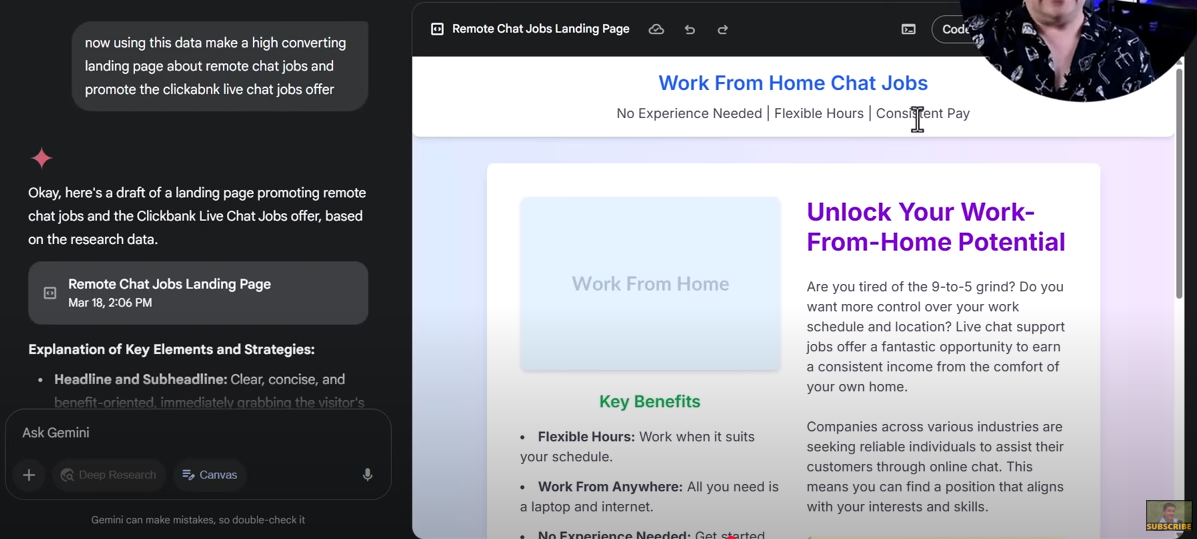
Use Canvas to Create a Landing Page
- Click the Canvas button in Gemini 2.0.
- Generate a high converting page or advertorial using the data from your Deep Research session.
- Insert affiliate links or call to action buttons where relevant.

-
Optimize the Page
- Add Compelling Headlines: Hook visitors immediately.
- Use Bullet Points: Present benefits of the product or offer in a clear, skimmable format.
- Incorporate Images: Enhance trust and brand appeal. (See image suggestion below.)
-
Drive Traffic
- Social Media Posts: Share short, engaging tidbits on Facebook, Pinterest, or TikTok.
- YouTube Videos: Turn Gemini’s content suggestions into quick, informative videos.
- Paid Ads: If you have a budget, amplify reach via targeted advertising campaigns.
-
Track and Test
- Monitor click through rates, conversions, and user engagement.
- Tweak headlines, calls to action, or even design elements to improve results.
Why Google Gemini 2.0 Works for Affiliate Marketing
Advanced Landing Page Customization
By creating direct response style pages, you can quickly convince potential buyers to act. Gemini 2.0 allows for easy edits and updates, so you’re always testing and refining.
Comprehensive Market Research
Deep Research takes the guesswork out of identifying profitable niches. With AI scouring websites and articles, you can confidently present verified data, building trust with your audience.
Versatile Monetization Methods
Whether you’re promoting digital products, offering downloadable guides, or selling services, Gemini 2.0 gives you all the tools you need to showcase value and drive conversions.
Google Gemini 2.0’s Canvas and Deep Research features are revolutionizing how entrepreneurs create and promote affiliate offers. From crafting high converting landing pages to uncovering profitable market insights, Gemini streamlines the process. Remember, the key to success lies in focusing on a profitable niche and delivering genuine value. Combine targeted content with strategic promotion, and watch your earnings grow.
Ready to take action? Jump in, experiment, and let Gemini 2.0 power your money making journey online!
Get Rich From Trump’s Recession – What They Aren’t Telling You!

Worried about the Trump recession? Discover hidden opportunities to profit from the coming downturn using AI, smart marketing, and timeless skills.
In the midst of rapid technological change, another economic storm may be brewing—one that many refer to as the “Trump recession.” With artificial intelligence (AI) automating jobs at lightning speed, inflation driving grocery bills sky-high, and housing prices poised for dramatic swings, it’s more critical than ever to stay informed. This post uncovers how you can not only survive but also thrive financially during turbulent times. Read on to learn about leveraging AI, building in-demand skills, and safeguarding (or even boosting) your income in the face of uncertainty.
“Hard times create strong men,
strong men create good times,
good times create weak men,
and weak men create hard times.”
G. Michael Hopf.
“Skyrocketing wealth. Millions and millions of new jobs and a booming middle class. We are going to boom like we’ve never boomed before.”
“I hate to predict things like that. There is a period of transition because what we’re doing is very big. We’re bringing wealth back to America. That’s a big thing, and there are always periods of, it takes a little time. It takes a little time, but I think it should be great for us.”
“There may be a slight disturbance, but we are comfortable with that. It won’t be significant.
“We’re in a tremendous economic boom. The best we’ve ever had. And I think it’s going to continue.”
“The economy is doing fantastically well. It’s the best it’s ever been. And I think it’s going to get even better.”







Understanding the Looming Trump Recession
Signs of Economic Upheaval
- Inflation on the Rise: Basic necessities are costing more, from groceries to gas.
- Housing Market Shifts: Many regions are seeing quick price reductions in real estate, coupled with declining consumer confidence.
- AI-Driven Job Loss: As AI continues to replace human tasks, many wonder if their role will be next.
Hard Times Create Strong Opportunities
In uncertain markets, those who adapt often see massive rewards. As the saying goes, “Hard times create strong men; strong men create good times.” While we face potential hard times, those who develop robust skills and seize opportunities may come out stronger financially and personally.
Change is Inevitable:
We’re living in an age of unprecedented technological advancement. Artificial intelligence is no longer a science fiction concept; it’s a reality. And like any powerful tool, it will reshape our world.
Economic cycles are also a reality. Recessions, depressions—they’ve happened before, and they will happen again. To pretend otherwise is to bury your head in the sand.
As Jim Rohn would say “Don’t wish it was easier, wish you were better.” We cannot change the outside conditions, but we can change ourselves.
HOW CAN YOU MAKE YOURSELF MORE VALUABLE?
In times of change, skills are your greatest asset. Not just any skills, mind you, but skills that are in demand. And in this age, AI skills are paramount.
Think of it: the ability to understand, utilize, and even create AI solutions puts you in a position of power. You become a creator, not just a consumer.
“Don’t wish for less problems, wish for more skills.” This is especially true now. The more skills that you obtain, the better that you will be able to handle any problem that comes your way.
AI is not a job destroyer; it’s a job transformer. It creates new possibilities, new industries, new ways of doing things.
In any economy, those who create value are rewarded.
How can you use AI to create value for yourself, for your employer, for your community?
Focus on solving problems, on providing solutions, on making a difference.
GET RID OF DISTRACTION – FOCUS!
- IT IS EASIER NOW THAN IT’S EVER BEEN!
- YOU CAN MAKE EXCUSES OR MAKE MONEY – BOTH TAKE THE SAME ENERGY!
- Your mindset is your most powerful tool. Cultivate a mindset of optimism, of resilience, of possibility.
- Believe in your ability to learn, to grow, to succeed.
- Remember that opportunity and difficulty always go together.
HOW MONEY IS MADE ONLINE
High Paid Skills for Online Entrepreneurs:
1. Search Engine Optimization (SEO) & Content Strategy (Expanded):
- Specific Skills:
- In-depth keyword research (understanding search intent).
- Technical SEO (website speed, mobile optimization, site architecture).
- On-page and off-page optimization.
- Developing a comprehensive content strategy (blog posts, videos, infographics).
- Building high-quality backlinks (link building).
- Understanding and adapting to algorithm updates.
- Entrepreneurial Advantage:
- Drives consistent organic (free) traffic.
- Establishes long-term authority and credibility.
- Reduces reliance on expensive paid advertising.
2. Paid Advertising & Performance Marketing (Expanded):
- Specific Skills:
- Proficiency in Google Ads, Facebook Ads, Instagram Ads, YouTube Ads, and other platforms.
- Targeting and retargeting strategies.
- Ad copywriting and creative development.
- Landing page optimization.
- A/B testing and data analysis.
- Calculating and optimizing Customer Acquisition Cost (CAC) and Return on Ad Spend (ROAS).
- Entrepreneurial Advantage:
- Allows for rapid scaling and immediate results.
- Provides precise targeting of ideal customers.
- Enables data-driven optimization of campaigns.
3. Social Media Marketing & Community Building:
- Specific Skills:
- Developing a social media content calendar.
- Creating engaging and shareable content.
- Building and managing online communities.
- Leveraging social media advertising.
- Influencer marketing.
- Social listening.
- Entrepreneurial Advantage:
- Builds brand awareness and customer loyalty.
- Drives traffic to websites and landing pages.
- Creates a platform for direct customer engagement.
4. Email Marketing & List Building:
- Specific Skills:
- Building and segmenting email lists.
- Creating high-converting lead magnets.
- Writing effective email copy.
- Automating email sequences.
- Analyzing email marketing metrics.
- Entrepreneurial Advantage:
- Nurtures leads and builds relationships.
- Drives repeat business and customer loyalty.
- Provides a direct channel for communication.
5. Content Marketing & Distribution:
- Specific Skills:
- Creating valuable and engaging content (blog posts, videos, podcasts).
- Distributing content across multiple channels.
- Guest blogging and content syndication.
- Building relationships with influencers and media outlets.
- Entrepreneurial Advantage:
- Attracts and engages potential customers.
- Establishes thought leadership and brand authority.
- Drives organic traffic and leads.
6. Analytics & Data-Driven Optimization:
- Specific Skills:
- Using Google Analytics and other analytics tools.
- Analyzing website traffic and user behavior.
- Identifying trends and patterns.
- Using data to optimize marketing campaigns and website performance.
- Customer journey mapping.
- Entrepreneurial Advantage:
- Provides insights into customer behavior.
- Enables data-driven decision-making.
- Optimizes marketing efforts for maximum ROI.
EVERYTHING IS EASIER NOW THAN ITS EVER BEEN
YET MORE PEOPLE ARE COMPLAINING AND GIVING UP!
ALSO… MORE PEOPLE ARE ACTUALLY GETTING RESULTS!
ARE YOU WILLING TO DO WHAT IT TAKES?
STORY OF GUYS PROPOSAL ON LIVE CHAT
While the looming Trump recession feels daunting, it also unveils unprecedented ways to grow your wealth and secure your future. AI is the game changer that can level the playing field, making it simpler to learn new skills and adapt quickly. Whether it’s SEO, paid ads, or building an engaged online community, the key is to stay focused, keep learning, and take consistent action. Turn economic challenges into stepping stones and get ready to emerge from this downturn stronger than ever.
Now is the time to act. Start leveraging AI, refining your marketing skills, and setting up profitable online ventures. The path may be bumpy, but the destination can be incredibly rewarding.
Ai Cat Memes – Crazy Profit Method!
Discover how to easily create and monetize AI cat videos using ChatGPT. Learn free tools, helpful tips, and proven methods to grow your audience and earn online.

AI cat videos are exploding in popularity, and for good reason. They’re fun, quirky, and capture people’s attention faster than almost any other type of content. Even better, you can make real money from them by leveraging simple tools like ChatGPT, AI image generators, and short form video platforms. In this post, we’ll explore how you can create these entertaining videos, grow a following, and tap into monetization opportunities without showing your face on camera.
Why AI Cats Are So Popular
- Memorable and Shareable: Funny cat imagery has always been Internet gold. AI-generated cats take that novelty to the next level, encouraging likes, shares, and comments.
- Short, Snackable Content: Quick cat videos. 30 to 60 seconds are perfect for social feeds and Stories, making it easy for viewers to consume and re watch.
- No Human Presenter Required: AI cat videos let you skip the camera altogether, making it easier for introverts or those who just don’t want to appear on screen.

Essential Tools for Creating AI Cat Videos
1. ChatGPT
- Brainstorming Ideas: Ask ChatGPT for unusual cat scenarios (e.g., “List 100 wacky things AI cats could do.”).
- Script Generation: Let ChatGPT draft short, catchy captions or even dialogue for your AI feline star.
2. AI Image Generators
- Microsoft Bing Image Creator (Co-Pilot): A free, straightforward option for producing AI images.
- Leonardo.ai: A paid solution known for more refined, higher-quality cat images.
- Alternative Tools: Explore Hugging Face or other open-source projects for free or budget-friendly AI image creation.
3. AI Video Creators
- Sora: Transforms your AI-generated cat images into brief, animated clips.
- CapCut or Camtasia: Perfect for layering text, music, and other effects onto your cat videos.
- Hedra: An option for making your AI cats talk, adding next-level personality to your content.
Creating Your First AI Cat Video
-
Generate a Cat Image
- Use ChatGPT to brainstorm a fun cat scenario (e.g., a “rich cat driving a Lamborghini”).
- Head to your chosen image generator (Leonardo, Co-Pilot, etc.) to render a unique AI cat image.

-
Refine the Image (If Needed)
- Adjust settings for realism, art style, or comedic effect.
- Keep the character consistent if you plan a recurring “cat persona” (e.g., “Workout Cat,” “Stock Market Cat,” or “Lazy Cat”).
-
Import into a Video Tool
- Upload your cat image(s) into software like Sora or Leonardo.
- Generate a short clip (5–10 seconds each) and combine multiple clips for a 30–60 second video.

-
Add Text and Music
- Overlay motivational quotes, funny captions, or quick tips (e.g., “5 Ways to Stop Procrastinating”).
- Add royalty free background music to keep your videos engaging and professional.

-
Export and Post
- Download your final video and publish it on Facebook, Instagram Reels, TikTok, or Pinterest.
- Remember to optimize titles and descriptions with relevant keywords like “AI cat videos,” “funny cat content,” or “ChatGPT cat creations.”
Monetizing Your AI Cat Videos

Leverage Facebook & Instagram Bonus Programs
- Eligibility: Consistently post videos that attract views and engagement.
- Earnings: Potential to earn per thousand views, with bonus payouts for high performance accounts.
Affiliate Links and Offers
- Niche Focus: If you create “Workout Cat,” promote fitness gear or workout programs.
- Finance Topics: “Stock Market Cat” could link to personal finance courses or investing platforms.
Print-on-Demand Products
- Merchandise: T-shirts, mugs, and plushies featuring your cat character.
- Ecommerce Integration: Use platforms like Etsy or Shopify to manage orders.
Website or Blog Monetization
- Display Ads: Embed your videos on a blog featuring relevant ads.
- Sponsored Content: Collaborate with brands seeking cute cat themed promotions.
Tips for Growing Your Audience
- Consistency Is Key: Post regularly (e.g., daily or weekly) to build momentum.
- Engaging Storylines: Turn your AI cat into a character with a backstory (e.g., “Fat Cat’s Weight-Loss Journey”).
- Use Trending Sounds: On platforms like Instagram Reels or TikTok, pair your cat videos with popular audio tracks.
- Engage Viewers: Ask questions, run polls, and encourage fans to request new cat scenarios.
AI cat videos have opened a world of opportunities for content creators looking to earn online. No fancy equipment or on camera presence required. With ChatGPT providing imaginative prompts and free or budget friendly AI tools creating eye catching visuals, there’s no limit to how far you can take this trend. Whether you focus on Facebook bonuses, affiliate links, or print on demand merch, remember that consistency and creativity are your best friends. Start brainstorming your next cat themed masterpiece, and let the AI magic begin!.