Make Money Online With Affiliate Marketing

When: Wed @ 3PM Eastern Time
How: Click This Link Wednesday @3pm est
FASTEST WAY TO START AFFILIATE MARKETING – CLICK HERE
FASTEST WAY TO START AFFILIATE MARKETING – CLICK HERE
Loveable = AI Powered Software?
Promote Clickbank Offers With Clipter
Get Clipter Now And Be Locked In At $27 A Month For LIFE!!!
USE COUPON CODE VY2DFCRW
ClickBank Income Reports & Top Offers: Real Data from Real Affiliates
This is a research-based collection of real income reports, affiliate case studies, and verified ClickBank offer metrics. The goal is simple: show you what real people are actually earning, what products they are promoting, and what traffic strategies they are using.
The earnings shown in this report come from real published case studies and ClickBank’s own marketplace data. They represent exceptional results from experienced affiliates and are not typical. The vast majority of people who try affiliate marketing earn little to no money. There is no guarantee of income. Your results depend entirely on your effort, skill, traffic, budget, and market conditions. This document is for educational and research purposes only.

Part 1 — Real Blogger & Affiliate Income Reports
Get Clipter Now And Be Locked In At $27 A Month For LIFE!!!
USE COUPON CODE VY2DFCRW
These are verified case studies and published income reports from real affiliates and bloggers who promote ClickBank products. The data covers a wide range of traffic sources, from long-form SEO blogging to aggressive Facebook Ads scaling, and spans multiple niches.
Robby Blanchard — $1M+ Per Month
Robby Blanchard is widely recognized as the top ClickBank affiliate in the world. He drives traffic primarily through Facebook Ads, sending it to high-converting Video Sales Letter funnels. His results are documented on the ClickBank blog and in multiple interviews. He relies heavily on paid social media at scale.
John Crestani — $500,000+ Per Month
John Crestani built his income through YouTube advertising and high-ticket webinar funnels. He is known for promoting Make Money Online products and also sells his own ClickBank course called the Super Affiliate System. His income is documented across the ClickBank blog and his own YouTube channel.
Adrian Brambila — $1M+ Total ClickBank Earnings
Adrian Brambila publicly documented his journey to becoming a ClickBank millionaire using TikTok and paid ads. He focuses on MMO and e-commerce offers and has shared his strategies through Medium articles and social media. He is a strong example of using short-form video to drive affiliate volume.
Pat Flynn — $100,000+ Per Month
Pat Flynn of Smart Passive Income built one of the most trusted affiliate blogs online. His income comes from podcasting, SEO, and email marketing. He promotes software tools and podcasting resources he personally uses, and his monthly income reports are among the most detailed and transparent in the industry.
Jon Dykstra — $40,000+ Per Month
Jon Dykstra runs Fat Stacks Blog and manages a portfolio of niche sites monetized through display ads and affiliate links. His strategy is long-term SEO compounding across many small sites. He documents his journey publicly and is a well-known figure in the niche site building community.
Matthew Woodward — $20,000+ Per Month
Matthew Woodward, now operating through SearchLogistics, built his income through detailed SEO tutorials and case studies. He drives high-intent organic traffic and promotes SEO tools and MMO products through review-style content.
Harsh Agrawal — $80,410 Total ClickBank Earnings Over 5 Years
Harsh Agrawal of ShoutMeLoud documented his five-year ClickBank earnings publicly. His income comes from organic blog traffic built on a highly authoritative domain. He promotes blogging tools, MMO products, and software through consistent long-form publishing.
Lori Ballen — $12,277 in One Month
Lori Ballen published a detailed income report on Medium showing over $12,000 in a single month from affiliate marketing. She uses SEO, Pinterest, and YouTube to drive traffic to software and info product reviews. Her content is review-style and targets buyers who are already searching for solutions.
LoveFamilyHealth Blog — $12,000 Per Month
This blogger uses Pinterest to drive traffic and build an email list, then promotes affiliate products to that list on the backend. It is a strong example of the content-to-email funnel model working in the parenting and lifestyle space.
Carley Schweet — $1,000+ Per Month
Carley Schweet focuses on Pinterest traffic for spirituality and self-care products. Her approach is low-overhead affiliate blogging with a focus on manifestation and wellness content. A good example of a smaller blogger building consistent passive income.
“Dave” — Warrior Forum Case Study
A Warrior Forum member documented a case study using Bing Ads with direct linking to ClickBank offers. He targeted exact-match brand keywords for products with a Gravity score between 20 and 70. No landing page was needed because the traffic was already warm and brand-aware. He reported consistent daily sales.
Anonymous — BlackHatWorld Case Study
A BlackHatWorld member documented the journey from zero to $10,000 per month in profit using Facebook Ads to promote ClickBank offers. The thread covers scaling strategies, ad creative testing, and funnel optimization across multiple paid media campaigns.
Part 2 — Top Spirituality, Manifestation & Brain Optimization Offers
This category features lower average payout values but exceptionally high conversion rates and broad audience appeal. It works well for email lists, social media, and broad-targeting paid ads. The brain audio sub-niche dominated the ClickBank charts throughout 2025 and into 2026.
The Genius Song — #1 ClickBank Offer, June 2026
Nickname: geniusbr. Average payout: $55.32. EPC: $1.11. Conversion rate: 2.18%. A 7-minute audio track using Gamma brainwave technology. Created by a marketer with over $100 million in career sales. Topped the ClickBank charts in June 2026. Commission structure requires affiliate approval.
The Brain Song — #1 Offer, January through April 2026
Nickname: brainsongx. Average payout: $58.05. EPC: $0.82. Conversion rate: 1.56%. Targets Theta brainwave activation for manifestation. Held the number one spot on ClickBank for four consecutive months. CPA payout available. Scales well on paid media.
The Genius Switch
Nickname: thegeniusx. Average payout: $52.25. EPC: $0.80. Conversion rate: 1.64%. Uses a Whole Brain Activation angle backed by a New York City neurologist. Reported low refund rates. Commission structure requires affiliate approval.
The Memory Wave
Nickname: memoryw. Average payout: $53.30. EPC: $0.23. Conversion rate: 0.44%. An audio product for mental clarity and memory. Uses a former NASA neuroscientist as the hook. Requires affiliate approval.
Wealth DNA Code
Nickname: wealthdna. Average payout: $48.30. EPC: $0.39. Conversion rate: 0.82%. Commission: 75%. Overlaps well with financial and make money online audiences. Total possible commission including upsells is $136.61 per sale.
The BioEnergy Code
Nickname: bienergyco. Average payout: $49.99. EPC: $0.28. Conversion rate: 0.56%. Commission: 75% plus upsells. One of the highest average payouts in the traditional spirituality and chakra category. Features a 60-day cookie window.
Soulmate Sketch
Nickname: soulmatesk. Average payout: $22.31. EPC: $0.20. Conversion rate: 0.88%. A hand-drawn soulmate sketch product priced at $29.99 base with upsells. Works extremely well for organic social media traffic. Commission requires affiliate approval.
Soulmate Reading
Nickname: smreading. Average payout: $16.95. EPC: $0.25. Conversion rate: 1.46%. Commission: up to 90%. One of the highest conversion rates in this category. Recurring membership options available on the backend.
Moon Reading
Nickname: thoughtop. Average payout: $19.27. EPC: $0.18. Conversion rate: 0.93%. Commission: 75%. Personalized moon sign readings with a 7-day email funnel. Evergreen performer on social media and organic content.
Numerologist
Nickname: numerology. Average payout: $10.34. EPC: $0.12. Conversion rate: 1.19%. One of the oldest products on ClickBank, active since 1999. Has a 3-million subscriber email list. Runs massive New Year promotions every year. Commission requires affiliate approval.
Get Clipter Now And Be Locked In At $27 A Month For LIFE!!!
USE COUPON CODE VY2DFCRW
Part 3 — Survival, E-Learning, Software & Home Business Offers
These categories offer unique hooks, recurring billing opportunities, and some of the highest raw conversion rates on the entire ClickBank platform. Rocket Languages in particular has a nearly 7 percent conversion rate, which is extraordinary for any affiliate offer.
Rocket Languages
Nickname: rocketlang. Average payout: $97.01. EPC: $5.33. Conversion rate: 6.74%. The highest conversion rate and one of the highest EPCs in this entire report. Covers Spanish, French, German, and more. One of the longest-running offers on ClickBank. Requires affiliate approval.
WoodProfits
Nickname: woodprofits. Average payout: $37.00. EPC: $1.10. Conversion rate: 3.20%. Commission: 75%. A guide on how to start a profitable woodworking business from home. Works well with DIY, hobby, and home business audiences. Solid mid-ticket offer with a strong conversion rate.
CB Passive Income
Nickname: cb-passive. Average payout: $47.00. EPC: $0.95. Conversion rate: 2.10%. Commission: 75%. A clone-a-website passive income system created by Patric Chan. Includes a recurring upsell. Converts well on make money online email lists and YouTube audiences.
Energy Revolution System
Nickname: enrev. Average payout: $51.01. EPC: $0.53. Conversion rate: 1.26%. Commission: 75%. Claims to cut energy bills by 88 percent. Appeals to preppers, survivalists, and budget-conscious homeowners. Solid performer in the survival and alternative energy niche.
SmartWaterBox
Nickname: watersb. Average payout: $51.52. EPC: $0.70. Conversion rate: 1.94%. Commission: 75%. An off-grid water supply system that pulls water from the air. CPA payout available. A consistent cold traffic winner in the prepper and survival niche.
Part 4 — The All-Time ClickBank Hall of Fame
These are the legendary products that have generated the most total revenue in ClickBank history, excluding health and supplement offers. Each one proves a different lesson about what makes a long-term affiliate offer succeed.
- Numerologist — Spirituality. On the platform since 1999. Has a 3-million subscriber email list. Runs massive New Year promotions every year.
- Rocket Languages — E-Learning. One of the longest-running CB offers. 6.74 percent conversion rate. Covers Spanish, French, German, and more. Requires affiliate approval.
- The Brain Song / Genius Song — Manifestation. Dominated the number one spot from January through June 2026. A 7-minute audio using Theta and Gamma brainwave technology. Created by a marketer with over $100 million in career sales.
- Moon Reading — Astrology. Personalized moon sign readings. 75 percent commissions. Evergreen social media performer.
- Soulmate Sketch — Psychics. Hand-drawn soulmate sketches. $29.99 base price plus upsells. Massive organic social media appeal.
- Wealth DNA Code — Manifestation. Overlaps with financial and MMO audiences. 75 percent commissions with a total possible payout of $136.61 per sale.
- WoodProfits — Home Business. How to start a woodworking business from home. 75 percent commissions. Strong with DIY and hobby audiences.
- The BioEnergy Code — Manifestation. Highest average payout in the traditional spirituality category. 75 percent on upsells with a 60-day cookie window.
- CB Passive Income — MMO and Software. Patric Chan’s clone-a-website system. 75 percent commissions with a recurring upsell. Converts well on MMO email lists.
- SmartWaterBox — Survival. Off-grid water-from-air system. 75 percent commissions. 1.94 percent conversion rate. Cold traffic winner in the prepper niche.
Get Clipter Now And Be Locked In At $27 A Month For LIFE!!!
USE COUPON CODE VY2DFCRW
Get My ClickBank Favorite Offer List, Niche List, Keyword Reports & More
Part 5 — Strategic Takeaways for Affiliates
After looking at 80-plus data points across income reports, case studies, and ClickBank’s own monthly rankings, a few clear patterns emerge that separate consistently profitable affiliates from those who struggle.
The VSL Does the Selling
Almost every top-tier offer on this list, including The Brain Song, Rocket Languages, and the Genius Song, relies on a high-converting Video Sales Letter or interactive demo. The VSL does the selling for you. Your job as an affiliate is simply to drive traffic to it.
Match Your Offer to Your Traffic Source
Spirituality and manifestation offers with average payouts between $17 and $58 tend to convert at 0.8 to 2.2 percent. Software and e-learning offers with payouts between $10 and $97 convert at 2 to 7 percent. Paid media works best for higher-payout offers. SEO and content work best for high-conversion-rate offers where you can rank for buyer-intent keywords.
CPA vs. RevShare
Top affiliates driving serious volume to high-ticket offers are increasingly choosing guaranteed CPA payouts over revenue share. A flat fee per sale protects you from refund fluctuations and makes your ad spend math much more predictable.
Traffic Source Determines Your Strategy
SEO and blogging build long-term compounding income, as demonstrated by Fat Stacks Blog and Smart Passive Income. But the products topping the monthly ClickBank charts are being scaled with paid media, specifically Facebook Ads, YouTube Ads, Native Ads, and TikTok. Know which model you are building before you start.
Gravity 20 to 70 Is the Sweet Spot
As documented in the Warrior Forum case study, filtering for products with a Gravity score between 20 and 70 that are less than two months old gives you popular but not yet saturated offers. These have proven conversion data without the extreme competition that comes with the top-ranked products.
Evergreen Niches Win Long-Term
Spirituality, manifestation, language learning, survival, and software tools have been top ClickBank categories for over ten years. The specific products change, but the niches remain. Building content assets in these verticals creates lasting income that compounds over time.
Compliance Note: Do not make guaranteed income, safety, or supernatural claims. Use neutral language such as “claims,” “offers,” “guide,” “training,” “may help,” and “check details.” Add affiliate disclosures on review pages, emails, and bridge pages. All EPC, APV, and conversion rate data is sourced from ClickBank’s official monthly Top Offers reports and is subject to change. Always verify live marketplace metrics before running paid traffic.
The Affiliate Marketing Flow
Every successful ClickBank affiliate follows this same core process — from idea to income.
- IDEA: Choose a niche you can create content around. Validate demand using ClickBank Gravity scores and keyword research before committing.
- TRAFFIC: Choose one traffic source and master it first. Options include SEO blog, YouTube, Pinterest, Facebook Ads, TikTok, Native Ads, or email. Do not spread yourself thin early on.
- MARKET: Understand your buyer’s pain points, desires, and the language they use. Study the offer’s affiliate page and look at what angles top affiliates are running.
- CONTENT: Create content that attracts and pre-sells. This could be review posts, comparison articles, YouTube videos, social posts, or paid ad creatives depending on your traffic source.
- LIST: Capture leads with a free lead magnet. Your email list is your most valuable long-term asset because it lets you promote multiple offers to the same audience over time.
- OFFER: Send traffic to a high-converting ClickBank offer. Match the offer to your audience’s interests. Test multiple offers to find your best earnings per click.
- $$$: Earn commissions, typically 50 to 75 percent. Scale what works. Reinvest into more traffic. Repeat the cycle across multiple niches and offers.
Get Clipter Now And Be Locked In At $27 A Month For LIFE!!!
USE COUPON CODE VY2DFCRW
1,000 Ai Images —> $1M Business???
Get Clipter Now And Be Locked In At $27 A Month For LIFE!!!
USE COUPON CODE VY2DFCRW
Get Clipter Now And Be Locked In At $27 A Month For LIFE!!!
USE COUPON CODE VY2DFCRW
Can You Really Make Money Creating 1,000 AI Images?
You have seen the headlines. The YouTube thumbnails. The TikToks. The Twitter threads. Everyone is claiming that AI generated images are the new gold rush. Just press a button, get some images, and boom, you are rich.
The honest truth? The idea is not wrong. The execution is.
Most people posting AI images online are making nothing, and the reason is simple. They think the image is the business. It is not. The image is the attention device. Once you understand that one thing, everything about how you create and use AI images changes.
This is the full breakdown of the system I walked through on the recent live training. If you want to watch the whole thing, the replay is here.
And the tool that runs this entire machine is Clipter, which you can lock in at a preorder rate below.
This is a preorder deal. The price goes up once the launch is complete.
Get Clipter Now And Be Locked In At $27 A Month For LIFE!!!
USE COUPON CODE VY2DFCRW
The #1 Fundamental Mistake Everyone Makes
Most people make a beautiful AI image, post it to Etsy, Redbubble, or social media, get a few likes, and then wonder why they made no money.
Here is why. The image was never supposed to be the product. The image is the hook. It stops the scroll. It triggers curiosity. It earns you two seconds of someone’s attention. What you do with those two seconds is where the money lives.
When you stop treating the image as the finish line and start treating it as the front door, the whole game opens up. The image is just the thing that gets the right person to stop and look. The business is everything that happens after.
Why Most People Fail At This
Before we get into the right way, let us be clear about why the common approach falls flat:
- Stock sites are flooded with AI images, so you are competing against an ocean of sameness.
- Print on demand platforms like Etsy are oversaturated, and the buyers there are bargain hunting.
- Pinterest traffic without a targeted offer and email capture is just a vanity metric. Pretty pins, empty bank account.
- A thousand random thumbnails with no video strategy will never rank and never convert.
- AI images alone do not build trust, authority, or a relationship with your audience.
That last point is the big one. Trust is what makes people buy. A random image cannot build trust on its own. A system of helpful, connected content can.
The Two Questions You Must Answer First
Before you create a single image, answer these two questions:
- What are the images about?
- What are the images for?
Without answers to these, you are just adding noise to an already crowded internet. “About” gives you your topic and your audience. “For” gives you your next step, the opt in, the click, the sale. If you cannot answer both in one sentence, you are not ready to hit generate yet.
This is exactly the kind of thinking Clipter is built to do for you. Drop an image or an idea in, and it tells you what the thing is about, what type of content it is, and where it could lead. It removes the guesswork from those two questions.
The Sideways Content Strategy
Think of your big topic like a giant report or a long sales letter. Instead of publishing it all in one place, you tip it on its side and break it into thousands of small, individually valuable pieces. Think baseball cards.
The Baseball Card Concept
A baseball card fits a massive amount of data onto a tiny two by three inch card. Each card stands alone and has value on its own. That is exactly what your AI images should be. Small, standalone pieces of value that each tell a story and each point somewhere useful.
A Real Example: The Dropshipping Niche
Instead of one big “Top 10 Dropshipping Products” post, you create 1,000 individual infographic cards. Each one shows a picture of the product, the cost on Amazon, how to source it, what the profit would look like, and a couple of related products.
Each card stands alone. Each card has value. Each card drives traffic back to your offer. One big post becomes a thousand seeds planted across the internet.
That is exactly what Clipter does. Locked at $27 a month for life with code VY2DFCRW
Get Clipter Now And Be Locked In At $27 A Month For LIFE!!!
USE COUPON CODE VY2DFCRW
Real Businesses That Built Empires With Images
This is not theory. These are real companies that used images and infographics as their starting point, not their end product:
- Mint built a massive finance app almost entirely through infographics with a tiny ad budget.
- Visual Capitalist turns data and stats into charts and graphics that make people think and click.
- Pinch of Yum grew their food blog to six figures a month using recipe images.
- BuzzFeed built a media empire on shareable image based content.
- Canva grew by showing people what was possible with visual content.
- The Pioneer Woman started with recipe images and ended up in grocery stores nationwide.
- NerdWallet used infographics to build a company that reached over a billion dollars in value.
- Zillow works because people want to see the house. The image is the product hook.
The lesson is the same across all of them. Every one of these businesses used images as the starting point, not the end product. The image opened the door. The system behind it built the company.
The Four Step Sequence That Drives Money
Every piece of content you create should follow this sequence:
Step 1: Attention
The image stops the scroll. It earns the first two seconds. This is your hook, and nothing else matters if you skip it.
Step 2: Interest
The content pulls them in and makes them want more. They are curious now, leaning forward instead of scrolling past.
Step 3: Intent
The content matches what they were already looking for. This is the most important step. You are not creating demand. You are meeting it. When your image lines up with a search someone is already making, you win.
Step 4: Action
What do you want them to do next? Opt in? Click a link? Buy something? Every image needs a next step, or it is just decoration.
When you think this way, 1,000 AI images stop being 1,000 random posts. They become 1,000 planted seeds across different platforms, each one engineered to move someone from a scroll to a sale.
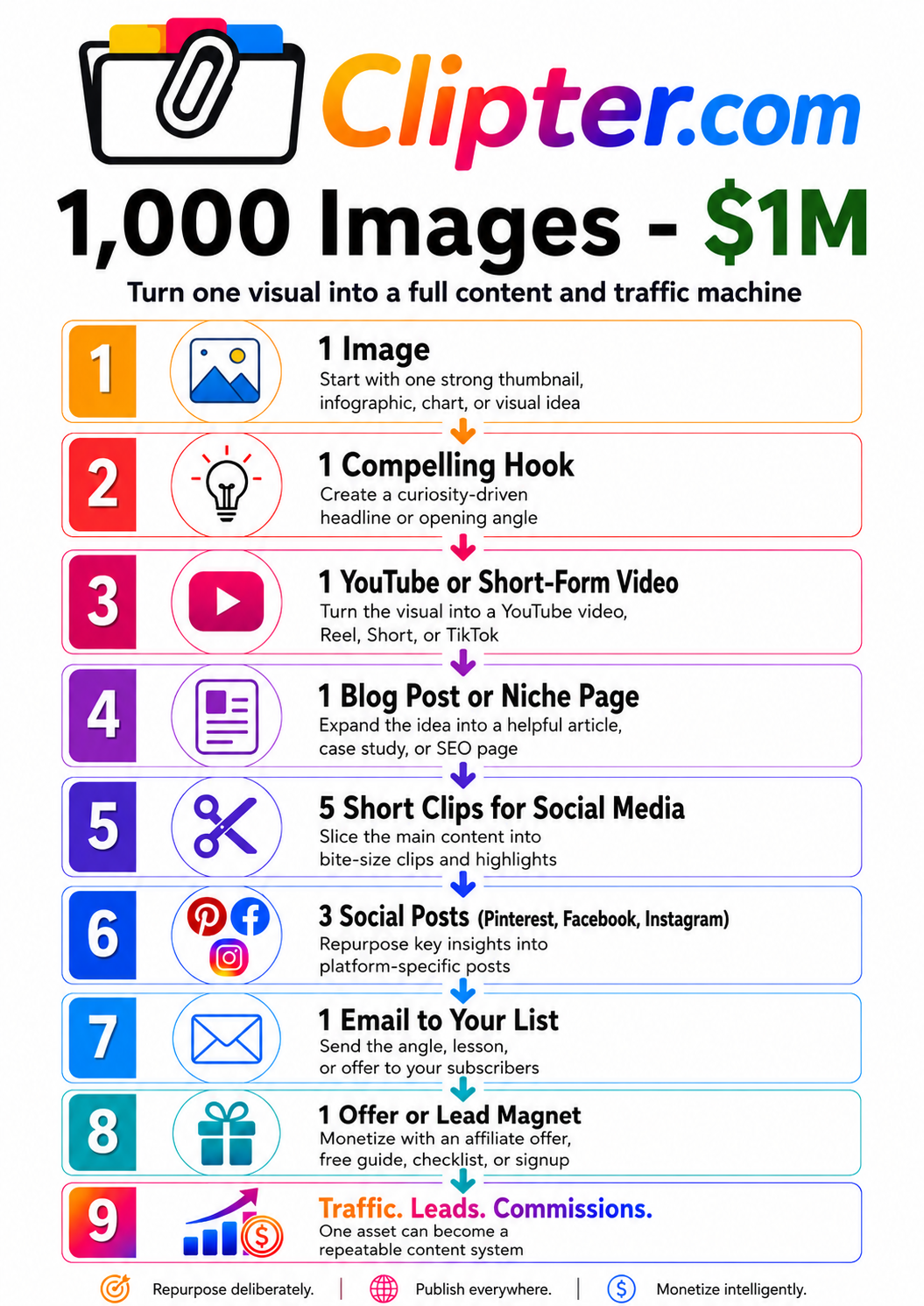
One Image Into a Full Business: The Content Machine
Here is what one single image can become when you treat it as a content seed:
- The Image. The compelling hook that stops the scroll on social media.
- The Thumbnail. Designed specifically to get video clicks. This is not the same as the infographic.
- The Video. A YouTube, TikTok, or short form video based on the image topic.
- The Blog Post. Long form content tied to keywords people are actually searching for.
- 5 Short Clips. Pulled from the video for Instagram, Facebook, and Pinterest.
- 5 Social Posts. Each one links back to the blog post.
- The Email. Send the blog post to your mailing list.
- The Offer or Lead Magnet. The thing that actually makes you money.
The result when done correctly is traffic, leads, and commissions. Now multiply that by 1,000 images. Even if only 5 percent gain traction, that is 50 content winners driving traffic and sales around the clock.
This is the part that breaks most people. Turning one image into eight assets sounds like a full day of work. With Clipter, you drop the image in and it generates the notes, the checklist, the blog post outline, and the next steps for you. The content machine that used to take hours now takes minutes.
Get Clipter Now And Be Locked In At $27 A Month For LIFE!!!
USE COUPON CODE VY2DFCRW
You Are a Content Harvester, Not a Content Creator
Forget the pressure of being original every single day. That pressure is what burns people out and makes them quit. Your real job is simpler:
- Go out and find things that already exist.
- Think about them in a different way.
- Wrap them in a compelling visual.
- Put them in front of the right audience.
The internet is overflowing with great ideas buried in the wrong format. Boring data sheets. Dry reports. Dense articles nobody reads. Your job is to find them and make them visual, shareable, and valuable.
Put on your niche goggles. View everything through the lens of your niche. When news breaks, when fresh data comes out, when something interesting happens, ask yourself how it fits into your content bucket and how you can position it for your audience. Once you train your brain to do this, you will never run out of ideas again.
Clipter is the dumping ground for all of it. See something interesting, save it, and pull from it later when you are ready to create. It becomes your private idea bank that never runs dry.
Build Your Foundation First
Before you start making images, get these four things in place.
1. Your Niche
Pick something specific that already has buyers, keywords, and affiliate offers attached to it. Do not be “the make money online guy.” Be the person who explains what others refuse to explain. Niche down until it almost feels too narrow, then go a little narrower.
2. Your Offer
Find one main offer to build around. The people who really make it are the ones who go deep on one specific thing. Even Jeff Bezos started as just the book guy. What is your one thing?
3. Match Image Intent to Buyer Intent
A luxury money image gets attention, but a title like “7 Hidden Wi-Fi Risks at the Airport” converts better because the intent is crystal clear. Specifics win. Vague gets ignored. Clear gets clicked.
4. Your Pages and Mailing List
Set up landing pages. Build your email list. This is the engine that turns traffic into money over and over again. Your list is the only traffic you truly own, so protect it and feed it.
Types of AI Images That Serve a Real Marketing Purpose
Not all images are equal. These are the ones that actually do a job:
- Thumbnails. For YouTube, blog headers, Facebook, and email headers.
- Infographics. Step by step, comparison, timeline, stats, and explainer styles.
- Social Post Images. Built to stop the scroll and drive to your content.
- Hero Images. For the top of blog posts and landing pages.
- Lead Magnet Covers. Make your free offer look professional and worth grabbing.
- Offer and Affiliate Images. Promote a specific product or service.
- Retargeting Images. Bring back people who already visited your site.
- Niche Brand Images. Build your identity and authority in your space.
Base Everything on Data, Not Hope
The single thing that separates people who build something from people who spin their wheels for months and quit is this. They look at the data.
- Use tools like Ahrefs to find keywords people are actually searching for.
- Use tools like SimilarWeb to see where traffic is really going.
- Use tools like ChatGPT and Clipter to dissect ideas and find what works.
Search data is what is inside the mind of the customer. Even as AI changes search, the customer still wants what the customer wants. That never changes.
When you find a keyword with lower competition, you give yourself the best chance at every step in the sequence. Do not make images you hope will work. Make images based on what people are already looking for. Hope is not a strategy. Data is.
Real World Example: The Dropshipping Pinterest Test
- Posted 200 product infographic images on Pinterest, each showing a different dropshipping product with cost, source, and profit data.
- Each image linked to a simple opt in page that said “Download the full report of crazy products that make money.”
- People opted in. The mailing list grew. Products were sold.
- Result: a few thousand dollars from 200 images, a built mailing list, and a content machine that kept running.
The key was that every image was helpful and stood alone. Each one could be sent to the mailing list every few days for a year without feeling like spam, because each one was genuinely useful on its own.
Real World Example: The Paint Colors Niche
A student took a simple idea and used AI to create paint swatch infographics based on color psychology data. For example:
- “Green plus Red equals Hectic. If you want to focus, use this instead.”
- “Beige plus Green equals Calm. Perfect for your TV room.”
That single video became the top viewed video on his channel. The end game was driving people to an affiliate offer that paid 30 dollars per lead for people who wanted their house painted.
The full funnel looked like this: Infographic, then Video Thumbnail, then Video, then Blog Post, then Email List, then Affiliate Offer with partners like Home Depot and local painters. One idea, fully harvested.
The Math: How 1,000 Images Can Build a Business
- 1,000 images posted strategically.
- Each image averages 10 visitors to your site, which is 10,000 visitors.
- If 7 percent of visitors opt in, that is 700 new email subscribers.
- If 5 percent of images gain real traction, that is 50 content winners driving ongoing traffic.
- Each content winner promotes your offer around the clock.
This is not a get rich quick scheme. It is a compounding content machine that gets stronger over time as you learn what works and what does not. The first hundred images teach you. The next nine hundred pay you.
How Clipter Fits Into All of This
Clipter is the tool built specifically to run this entire system for you. Here is what it does:
- Dissect any image or idea. Drop an image in and Clipter breaks it down. What it is, what type of content it is, what the higher level topic is, and how to get more of it.
- Generate notes, checklists, and glossaries from any piece of content in seconds.
- Plan your content calendar. Save ideas to your planner and schedule them out. That idea becomes Wednesday’s content with one click.
- Turn infographics into blog posts. Use the built in AI to expand any image into a full written piece.
- Use it as your idea dumping ground. Save everything interesting you find, then pull from it when you are ready to create.
- Think Like Marcus button. Applies a proven content framework to your ideas automatically.
Clipter is the content factory that makes the whole system work faster and smarter. Everything in this post, the harvesting, the four step sequence, the one image into eight assets, it all runs through Clipter.
Key Takeaways
- The image is the attention device, not the product.
- AI images alone do not make money. The system behind them does.
- Base everything on data, not hope.
- Every image needs a next step. Opt in, blog post, video, or offer.
- You are a content harvester. Find what already works and make it visual.
- Build your mailing list. It is the only traffic you truly own.
- Deliberately promote your content. Do not just pray the algorithm shows it.
- A smart person learns from their mistakes. A wise person learns from the mistakes of others.
Clipter breaks down every idea, builds your content planner, and generates hooks, checklists, glossaries, blog posts, and more, all powered by AI.
Get Clipter Now And Be Locked In At $27 A Month For LIFE!!!
USE COUPON CODE VY2DFCRW
This is a preorder deal. The price goes up once the launch is complete. Lock in your rate now and never pay more.
Disclaimer: Results are not typical, implied, or guaranteed. The average person attempting any business venture makes little to no money. Your results depend on your effort, your market, and many factors outside of anyone’s control.
Get Clipter Now And Be Locked In At $27 A Month For LIFE!!!
USE COUPON CODE VY2DFCRW
Public Data Net Worth Infographics Business
Affiliate Data Mining With Ai = Traffic!
SIGNUP FOR MARCUS FULL DATA PROFITS CLASS – ONLY $27
JOIN SIMPLE SITES BOOTCAMP AND WORK WITH MARCUS
How to Get Millions of Visitors Using Simple Visual Data
If you’ve spent any time on social media, news websites, Pinterest, YouTube, or even Google Discover, you’ve probably noticed something interesting.
A simple chart showing housing prices can generate hundreds of thousands of views.
A map showing the cheapest states to retire can spread across Facebook for months.
A graphic comparing rent versus buying can attract thousands of shares.
Meanwhile, many creators spend hours producing videos, writing articles, or creating graphics that barely receive any attention.
Why?
The answer is surprisingly simple.
People are naturally drawn to information that helps them understand the world faster.
A well-presented statistic instantly answers a question.
A chart compresses thousands of words into a single visual.
A comparison graphic helps people make decisions.
A map helps them see patterns they would never notice in a spreadsheet.
This is why data-driven content consistently outperforms many traditional forms of content. It combines curiosity, authority, simplicity, and usefulness into one package.
The internet has become increasingly crowded with opinions. Every day people are exposed to countless hot takes, predictions, arguments, and recycled content. Much of it is forgotten within minutes.
Data works differently.
When someone sees a statistic that challenges their assumptions, they stop scrolling.
Consider these examples:
- The average homeowner overpays thousands in mortgage interest.
- Most renters underestimate the value of their belongings.
- Millions of workers are behind on retirement savings.
- Some cities have housing costs that are double the national average.
- Certain travel rewards programs save frequent travelers thousands of dollars annually.
These statements immediately trigger curiosity because they contain measurable information.
People naturally ask:
- Is that true?
- Does that apply to me?
- How much am I losing?
- What should I do about it?
That curiosity becomes traffic.
Traffic becomes attention.
Attention becomes subscribers, leads, customers, and revenue.
The good news is that creating this type of content has never been easier.
A few years ago, gathering information required hours of research, spreadsheet work, data cleaning, and graphic design.
Today, artificial intelligence can help locate information, organize data, identify trends, and generate ideas much faster.
That does not mean AI replaces research.
It means the process becomes dramatically more efficient.
Instead of spending ten hours collecting information, creators can spend those hours packaging information into formats people actually want to consume.
Many of today’s fastest-growing publishers rely heavily on this model.
Some build websites around statistics.
Others create newsletters centered around charts.
Many create social media accounts that share data visualizations every day.
What makes these businesses powerful is that data content works across nearly every platform:
- X
- TikTok
- YouTube Shorts
- Newsletters
One statistic can become dozens of traffic-generating assets.
That is the foundation of the strategy you’ll learn throughout this guide.
The objective is not simply to create content.
The objective is to create content that attracts attention, builds trust, and directs visitors toward a specific action.
Before we dive into the system, let’s establish some important ground rules.
SIGNUP FOR MARCUS FULL DATA PROFITS CLASS – ONLY $27
JOIN SIMPLE SITES BOOTCAMP AND WORK WITH MARCUS
Disclaimer
Before building a traffic strategy around data-driven content, it’s important to understand both the opportunities and responsibilities involved.
Data can be one of the most powerful content formats on the internet.
It can also be one of the easiest ways to lose credibility if handled carelessly.
The purpose of visual data content should always be to educate, inform, and help people make better decisions.
It should never be used to intentionally mislead readers, manipulate statistics, or create false conclusions.
When creating visual data content, follow these principles:
The Visual Data Format Sheet
What Counts as Visual Data?
When most people hear the phrase “visual data,” they immediately think of charts.
Charts are certainly part of the picture, but visual data is much broader than that.
Visual data is any format that transforms information into a visual representation that people can quickly understand.
The purpose is simple:
Reduce complexity.
People do not want to read a 50-page report.
They want the key insight.
Visual data acts as a shortcut between information and understanding.
Let’s explore the major formats.
Charts
Charts are among the simplest and most effective forms of visual data.
Examples include:
- Bar charts
- Line charts
- Pie charts
- Area charts
Charts work because they allow users to compare values instantly.
Example:
A chart comparing average home prices across states immediately reveals patterns that would be difficult to notice in a spreadsheet.
Maps
Maps are one of the most shareable visual formats online.
People naturally look for:
- Their state
- Their city
- Their region
This creates built-in engagement.
Examples:
- Cheapest states to retire
- Average rent by state
- FHA down payment requirements
- Internet costs by location
Maps combine data with geographic identity, making them highly effective.
Rankings
People love rankings.
Examples:
- Top 10 cities for remote workers
- Best states for retirees
- Most affordable housing markets
- Highest-paying careers
Rankings trigger curiosity because people want to know who wins and who loses.
Comparison Graphics
Comparison content performs exceptionally well because people constantly evaluate alternatives.
Examples:
- Rent vs Buy
- Tesla vs Gas Cars
- FHA vs Conventional Loans
- Cashback vs Travel Credit Cards
Comparisons help users make decisions.
Decision-focused content often converts very well.
Infographics
Infographics combine:
- Statistics
- Visual hierarchy
- Graphics
- Explanations
into one complete asset.
They remain one of the most versatile formats available.
A single infographic can often be repurposed into:
- Blog posts
- Social media posts
- Videos
- Email content
Timelines
Timelines show progression over time.
Examples:
- Housing prices over 20 years
- Inflation trends
- Historical stock performance
- Technology adoption rates
These visuals help users understand change.
Statistics Cards
A statistics card focuses on one powerful number.
Example:
“65% of renters have no renters insurance.”
Simple.
Direct.
Easy to share.
Highly effective.
Heat Maps
Heat maps use color intensity to reveal patterns.
Examples:
- Housing affordability
- Crime rates
- Population growth
- Economic activity
These visuals quickly communicate complex relationships.
Before-and-After Visuals
Humans are naturally interested in transformation.
Examples:
- Retirement savings projections
- Debt reduction examples
- Energy savings comparisons
- Home value appreciation
Transformation-based visuals often generate strong engagement because they create emotional impact.
Comparing Visual Data Formats
| Format | Difficulty | Viral Potential | Monetization Potential |
| Statistics Card | Very Easy | High | High |
| Chart | Easy | High | High |
| Ranking List | Easy | High | High |
| Comparison Graphic | Easy | Very High | High |
| Timeline | Medium | Medium | Medium |
| Map | Medium | Very High | High |
| Heat Map | Medium | High | High |
| Infographic | Medium | Very High | Very High |
SIGNUP FOR MARCUS FULL DATA PROFITS CLASS – ONLY $27
JOIN SIMPLE SITES BOOTCAMP AND WORK WITH MARCUS
The key lesson here is simple:
You do not need complex graphics.
Many of the highest-performing visual assets online are extremely simple.
A single compelling statistic can outperform a beautifully designed graphic if it captures attention and creates curiosity.
The goal is not artistic perfection.
The goal is communicating useful information in the fastest and clearest way possible.
Who Is Already Doing This and Getting Paid?
One of the easiest ways to understand the potential of visual data is to look at businesses that have already built successful audiences around it.
These organizations prove that people actively seek out statistics, charts, comparisons, and visual explanations.
More importantly, they demonstrate that data itself can become a traffic asset.
Visual Capitalist
Visual Capitalist has built an enormous audience by transforming complex topics into easy-to-understand visuals.
Their content frequently covers:
- Investing
- Economics
- Technology
- Global trends
- Demographics
Rather than publishing lengthy reports, they simplify information into attractive charts, maps, and infographics.
This approach allows readers to absorb information within seconds.
Statista
Statista has become one of the most visited data websites in the world.
Its entire business revolves around presenting statistics in accessible formats.
Users visit the platform because they need quick answers.
Examples include:
- Market size estimates
- Consumer behavior data
- Industry trends
- Economic indicators
The lesson here is important:
People actively search for statistics.
Our World in Data
Our World in Data focuses on making complex research understandable.
Topics include:
- Population growth
- Climate
- Health
- Energy
- Education
Their success demonstrates that valuable information can attract massive audiences when presented clearly.
Chartr
Chartr built a large newsletter audience using a simple formula:
One chart.
One story.
One insight.
This shows that data does not need to be complicated.
Sometimes a single chart can drive significant engagement.
Sherwood News
Sherwood uses data-rich storytelling to explain business and economic developments.
Their content often includes:
- Visual breakdowns
- Trend analysis
- Market comparisons
This format helps simplify topics that many people would otherwise ignore.
Humphrey Yang
Humphrey Yang frequently uses statistics, calculations, and visual examples to explain financial concepts.
His content demonstrates that data can be entertaining while remaining educational.
Many of his videos succeed because they answer practical questions people already have.
The Infographics Show
The Infographics Show has built millions of subscribers by turning information into visual stories.
Their success highlights a critical principle:
Information becomes more engaging when presented visually.
What These Businesses Have in Common
Although they operate in different niches, they all follow a similar formula:
| Brand | Primary Format | Traffic Source | Monetization Model |
| Visual Capitalist | Infographics | SEO + Social | Ads + Sponsorships |
| Statista | Statistics | SEO | Subscription |
| Our World in Data | Charts & Research | SEO + Links | Donations + Partnerships |
| Chartr | Charts | Newsletter | Sponsorships |
| Sherwood | Visual News | Newsletter + Social | Advertising |
| Humphrey Yang | Videos | Social Media | Ads + Affiliates |
| The Infographics Show | Animated Visuals | YouTube | Advertising |
The biggest takeaway is that none of these businesses rely solely on opinion-based content.
They rely on information.
More specifically:
They rely on information that is easy to consume, easy to share, and easy to understand.
That is exactly what makes visual data such a powerful traffic-generation strategy.
Data-Based Content vs Non-Data-Based Content
If you spend enough time studying viral content, you’ll notice something interesting.
Most people assume content goes viral because it’s funny, controversial, emotional, or entertaining.
While those factors certainly help, there is another category of content that consistently performs well across nearly every platform:
Data-driven content.
The reason is simple.
Opinions create debates.
Data creates curiosity.
And curiosity is often a stronger traffic generator than entertainment.
Think about how people browse the internet.
Most users are not actively searching for content.
They’re scrolling.
They are moving quickly through hundreds of posts, videos, images, and headlines.
Your content has only a few seconds to stop them.
A statistic can accomplish that instantly.
For example, imagine seeing these two headlines:
Example 1
“Why Renters Insurance Matters”
Example 2
“65% of Renters Have No Insurance Despite Owning More Than $20,000 Worth of Belongings”
Which one makes you stop?
The second headline immediately creates questions:
- Is that true?
- Am I part of that 65%?
- What happens if something goes wrong?
- How much coverage do I need?
The data itself creates the hook.
That is the fundamental difference between data-driven content and traditional content.
Why Humans Naturally Respond to Statistics
Humans are wired to seek patterns.
Long before the internet existed, people relied on observations and comparisons to make decisions.
Questions like these have always mattered:
- Which village produced the most crops?
- Which route was safest?
- Which investment produced the highest return?
- Which treatment worked best?
Statistics help answer those questions.
Even today, people use data to make decisions about:
- Money
- Housing
- Insurance
- Careers
- Education
- Travel
- Health
- Business
Because data helps reduce uncertainty.
When uncertainty decreases, attention increases.
The Trust Advantage
One of the biggest problems facing content creators today is trust.
The internet is filled with:
- Opinions
- Predictions
- AI-generated articles
- Recycled content
- Unsupported claims
As a result, readers have become skeptical.
Statistics create a perception of credibility.
That doesn’t mean every statistic is accurate.
But properly sourced data immediately feels more trustworthy than unsupported opinions.
Consider these examples.
Generic Statement
“Many people struggle with retirement.”
Data-Based Statement
“The average American approaching retirement has significantly less savings than financial experts recommend.”
The second statement feels more authoritative because it references measurable information.
This trust factor often leads to:
- Higher engagement
- More shares
- Better conversion rates
- Longer reading sessions
Why Data Content Generates More Shares
People share content for specific reasons.
They want to:
- Teach others
- Warn others
- Impress others
- Start conversations
- Support an argument
Data-driven content accomplishes all five.
For example:
A chart showing housing affordability by state gives people something useful to discuss.
A ranking of the most expensive cities gives people something to compare.
A graph showing inflation trends gives people something to debate.
Statistics become social currency.
People share them because they make conversations more interesting.
Data Creates Instant Context
One of the biggest strengths of visual data is speed.
Readers do not need to consume thousands of words.
A single chart can communicate an entire story.
For example:
| Content Type | Information Delivery Speed |
| Blog Article | Slow |
| Video | Medium |
| Podcast | Medium |
| Chart | Fast |
| Infographic | Very Fast |
| Comparison Graphic | Extremely Fast |
This is why visual content performs so well on social media.
The faster information can be understood, the higher the chance someone engages with it.
The Psychology Behind Curiosity Gaps
Many successful content creators intentionally use curiosity gaps.
A curiosity gap occurs when someone realizes there is information they do not know.
Statistics naturally create these gaps.
Examples:
- Most homeowners overpay by thousands on their mortgage.
- The average family wastes hundreds each year on unused subscriptions.
- Certain cities offer significantly cheaper housing than others.
- Some credit card users earn thousands in rewards while others earn nothing.
The reader immediately wants more information.
This creates the perfect opportunity to guide them toward:
- A website
- A lead magnet
- An affiliate offer
- A newsletter
- A product
Data Helps Pre-Sell Visitors
One of the most powerful concepts in traffic generation is pre-selling.
Pre-selling means preparing someone mentally before they ever reach the offer.
Let’s look at an example.
Traditional Promotion
“Get Renters Insurance Today”
Most people ignore it.
Data-Driven Promotion
“The Average Renter Owns Thousands of Dollars Worth of Personal Property Yet Millions Have No Coverage.”
Now the visitor is already thinking about risk.
When they later see an insurance offer, the offer feels more relevant.
The statistic has already done part of the selling.
This is why data-driven content often converts better than direct advertising.
Data Content Works Across Multiple Niches
Another major advantage is flexibility.
Almost every niche contains data.
Examples include:
Insurance
- Claims statistics
- Risk percentages
- Average premiums
- Coverage rates
Real Estate
- Housing prices
- Rent costs
- Mortgage rates
- Inventory levels
Personal Finance
- Savings rates
- Debt levels
- Credit scores
- Investment returns
Health
- Nutritional deficiencies
- Exercise habits
- Healthcare costs
- Sleep statistics
Travel
- Flight prices
- Tourism trends
- Reward point values
- Hotel costs
Business
- Startup costs
- Revenue benchmarks
- Marketing metrics
- Industry growth rates
Where there is data, there is content.
Where there is content, there is traffic.
Comparing Data-Based and Non-Data-Based Content
| Data-Based Content | Non-Data-Based Content |
| Creates curiosity | Creates entertainment |
| Easier to trust | Harder to verify |
| Often evergreen | Often short-lived |
| Supports buying decisions | Mostly informational |
| Works across platforms | Platform dependent |
| Generates backlinks | Rarely earns backlinks |
| Builds authority | Builds personality |
| Can rank in search engines | Often struggles in SEO |
| Easy to repurpose | Harder to repurpose |
| Strong monetization potential | Varies greatly |
Why Simple Data Often Beats Fancy Design
Many creators believe success comes from:
- Expensive software
- Professional designers
- Complex animations
- Fancy editing
In reality, the information itself is usually more important.
A simple chart with a compelling statistic often outperforms a beautifully designed graphic containing weak information.
Think about what grabs attention:
Not the color.
Not the font.
Not the animation.
The insight.
People remember:
- The statistic
- The comparison
- The surprising finding
Very few people remember the design.
This is why some of the highest-performing visual content online is surprisingly simple.
The Formula Behind High-Performing Data Content
Most successful visual-data assets follow a predictable formula.
Step 1
Find an interesting statistic.
Step 2
Turn it into a visual.
Step 3
Create curiosity.
Step 4
Provide context.
Step 5
Guide the visitor to the next step.
You are not creating content for the sake of creating content.
You are creating content that moves people from:
Attention → Interest → Desire → Action
This is the foundation of nearly every successful visual-data business.
Before creating content, however, you need a system for understanding how one piece of information can become dozens of traffic assets.
That is where the Big Format Map comes in.
The Big Format Map
Most creators think in terms of individual pieces of content.
They create:
- One blog post
- One video
- One infographic
Then they move on to the next topic.
Traffic-focused publishers think differently.
They think in terms of content ecosystems.
Instead of asking:
“What should I post today?”
They ask:
“How many traffic assets can I create from one data point?”
This shift changes everything.
A single statistic can become an entire content campaign.
For example, let’s start with this simple data point:
“The average renter owns more personal property than they realize.”
Most people would create one social media post and stop there.
A traffic-focused publisher sees multiple opportunities.
Asset #1
Statistics Card
“Most renters underestimate the value of everything they own.”
Asset #2
Pinterest Infographic
“How Much Is Inside Your Apartment?”
Asset #3
Instagram Carousel
Slide 1: Statistic
Slide 2: Average Property Value
Slide 3: Common Mistakes
Slide 4: Protection Options
Asset #4
TikTok Video
Quick explanation of the statistic.
Asset #5
YouTube Short
Visual walkthrough of the numbers.
Asset #6
Blog Post
“Why Most Renters Underestimate Their Personal Property Value”
Asset #7
Lead Magnet
“Renters Insurance Starter Guide”
Asset #8
Bridge Page
Educational page leading to an affiliate offer.
Asset #9
Email Newsletter
Weekly tip using the statistic as the opening hook.
Asset #10
Comparison Graphic
“Covered vs Uncovered Property Loss”
The Content Multiplication Mindset
The goal is no longer:
One idea = One piece of content
The goal becomes:
One idea = Ten to Fifty traffic assets
This is how large publishers produce enormous amounts of content without constantly searching for new topics.
They extract maximum value from every piece of data.
The One-Data-Point Workflow
| Stage | Output |
| Statistic | Core insight |
| Visual | Graphic or chart |
| Social Post | Engagement |
| Short Video | Reach |
| Blog Article | SEO |
| Lead Magnet | Email subscribers |
| Advertorial | Conversions |
| Newsletter | Audience retention |
This is the core concept behind scalable traffic generation.
The next step is identifying profitable niches and finding offers that are worth building content around. That is where the real strategy begins.
Step 1: Finding a Niche Market and Affiliate Offer
Most people get traffic generation backwards.
They spend weeks creating content before they know whether the traffic can actually make money.
This is one of the biggest reasons websites fail.
The smarter approach is to start with monetization and work backwards.
Instead of asking:
“What content should I create?”
Ask:
“What problem am I helping solve, and what offer can I promote?”
Once you know what makes money, finding content ideas becomes dramatically easier.
Visual data works best when it attracts people who are already interested in solving a specific problem.
That means niche selection matters.
A lot.
The Three Characteristics of a Profitable Niche
Not every niche deserves your time.
The best niches usually share three characteristics:
- The Problem Is Expensive
People spend money to solve it.
Examples:
- Insurance
- Debt
- Mortgages
- Legal services
- Retirement planning
- Healthcare
When the problem costs money, businesses are willing to pay for customers.
- Buyers Already Exist
You don’t want to convince people they have a problem.
You want to find people who already know they have one.
Examples:
- Looking for insurance quotes
- Comparing mortgage rates
- Searching retirement calculators
- Seeking debt relief options
These users already have intent.
- Data Exists
Without data, the entire visual-content strategy becomes difficult.
Good niches have:
- Public reports
- Industry studies
- Government statistics
- Survey results
- Consumer trends
The more data available, the more content opportunities you have.
Follow Advertiser Spending
One of the easiest shortcuts is following industries that spend heavily on advertising.
If companies spend millions buying clicks, customers are valuable.
Examples:
| Industry | Typical Value Per Customer | Advertising Competition |
| Insurance | Very High | Very High |
| Mortgages | Very High | Very High |
| Credit Cards | High | High |
| Debt Relief | High | High |
| Legal Services | Very High | Very High |
| Investing | High | High |
| Software | Medium to High | High |
| Healthcare | High | High |
Advertisers do not spend money without a reason.
Their spending validates market demand.
Follow Pain Points
The best content often starts with a pain point.
People rarely search because they are curious.
They search because they need help.
Common pain categories include:
Financial Pain
- Debt
- Poor credit
- Retirement concerns
- High insurance costs
Emotional Pain
- Divorce
- Relationships
- Stress
- Career uncertainty
Physical Pain
- Health conditions
- Weight loss
- Mobility issues
Business Pain
- Lead generation
- Marketing
- Customer acquisition
- Productivity
Every pain point creates content opportunities.
Niche and Sub-Niche Database
The following table provides examples of niches that work particularly well with visual data marketing.
| Niche | Sub Niche | Core Pain Point | Affiliate Offer Types | Best Data Angles |
| Insurance | Auto Insurance | High premiums | Quote offers | Average rates by state |
| Insurance | Renters Insurance | Property loss | Insurance leads | Coverage statistics |
| Insurance | Life Insurance | Family protection | Insurance applications | Risk and mortality data |
| Real Estate | FHA Loans | Affordability | Mortgage leads | Down payment comparisons |
| Real Estate | First-Time Buyers | Buying confusion | Loan programs | Housing market data |
| Finance | Credit Cards | Travel costs | Credit card offers | Reward comparisons |
| Finance | Retirement | Savings shortfalls | Investment platforms | Retirement gap statistics |
| Finance | Personal Loans | Cash flow problems | Lending offers | Debt trends |
| Investing | Stock Market | Wealth building | Brokerage accounts | Historical returns |
| Legal | Prenups | Asset protection | Legal leads | Marriage statistics |
| Legal | Estate Planning | Family security | Legal consultations | Probate costs |
| Health | Vitamins | Nutrient deficiencies | Supplements | Nutrition studies |
| Health | Fitness | Weight loss | Coaching programs | Obesity statistics |
| Technology | Cybersecurity | Data theft | Security software | Breach statistics |
| Business | Small Business Loans | Capital access | Lending programs | Approval rates |
| Business | CRM Software | Lead management | SaaS offers | Productivity studies |
High-Traffic Data Angles by Niche
Once a niche is selected, you need content angles.
Think of angles as traffic magnets.
Insurance
- Average claim size
- Most common claims
- State comparisons
- Risk percentages
- Cost comparisons
Real Estate
- Home prices
- Rent vs buy
- Affordability rankings
- Population growth
- Migration trends
Retirement
- Savings by age
- Retirement readiness
- Investment growth
- Inflation impact
- State retirement costs
Credit Cards
- Reward comparisons
- Cashback averages
- Travel value
- Consumer spending habits
- Debt statistics
Legal
- Divorce rates
- Lawsuit costs
- Estate settlement expenses
- Business formation trends
The Ideal Niche Formula
The most attractive opportunities usually satisfy all five conditions:
✓ Strong buyer intent
✓ Expensive customer value
✓ Lots of available data
✓ Evergreen demand
✓ Affiliate or lead generation offers
When all five exist, visual data becomes significantly easier to monetize.
The next challenge is figuring out exactly what data should be collected.
That starts with building a data map.
Step 2: Mapping All the Data Branches
Most people make a mistake when researching content ideas.
They think in topics.
Successful publishers think in data ecosystems.
A niche is not a topic.
A niche is a collection of interconnected data branches.
Understanding those branches allows you to create hundreds or even thousands of content ideas.
What Is a Data Branch?
A data branch is a category of information connected to a niche.
Let’s use retirement planning as an example.
Most people stop here:
Retirement
A publisher continues digging:
Retirement
↓
Savings
↓
Age Groups
↓
Income Levels
↓
Locations
↓
Investment Types
↓
Withdrawal Rates
↓
Lifestyle Costs
↓
Healthcare Expenses
↓
Inflation
Each branch creates dozens of content opportunities.
The Finance Branch Mapping Example
Finance is one of the largest data ecosystems available.
Main Category
Finance
First-Level Branches
- Credit
- Debt
- Investing
- Retirement
- Banking
- Taxes
Second-Level Branches
Retirement
↓
Savings
↓
Age
↓
Income
↓
Region
↓
Account Type
↓
Investment Allocation
Suddenly one topic becomes hundreds of content possibilities.
The Branch Mapping Framework
Use this framework when exploring any niche.
| Category | Description | Audience Reaction | Example |
| Cost | What something costs | Shock | Average ER bill |
| Savings | Money retained | Interest | Retirement contributions |
| Growth | Increase over time | Curiosity | Home values |
| Comparison | A versus B | Debate | Renting vs buying |
| Risk | Potential danger | Fear | Uninsured homes |
| Opportunity | Potential gains | FOMO | Dividend investing |
| Rankings | Best and worst | Curiosity | Cheapest states |
| Trends | Directional changes | Interest | Inflation rates |
| Demographics | Audience breakdowns | Relevance | Savings by age |
| Geography | Location-based data | Identity | Cost by state |
Why Branch Mapping Matters
Without branch mapping:
You create content randomly.
With branch mapping:
You build an endless content engine.
One niche can easily generate:
- 500 blog topics
- 1,000 social media posts
- Hundreds of infographics
- Dozens of lead magnets
This process transforms content creation from guessing into systematized publishing.
Example: Insurance Branch Map
Insurance
↓
Auto Insurance
↓
Premiums
↓
States
↓
Age Groups
↓
Vehicle Types
↓
Claims
↓
Risk Factors
↓
Coverage Levels
Each branch can become:
- Charts
- Maps
- Rankings
- Videos
- Blog posts
This is how publishers build large content libraries.
Example: Real Estate Branch Map
Real Estate
↓
Buying
↓
Prices
↓
Cities
↓
Mortgage Rates
↓
Income Requirements
↓
Inventory
↓
Migration Trends
↓
Affordability
One branch can fuel months of content production.
The Goal of Branch Mapping
The purpose is not organization.
The purpose is content multiplication.
Every branch becomes:
- New traffic opportunities
- New keywords
- New visual assets
- New monetization pathways
The bigger your map becomes, the easier content creation gets.
Next, we need actual statistics and information to fill those branches.
That’s where data sourcing comes in.
Step 3: Finding the Right Data Points
Now that you have:
- A niche
- An offer
- A branch map
It’s time to collect the raw material.
The raw material is data.
This is where many creators struggle because they assume they need unique information.
You don’t.
You simply need useful information packaged better than everyone else.
What Makes a Good Data Point?
A strong data point usually has at least one of these characteristics:
Surprising
“Most people underestimate retirement costs.”
Contrarian
“The cheapest cities aren’t always the best value.”
Emotional
“Millions of families have inadequate coverage.”
Useful
“The average homeowner could save money by refinancing.”
Actionable
“Small increases in contributions dramatically impact retirement outcomes.”
Major Types of Data to Source
| Data Type | What It Is | Why It Works | Where To Find It |
| Government Data | Official statistics | Highly trusted | Census, labor departments |
| Surveys | Consumer behavior data | Relatable | Research firms |
| Industry Reports | Market-specific insights | Commercial intent | Industry organizations |
| Public Company Reports | Financial information | Authoritative | Investor reports |
| Academic Research | Studies and experiments | Credibility | Universities |
| News Data | Trending developments | Fresh content | News organizations |
| Consumer Data | Spending and habits | Practical insights | Market studies |
| Economic Data | Macro trends | Broad appeal | Economic databases |
| Healthcare Data | Medical statistics | Strong interest | Public health sources |
| Technology Data | Industry growth | High engagement | Tech research firms |
Evergreen Data vs Trending Data
The best publishers use both.
Evergreen Data
Remains useful for years.
Examples:
- Retirement savings
- Home ownership rates
- Insurance coverage
- Consumer debt
Trending Data
Creates immediate interest.
Examples:
- Current mortgage rates
- Inflation updates
- Housing market changes
- Economic news
Data Sources That Produce Endless Content
Some sources can generate hundreds of content ideas.
Examples:
Government Databases
- Census data
- Labor statistics
- Economic reports
Research Organizations
- Consumer surveys
- Economic studies
- Demographic reports
Industry Associations
- Insurance data
- Real estate reports
- Lending statistics
The Best Data Angles
Look for statistics involving:
- Cost
- Growth
- Rankings
- Comparisons
- Savings
- Risk
- Opportunity
These categories repeatedly generate engagement.
Data Validation Checklist
Before using a statistic:
✓ Verify source
✓ Check publication date
✓ Confirm methodology
✓ Avoid misleading context
✓ Save source reference
This simple process dramatically improves credibility.
Building a Data Library
The most efficient publishers create their own database.
Store:
| Item | Example |
| Statistic | Homeownership Rate |
| Source | Census Data |
| Category | Real Estate |
| Date | Current Year |
| Content Ideas | Blog, Video, Infographic |
| Monetization Path | Mortgage Lead |
Over time this becomes a competitive advantage.
Instead of constantly searching for ideas, you build a growing content inventory.
The next step is transforming raw data into content people actually want to consume.
Step 4: Formatting the Content — Start With the Stat
Most content creators begin with explanations.
Successful visual publishers begin with attention.
The easiest way to capture attention is with a statistic.
The statistic becomes the foundation of the entire content asset.
The Core Formula
Every piece of content follows this sequence:
Statistic → Hook → Visual → Explanation → Call to Action
Simple.
Repeatable.
Scalable.
Why Start With the Statistic?
Because the statistic creates immediate curiosity.
Consider these openings.
Weak Opening
“Today we’re discussing retirement planning.”
Strong Opening
“The average worker is significantly behind recommended retirement savings targets.”
The second statement immediately creates interest.
The Four-Part Hook Formula
A good hook should:
Get Attention
Present a surprising fact.
Create Interest
Show why it matters.
Build Desire
Suggest a solution exists.
Encourage Action
Lead to the next step.
Hook Formula Examples
| Formula | Example |
| Most People | Most homeowners overpay for insurance |
| Average Person | The average renter owns more than they realize |
| Did You Know | Did you know some loans require surprisingly low down payments? |
| Warning | Many retirees underestimate healthcare costs |
| Comparison | Renting vs buying in today’s market |
| Ranking | The cheapest states for retirement |
| Opportunity | Small changes can dramatically increase savings |
| Cost | The hidden costs of waiting |
Turning Statistics Into Visuals
A single statistic can become:
Bar Chart
Compare values.
Map
Show geographic differences.
Ranking List
Highlight winners and losers.
Infographic
Explain the full story.
Carousel
Break down information step by step.
Short Video
Explain the insight visually.
The AIDA Framework
Nearly every successful visual asset follows AIDA.
Attention
Grab attention with a statistic.
Interest
Explain what it means.
Desire
Show the opportunity.
Action
Guide the visitor.
Example Workflow
Statistic:
“Average renters underestimate the value of their belongings.”
↓
Hook:
“Could you replace everything you own tomorrow?”
↓
Visual:
Property value breakdown chart.
↓
Explanation:
Common renter mistakes.
↓
Action:
Learn how protection options work.
The Biggest Mistake to Avoid
Many creators start with information.
Successful publishers start with curiosity.
People do not consume content because information exists.
They consume content because they want answers.
The statistic creates the question.
The content provides the answer.
That simple shift dramatically increases engagement across:
- Blogs
- TikTok
- YouTube
- Newsletters
- Advertorials
And that is exactly what we’ll build next when we cover the multi-platform distribution workflow and the complete traffic distribution map.
Step 5: The Multi-Platform Distribution Workflow
Creating the visual asset is only half the battle.
Distribution is where traffic is generated.
One of the biggest mistakes new publishers make is treating content creation as the finish line.
In reality, content creation is the starting line.
A single data point should be transformed into multiple content formats so it can reach users wherever they consume information.
Think like a media company.
A media company doesn’t create one piece of content.
It creates a content ecosystem.
The goal is simple:
One Data Point → Multiple Formats → Multiple Platforms → Multiple Traffic Sources
This approach maximizes reach without constantly creating new material.
Why Multi-Platform Distribution Works
Different people consume content differently.
Some prefer:
- Reading
- Watching videos
- Viewing charts
- Browsing social feeds
- Receiving emails
If you only publish in one format, you’re limiting your potential audience.
By repackaging the same information, you dramatically increase exposure.
For example:
A housing affordability statistic could become:
- A tweet
- An infographic
- A short video
- A blog article
- An email newsletter
- A lead magnet
- An advertorial
All from the same source data.
Format 1: Text Post for X (Twitter)
X remains one of the fastest ways to distribute statistics.
Users scroll quickly.
This makes short, curiosity-driven posts extremely effective.
Simple Formula
Statistic
↓
Insight
↓
Question or CTA
Example
Home prices in some cities have increased faster than wages over the last decade.
Many first-time buyers are discovering affordability challenges that didn’t exist ten years ago.
How is your local market changing?
Why X Works
Benefits include:
- Fast publishing
- Easy sharing
- High engagement
- Viral potential
- Strong discussion
Best content types:
- Statistics
- Rankings
- Comparisons
- Predictions
- Trends
X Post Template
| Component | Example |
| Statistic | Average rent increased 22% |
| Insight | Housing costs continue rising |
| Engagement | What are you paying now? |
| CTA | Read the full breakdown |
Format 2: Simple Image Infographic (Pinterest & Instagram)
This is where visual data really shines.
Pinterest and Instagram users consume information visually.
Instead of reading long articles, they want quick insights.
Ideal Infographic Structure
Headline
↓
Statistic
↓
Visual Representation
↓
Explanation
↓
Call To Action
Example
Average Retirement Savings by Age Group
Include:
- Age brackets
- Savings levels
- Key takeaway
- CTA
Pinterest Advantages
Pinterest behaves more like a search engine than a social network.
Pins can generate traffic for:
- Months
- Years
- Even longer
This makes Pinterest one of the strongest platforms for visual data.
Instagram Advantages
Instagram rewards:
- Carousels
- Charts
- Rankings
- Comparisons
Data-driven carousels frequently outperform generic motivational content.
Infographic Checklist
✓ Strong headline
✓ One key statistic
✓ Clear design
✓ Easy to scan
✓ Direct CTA
Format 3: Short Video (TikTok & YouTube Shorts)
Short-form video combines visual storytelling with data.
The goal is not complexity.
The goal is simplicity.
Basic Script Structure
Hook
↓
Statistic
↓
Explanation
↓
Implication
↓
CTA
Example
Hook
“Most people underestimate how much retirement actually costs.”
Statistic
“Many retirees spend hundreds of thousands during retirement.”
Explanation
“Healthcare, housing, and inflation contribute significantly.”
CTA
“See how your state compares.”
Why Data Works in Short Videos
Statistics naturally create curiosity.
People stay to learn:
- What happened
- Why it happened
- What it means
This increases watch time.
High-Performing Video Types
| Type | Example |
| Rankings | Best states for retirees |
| Comparisons | Renting vs buying |
| Maps | Cheapest cities |
| Trends | Housing prices |
| Statistics | Savings rates |
| Predictions | Future demographics |
Format 4: Blog Post (Website)
The blog post becomes the long-term traffic asset.
Social platforms generate bursts of traffic.
SEO generates compounding traffic.
A good blog post can attract visitors for years.
Blog Structure
Hook
Lead with the statistic.
Explanation
What does it mean?
Supporting Data
Additional evidence.
Visuals
Charts, maps, comparisons.
Solutions
What should readers do?
CTA
Lead generation or affiliate offer.
Example
Title:
Average Retirement Savings by Age: How Do You Compare?
Contents:
- Statistics
- Charts
- Explanations
- Comparisons
- Recommendations
Why Blogs Matter
Benefits include:
- Search traffic
- Backlinks
- Email subscribers
- Affiliate commissions
- Lead generation
The blog acts as the central hub for all traffic.
Format 5: The Advertorial / Bridge Page
Many marketers send traffic directly to offers.
A bridge page often converts better.
Why?
Because visitors need context.
What Is a Bridge Page?
A bridge page sits between content and offer.
Its job is to:
- Educate
- Build trust
- Create desire
- Encourage action
The AIDA Model
Attention
Present the statistic.
Interest
Explain the problem.
Desire
Show the solution.
Action
Guide visitors to the offer.
Example Flow
Statistic:
“Millions of homeowners may be overpaying for insurance.”
↓
Problem Explanation
↓
Comparison Tool
↓
Quote Request
↓
Offer
Why Bridge Pages Work
They reduce friction.
Visitors arrive informed rather than confused.
This often improves:
- Click-through rates
- Conversion rates
- Lead quality
The Content Repurposing Engine
One statistic can create:
| Asset | Purpose |
| Tweet | Engagement |
| Infographic | Social sharing |
| Video | Reach |
| Blog Post | SEO |
| Retention | |
| Bridge Page | Conversions |
| Lead Magnet | Subscriber growth |
This is how publishers scale content efficiently.
Instead of creating more ideas, they create more formats.
Step 6: Where to Post – The Full Distribution Map
Creating great content is useless if nobody sees it.
Distribution determines whether content receives:
- 100 views
- 1,000 views
- 100,000 views
- Millions of views
The best publishers treat distribution as seriously as content creation.
The Three Traffic Types
Before selecting platforms, understand the three traffic categories.
Borrowed Traffic
Traffic you do not own.
Examples:
- TikTok
- X
Benefits:
- Fast growth
- Large audiences
Risks:
- Algorithm changes
Search Traffic
Users actively looking for information.
Examples:
- Bing
- Pinterest Search
- YouTube Search
Benefits:
- High intent
- Long lifespan
Owned Traffic
Traffic you control.
Examples:
- Email lists
- SMS lists
- Communities
Benefits:
- Stability
- Higher conversions
Complete Platform Distribution Table
| Platform | Best Format | Content Lifespan | Traffic Type | Link Strategy |
| Infographics | Years | Search | Direct links | |
| Carousels | Days | Social | Bio links | |
| Images & Videos | Days | Social | Direct links | |
| X | Statistics | Hours | Social | Direct links |
| TikTok | Short Videos | Weeks | Social | Bio links |
| YouTube Shorts | Videos | Months | Search + Social | Description links |
| YouTube | Long Videos | Years | Search | Description links |
| Blog | Articles | Years | SEO | Internal linking |
| Newsletters | Ongoing | Owned | Direct links | |
| Charts & Insights | Days | Professional | Direct links | |
| Data Discussions | Days | Community | Contextual links | |
| Medium | Articles | Months | Search | Internal links |
Platform Prioritization Strategy
Most beginners try to be everywhere.
That creates burnout.
Instead, start with:
Primary Platform
Choose one.
Examples:
- TikTok
- YouTube
- Blog
Secondary Platform
Repurpose content.
Examples:
- X
Owned Asset
Always build:
- Email list
- Newsletter
- Subscriber base
This protects you from algorithm changes.
The Ideal Distribution Workflow
Research Statistic
↓
Create Main Visual
↓
Publish Blog
↓
Create Infographic
↓
Post to Pinterest
↓
Create Carousel
↓
Post to Instagram
↓
Create Short Video
↓
Post to TikTok
↓
Post to YouTube Shorts
↓
Create X Thread
↓
Send Email Newsletter
One piece of research becomes an entire traffic campaign.
The Power of Traffic Compounding
Every content asset acts like a digital employee.
A tweet may last a day.
A Pinterest pin may last years.
A blog post may rank for a decade.
An email subscriber may generate value for years.
Over time, these assets stack.
Instead of relying on one viral hit, you build a system that consistently attracts visitors.
Summary: The Complete One-Data-Point Workflow
Everything in this guide comes down to a surprisingly simple process.
You do not need thousands of content ideas.
You need one useful data point.
Then you maximize its value.
The Complete Workflow
Step 1
Choose a profitable niche.
Examples:
- Insurance
- Finance
- Real Estate
- Health
- Legal
- Business
Step 2
Find a monetization path.
Examples:
- Affiliate offers
- Lead generation
- Software
- Services
- Advertising
Step 3
Map all possible data branches.
Example:
Real Estate
↓
Housing Prices
↓
Affordability
↓
Migration
↓
Mortgage Rates
↓
Inventory
Step 4
Find compelling statistics.
Focus on:
- Costs
- Savings
- Growth
- Comparisons
- Risk
- Opportunity
Step 5
Build the visual asset.
Possible formats:
- Charts
- Maps
- Rankings
- Infographics
- Comparisons
Step 6
Create multiple content formats.
One statistic becomes:
- Tweet
- Infographic
- Video
- Blog post
- Advertorial
Step 7
Distribute everywhere.
Leverage:
- TikTok
- YouTube
- X
- Blogs
Step 8
Capture traffic.
Use:
- Lead magnets
- Email forms
- Newsletter signups
- Quote forms
Step 9
Convert visitors.
Apply:
- AIDA
- Bridge pages
- Educational content
- Offer positioning
Step 10
Repeat and scale.
Every new statistic becomes another traffic asset.
The Master Workflow Table
| Stage | Action | Output |
| Research | Find profitable market | Niche |
| Monetization | Select offer | Revenue source |
| Data Collection | Gather statistics | Data library |
| Branch Mapping | Expand topics | Content opportunities |
| Creation | Build visual asset | Content |
| Repurposing | Create multiple formats | Distribution assets |
| Publishing | Distribute content | Traffic |
| Lead Capture | Collect contacts | Audience |
| Conversion | Present offers | Revenue |
| Scaling | Repeat system | Growth |
The real power of this strategy is not the infographic, chart, or statistic itself.
The power comes from turning a single piece of data into an entire traffic ecosystem that attracts visitors, builds authority, generates leads, and creates revenue across multiple platforms simultaneously.
SIGNUP FOR MARCUS FULL DATA PROFITS CLASS – ONLY $27
JOIN SIMPLE SITES BOOTCAMP AND WORK WITH MARCUS
$50 MILLION Dollar Prenup Niche?
This Niche Fetches Up To $13+ Per Click
Or More…
It has thousands of low-competition keywords, several affiliate offers paying real commissions — and one company in this space is pulling in $50 Million a year after being seen on Shark Tank.
Thousands of Low-Competition Keywords — Just Waiting
A single keyword research pull in this niche returned 11,495 keywords with a combined search volume of 749K/month. Most have KD scores under 25 — meaning a new site can rank fast.

How I Stumbled Onto This Niche
Every single day I check domain auctions. It’s a habit I’ve built over years — scrolling through expired domains, looking for hidden gems that already have backlinks, history, or a brand attached to them. Most days it’s nothing. Occasionally you find something interesting. But this particular day was different.
I was going through the auction listings like usual — filtering by niche, checking metrics, looking for anything with decent authority that wasn’t priced through the roof. I came across a domain in a niche I hadn’t really thought much about. The name was clean, the metrics were solid, and the price was sitting at around $30. I almost scrolled past it.
But something made me stop. I ran the keywords. Then I ran them again. 11,495 keywords. KD scores mostly under 25. $13+ per click. I sat there for a minute just staring at the screen.
I grabbed the domain, threw up some content, and went to bed. By the next morning it was already ranking. Not for everything — but for enough. The kind of results that make you go back and check your analytics twice because you think something’s broken.
That’s when I started digging deeper into the actual niche itself — and that’s when I found the Shark Tank company doing $50 million a year in this exact space. The affiliate program. The multiple offers. The whole picture came together.
That’s what this video is about. I’m walking you through exactly what I found, how I found it, and how you can do the same thing.
Why This Niche Pays So Much Per Click
The legal industry has some of the highest cost-per-click rates in the history of Google Ads. Law firms and legal platforms spend aggressively to capture high-intent traffic — and that spending flows directly to content creators and affiliates who rank for those keywords. This niche sits right at the intersection of law + marriage + money, which is a triple threat for CPC rates.
Keywords in this niche command $10–$20+ per click in Google Ads. When you run display ads on a content site targeting these terms, you earn a share of that — often $13+ per click on your own site traffic.
People searching these keywords are engaged, have money, and are making a major life decision. This is the ideal traffic profile — high intent, high income, ready to buy.
Despite the high CPC, most keywords in this niche have KD scores of 0–25. That means a new site with basic SEO can rank on page one within weeks — not years.
The Market — How Big Is This Opportunity?
There are roughly 2.39 million marriages in the US every year. Around 20% of couples now get a prenup — up from just 3% in 2010. Among Gen Z and Millennials, that number jumps to 41–47%.
The US prenup market alone is estimated at $1.8–$2.4 billion per year. The broader online legal services market sits between $11.5B and $28.8B and is growing at 13–15% per year. The total marriage market — which is what the lead company in this space targets — is estimated at $80 billion.
29% of married people regret not getting a prenup. That is a massive untapped audience for content, education, and postnuptial agreement offers.
The $50M Company — Seen on Shark Tank
One online platform in this exact niche appeared on Shark Tank with only $20,000 in lifetime sales. After the episode aired, sales surged 545% and traffic jumped from 2,800 to over 30,000 visitors per month.
Today the company is estimated to generate approximately $50M in annual revenue with a valuation of around $140M. They have an open affiliate program that anyone can join — paying 20% commission per sale, with a 60-day cookie window.
The founders walked away with a deal of $150,000 for 30% equity. The episode continues to re-air on Hulu, Peacock, and cable — driving free traffic every single time it airs.
The company has now protected over $26 billion in assets for couples and holds approximately 20% of the US market in their category.
Multiple Affiliate Offers In This Niche
This niche is not a one-trick pony. There are several affiliate programs you can stack on a single content site — prenup services, estate planning, financial planning for couples, wedding planning tools, and family law directories. One piece of content can earn from multiple sources simultaneously.
The lead prenup platform pays 20% per sale — roughly $119 per sale on the base price, with a 60-day cookie and PayPal Net 30 payouts.
Online legal document services like LegalZoom and Rocket Lawyer pay $20–$50 per lead and are easy to rank for with branded and comparison keywords.
Estate planning and will services pay 15–30% or a flat fee and are a natural upsell — couples getting prenups often need wills too.
Financial planning for couples can pay $50–$200 per lead and targets the same audience at a different stage of the journey.
On top of all of that, display ads through AdSense or Mediavine add a passive income layer — this is a high CPC niche so RPMs are strong.
The SEO Traffic Strategy — Why It Works Fast
Google has been indexing and ranking informational legal content faster than most niches right now. AI-generated content has flooded generic niches, but this niche still has a high percentage of thin, outdated, or low-quality pages ranking. Fresh, well-structured content can appear in Google within 48–72 hours for long-tail terms.
Target informational long-tail keywords — “how much does a [X] cost,” “[X] pros and cons,” “do I need a [X],” “[X] checklist,” “[X] vs [Y].” These are high-volume, high-CPC, and low-competition. The video reveals the exact terms.
Build content around the life event journey — financial planning, legal protection, relationship milestones. Embed affiliate links naturally. The audience is already in a buying mindset.
The keyword research shown in the video reveals 11,495 keywords with a combined global search volume of 749K searches per month. Even capturing 1% of that traffic at $13 CPC is life-changing income.
Key Takeaways
1. The CPC is real. $10–$20+ per click in Google Ads equals $13+ earnings per click for content creators running display ads in this niche. This is one of the highest-paying content niches available.
2. The keywords are wide open. 11,495 keywords, KD 0–25, 749K global monthly searches. Most of the content ranking now is thin and beatable.
3. Stack your income. Display ads + lead prenup affiliate (20%) + legal services affiliates + estate planning offers = multiple income streams from one content site.
4. The market is exploding. 47% of Millennials now get a prenup. The niche is going mainstream and the content gap is still massive.
5. Proof of concept exists. A Shark Tank company in this exact space went from $20K lifetime sales to $50M per year. The demand is proven, the market is real, and the affiliate program is open to anyone.
Teaching Youtube Marketing Back In 2010!
Google Ai VS Affiliate Review Sites
SIMPLE SITES BOOTCAMP STARTS SOON
join and get 8 weeks hands on coaching from
marcus plus a domain website niche and more.
Making A Digital Product With Manus Ai
CLICK HERE TO JOIN AI PROFIT SCOOP ELITE
Building Simple Projects in Public: Faceless Video Data Dashboard
This workbook is based on “Day 2” of a video series focused on building simple projects in public that generate revenue. The core philosophy is to move away from overly complex, “highbrow” coding tutorials and instead focus on practical, actionable projects using AI tools like Manus AI, Claude AI, and ChatGPT. The ultimate goal is to create small, valuable digital products—specifically, a $27 “loss leader” dashboard—that can be sold repeatedly to build a customer base and generate consistent income.
Core Strategy: The $27 Loss Leader Dashboard
Why a Loss Leader?
The Dashboard Concept
Step-by-Step Execution Using AI
CLICK HERE TO JOIN AI PROFIT SCOOP ELITE
1. Ideation and Prompting
To ensure the output is exactly what is needed, the prompt is refined with specific constraints: