Stop Making Content – Make THIS Instead!
Get Clipter Now – Save $20 A Month For LIFE (7 Spots Left)
Stop Making Content… Make The “ONE” Thing That Gets You Paid!
Every single day, you open your phone and get assaulted by the exact same guru advice: Post more. Be everywhere. Publish 10 times a day. Repurpose every thought into a short, a reel, a tweet, a carousel, a blog post, and a newsletter. If you aren’t posting hundreds of pieces of content a week, you’re invisible.
The content culture has convinced an entire generation of entrepreneurs, affiliate marketers, and creators that business growth is purely a volume lottery. If you just throw enough digital spaghetti against the algorithm’s wall, a stray piece will magically stick, go viral, and shower you with passive income while you sleep.
Except that is not how real businesses are built. In fact, for 99% of solo operators, it is the fastest route to total burnout and financial ruin.
The Brutal Reality: Random, disconnected content is an endless treadmill. You can publish 1,000 pieces of content and walk away with $891 to show for months of exhausted labor, while a competitor with a single high-converting asset, a clear direct-response system, and twenty targeted posts clears $100,000 or more. The difference is not work ethic—it is architecture.
If you want to stop trading your life away for vanity views that don’t pay the bills, it’s time to flip the script. Stop making content for the sake of making content. Instead, build the ONE big thing that actually gets you paid—and force every single post you ever publish to work for that asset.
The Guru Illusion: The 900-Post-A-Day Trap
Let’s name the elephant in the room. When influencers like Gary Vaynerchuk stand on stage and declare that you should be putting out 100, 900, or even their new stated goal of 100,000 pieces of content across every channel, they are speaking from a completely different economic reality.
Consider the cold, hard mathematics of an everyday human life:
- There are exactly 1,440 minutes in a single 24-hour day.
- If you were to create, edit, optimize, caption, tag, and publish just 900 pieces of micro-content per day—and each one took you only one single minute—that is 900 minutes.
- That is 15 continuous hours of non-stop work every single day, with zero seconds left for strategy, fulfilling client work, product development, answering customer emails, eating, or sleeping.
When massive digital media moguls push volume, they aren’t sitting at a kitchen table editing CapCut videos on their iPhone. They operate massive media agencies with teams of videographers, sound engineers, graphic designers, copywriters, and distribution managers chopping up their daily speaking gigs and podcast interviews. Their machine runs on venture budgets, enterprise agency contracts, and corporate speaking fees.
Worse yet, if you examine the actual financial filings and revenue trajectory of these content operations, the volume of social clips rarely correlates to a direct spike in net profit. The estimated revenue earned per individual piece of micro-content is often measured in fractions of a penny. An empire producing 36 million micro-impressions a year might average less than a dollar per post in direct attribution.
When a solo operator tries to copy that playbook, they are attempting to deploy an enterprise branding strategy with zero enterprise infrastructure. You end up running an unpaid digital sweatshop where you are the sole exhausted employee, creating endless low-leverage posts that vanish into the digital void.
Part 1: The Pain of Isolated Content
Why does content marketing feel so brutal for solo creators and niche site builders today? Because most people are playing a game where every single post is completely on its own. Every Monday morning, you wake up, stare at a blank document, and experience the exact same creative dread: “What am I supposed to post today?”
This trap creates three distinct operational bottlenecks that choke your business before it ever has a chance to breathe:
1. The Disappearing Treadmill
You spend four hours researching, scripting, filming, editing, and formatting a post. You hit publish. The platform displays it to a handful of users. Within 24 hours, the algorithm has digested it, buried it under millions of newer posts, and moved on. The post is dead. Its value drops to absolute zero. If you don’t create another one tomorrow, your traffic flatlines instantly.
2. The Guessing Machine
Because your content lacks an underlying commercial hypothesis, nothing feels repeatable. You post a video that inexplicably gets 50,000 views. You celebrate, thinking you finally cracked the code. You try to recreate the exact same style the following day, and it stalls at 120 views. You cannot reverse-engineer your wins or diagnose your losses because your topics are chosen randomly based on momentary inspiration rather than commercial demand.
3. Empty Vanity Metrics
You might hit a vein of casual curiosity and accumulate views, likes, or random followers. But when you check your Stripe account, your affiliate dashboards, or your email subscriber list, nothing moved. You cannot deposit likes into a bank account. A million impressions from people who have no intention of taking a commercial step with you is not a business; it’s unpaid entertainment.
The Core Truth: You are not bad at creating content. You are simply creating isolated pieces of media that are forced to win from absolute scratch every single time they appear in the feed.
Part 2: The Algorithm Is Not Your Business Model
Social media platforms—whether YouTube, TikTok, Facebook, Instagram, or X—are designed with one single priority: to keep human eyeballs glued to their screen for as long as possible so they can sell ad inventory.
That is their entire business model. It is not their job to make you rich. It is not their job to send buyers to your website. In fact, their incentives are fundamentally opposed to yours. You want to extract an interested user off the platform and bring them into your private ecosystem (an email list, a sales funnel, or a high-ticket checkout). The platform wants to trap that user inside an infinite scroll loop.
Look at what the algorithm rewards versus what your business actually requires to survive:
- What the Algorithm Rewards: Immediate shock value, instant engagement, high retention, novelty, controversy, polarization, and continuous platform-native consumption.
- What a Real Business Requires: Trust, authority, clear solutions to urgent problems, targeted qualification of real buyers, distinct commercial positioning, and assets that generate recurring revenue over months and years.
Relying on algorithm spikes is financial roulette. Consider what happens when an ordinary creator goes viral with a funny video or a provocative quote—like the infamous viral memes that cycle through culture every few months. A creator can gain 2 million followers in forty-eight hours. Yet, within six months, they are broke, struggling to pay rent, and hawking dubious crypto schemes because they built no underlying mechanism to capture, qualify, and monetize that fleeting tsunami of attention.
A spike is not a system. If your content does not lead somewhere specific, a viral post simply gathers a larger crowd of strangers who will forget your name by tomorrow afternoon.
Part 3: The Critical Reframe — Direct-Response Architecture
To break free from this cycle, you must shift your mindset from that of an entertainer chasing applause to a direct-response marketer building an asset machine.
Direct response is not about being slimy, loud, or aggressive. Direct response is simply the practice of creating marketing media that asks for a specific, measurable, and intentional reaction from the target audience. It is communication built with a destination in mind.
Stop asking: “What can I post today to get views?”
Start asking: “What is the ONE big asset I am building, and how does this specific post guide a qualified buyer toward it?”
When you establish this “Center of Gravity,” your business transforms. Instead of your content floating aimlessly in space, every single post acts like an orbital satellite tethered to a massive planetary core. Your ideas stop being random thoughts and become strategic pathways leading directly to a commercial transaction.
Click Here To Get Clipter Before The Price Goes Up
Part 4: What Exactly Is the “ONE Big Thing”?
The “One Big Thing” is a concrete, focused, and irresistible asset that solves a specific, painful problem for a targeted group of people. It does not require six months of agonizing development or a 40-hour video course. In fact, the more compact, actionable, and outcome-oriented it is, the better it performs.
Depending on your business model, your core asset will typically fall into one of three distinct categories:
Option A: The High-Utility Lead Magnet
This is not a generic “free newsletter” or a fluffy 50-page PDF ebook nobody reads. It is an immediate tactical shortcut that removes friction for someone trying to accomplish a goal. Examples include:
- A high-converting swipe file of 50 proven cold email templates for commercial real estate brokers.
- A print-and-go 1-page emergency checklist for winterizing homestead gardens before the first frost.
- A detailed roadmap comparing the exact costs and building codes for installing impact windows in coastal hurricane zones.
Option B: The Functional Interactive Tool
Tools are the absolute pinnacle of high-leverage assets. People love interactive utilities because they provide personalized answers with minimal cognitive effort. A simple tool establishes instant authority and creates an unshakeable reason for someone to bookmark and return to your web ecosystem. Examples include:
- A simple web calculator that estimates solar battery storage requirements based on square footage.
- A domain appraisal metric sheet that calculates market value based on past industry sales.
- A Notion-based sprint planner tailored exclusively for freelance copywriters managing multiple client retainers.
Option C: The Core Monetized Offer or High-Ticket Affiliate Destination
If you are an affiliate marketer or direct seller, your big thing is the primary vehicle that pays you a significant commission or profit margin. It is the definitive solution to the problem your content discusses. Examples include:
- A comprehensive step-by-step masterclass on building custom micro-SaaS web apps using modern “vibe coding” workflows.
- A high-end home freeze-dryer affiliate offer that pays a $300 to $600 bounty per unit sold to preppers and gardeners.
- A specialized orthopedic walking shoe designed specifically for active seniors suffering from plantar fasciitis.
The Golden Rule of the Core Asset: The big thing is never something you nervously conceal behind an obscure link hoping someone stumbles across it. It is the central destination that gives your content context, authority, and economic purpose.
Part 5: The Anatomy of a Direct-Response Post
Once your core asset is locked in place, you never have to guess how to structure your social media updates, articles, or short-form videos again. Every piece of content you produce follows a battle-tested direct-response framework designed to move a viewer from passive scrolling to active engagement.
This structure consists of three straightforward steps:
- Earn the Stop (The Hook): The sole purpose of the first three seconds or the first line of text is to filter out the wrong people and force the right prospect to pause. It names a sharp pain point, a widespread misconception, or a tangible outcome in a single breath.
- Create Belief (The Micro-Lesson): Deliver one punchy, high-value insight. You don’t teach the entire curriculum; you spotlight a single fatal mistake, reveal an unexpected data point, or explain a foundational principle that shifts how the audience perceives their problem.
- Ask for a Move (The Clear Call to Action): Never leave your prospect hanging at the end of a post. Direct them to take a single, frictionless action that connects them directly to your One Big Thing.
Contrasting the Two Approaches
To see how profound this shift is in practice, look at how an average content creator approaches an audience versus how a direct-response marketer approaches the exact same niche:
The Weak, Content-First Approach:
“Here are 3 quick tips for beginner gardeners! 1. Make sure you water your plants early in the morning so the sun doesn’t burn the leaves. 2. Use good soil with compost. 3. Watch out for pests on your tomatoes! Hope this helps, like and follow for more daily gardening inspiration!”
The Result: It might earn 20 polite likes from friends and strangers, but it gives nobody a reason to remember who created it, visit a website, join an email list, or spend money. It is dead media within twelve hours.
The Direct-Response Version:
“If your backyard tomato plants look thick and bushy right now, but your fruit yield is pathetic, you made the classic nitrogen trap mistake. High-nitrogen soil forces the plant to build massive green foliage while starving blossom development. Before you pull your hair out, use this simple formula to rebalance your phosphorus and calcium levels. I laid out the exact soil ratio chart inside the Small-Space Garden Resilience Blueprint. Comment GARDEN below and I’ll send you the direct access link right now.”
The Result: The hook eliminates casual onlookers and grabs serious growers struggling with that exact issue. The micro-lesson delivers genuine education that re-frames their frustration. The call to action provides an immediate, irresistible next step that builds an email list and drives affiliate traffic to soil test kits, organic fertilizers, and garden design templates.
Part 6: Reverse-Engineering Your Content from the Offer
Instead of waking up and searching the horizon for random topics, direct-response creators build their editorial calendar backwards from the final transaction. When you work backwards from your core asset, your marketing becomes mathematically targeted.
Here is the 5-step operational framework for engineering an infinite stream of commercial content:
- Isolate One Clear Outcome: Clearly identify the ultimate transformation your core asset delivers. (e.g., “This tool helps suburban homeowners design an emergency food garden that produces 500 lbs of shelf-stable calories in a 100-square-foot space.”)
- Map the Roadblocks: Brainstorm every single obstacle, misconception, fear, technical barrier, or bad piece of advice that prevents someone from achieving that outcome on their own. (e.g., Lack of yard space, poor native soil, confusing crop rotation schedules, fear of wasting money on dead plants, uncertainty about seed preservation).
- Convert Every Roadblock into an Angle: Each roadblock is not just an obstacle; it is a dedicated piece of media. One roadblock can easily yield a myth-busting video, an infographic breakdown, a teardown of common mistakes, a case study, or a direct contrast post.
- Assign Each Post a Single Job: A post does not need to sell the entire product, build a brand, and entertain the universe all at once. Assign each post one specific role: clarify a definition, demonstrate proof, shift a flawed belief, or invite the prospect to download your resource.
- Vary the Entry Point, Not the Core Message: You are never repeating yourself in a negative way. You are presenting the exact same underlying commercial truth from dozens of different angles, meeting different prospects wherever they happen to be stuck in their journey.
Click Here To Get Clipter Before The Price Goes Up
Part 7: The Direct-Response Content Factory
When you have a singular core asset anchoring your business, ideation becomes effortless. You no longer suffer from writer’s block because you have established a rich, bounded territory to explore. You can systematically spin out high-performing content angles using six core direct-response formats:
1. The Glossary Method
Every industry, hobby, and commercial market possesses its own specialized vocabulary, technical jargon, and insider acronyms. The Glossary Method involves extracting these terms and creating dedicated educational posts around them.
You define the concept, explain why the general public misunderstands it, show how that misunderstanding costs them money or time, and connect the solution back to your asset. For example:
- “Everyone tells you to write better hooks. Here is what an actual direct-response hook looks like, why it is not a clickbait trick, and how to write one in under 60 seconds.”
- “What is the difference between CPM and CPC in affiliate marketing, and why will chasing cheap clicks bankrupt your campaign before you make your first sale?”
2. The Counter-Intuitive Fact Post
Surface surprising industry statistics, historical anomalies, or calculated numbers that challenge default assumptions. Numbers instantly stop the scroll because they demand cognitive processing.
“Did you know that 85% of home security systems that charge an ongoing $50 monthly monitoring fee run on the exact same cellular delay as a free, self-hosted wireless camera setup? You aren’t paying for protection; you’re paying for a brand name sticker on your front lawn.”
3. The 60-Second Framework Teardown
Deliver pure, unadulterated tactical value with zero fluff. Take one micro-element of your system and walk through the mechanics on screen or in text.
“Here is the exact three-question checklist I run through before I spend a single dollar testing an affiliate offer. If the offer fails even one of these criteria, I kill it immediately.”
4. The Belief-Shift Post
Before someone will buy a solution, they must abandon the broken philosophy that caused their problem in the first place. Belief-shift content challenges the bad advice your audience has been fed by mainstream gurus and replaces it with an actionable truth.
“You don’t need a bigger content calendar; you need a clearer path to profit. More content without an offer doesn’t create momentum—it just makes you an exhausted, unpaid volunteer for Meta and ByteDance.”
5. Proof, Case Studies, and Teardowns
Demonstrate your asset operating in the real world. Show the actual results, the messy first drafts, the client breakthroughs, or the brutal mistakes that taught you the lesson.
“A student of ours was posting three fitness reels a day for six months and made $0. We wiped his profile clean, built a simple 1-page workout planner for local desk workers over 40, and had him publish five targeted breakdowns pointing to that planner. He booked four private coaching clients in his first eleven days.”
6. The FAQ and Preemptive Objection Killer
Every buyer has silent internal objections regarding cost, time investment, technical complexity, and personal capability. Direct-response content systematically dismantles these doubts out in the open before the prospect even reaches your sales page.
“Think you need an existing audience of 10,000 subscribers before you build an interactive lead tool? The exact opposite is true. When your audience is small, you cannot afford the luxury of vague branding. A tool is what forces a tiny audience to convert into paying customers.”
Part 8: Real-World Case Studies — From Niche Content to High Profits
To understand how this strategy operates in different markets, let’s examine four concrete examples where focused, asset-backed content demolishes random volume marketing.
Case Study 1: The Suburban Gardening / Homesteading Niche
Most creators in the gardening niche produce generic aesthetic content: photos of lush garden beds, soothing videos of harvesting carrots, and generic advice on watering schedules. They monetize with low-tier display ads that pay pennies per thousand views.
The Direct-Response Pivot:
- The One Big Thing: A specialized high-ticket affiliate partnership with an American home freeze-dryer manufacturer (paying $350-$500 per sale), paired with a proprietary “High-Calorie Garden Yield Calculator.”
- The Direct-Response Content Strategy: Instead of filming generic vegetable tours, every piece of content targets food security, long-term food preservation, and calorie density:
- “3 critical mistakes that turn your vegetable garden into an expensive hobby that won’t feed your family in an emergency.”
- “The 7 survival crops that actually produce real caloric sustenance in a 100-sq-ft raised bed (and why lettuce is a complete waste of your space).”
- “Canning vs. Dehydrating vs. Freeze-Drying: The real cost-per-pound breakdown for family food storage.”
- The Conversion Mechanism: Every post directs the viewer to grab the free Yield Calculator spreadsheet. The confirmation page and follow-up email sequences educate the subscriber on how to process that harvested yield using the recommended freeze-dryer unit.
- The Result: With less than 1,500 views per video, the creator reliably generates thousands of dollars in high-ticket affiliate commissions every month from a hyper-targeted, qualified audience.
Case Study 2: Senior Fitness and Orthopedic Footwear
A fitness creator posting daily workout videos for older adults faces an uphill battle competing against massive influencers and corporate fitness apps. Trying to out-publish the competition leads straight to burnout.
The Direct-Response Pivot:
- The One Big Thing: An affiliate bridge page partnering with high-end orthopedic footwear brands that pay recurring bounties on specialized walking shoes designed for adults over 50.
- The Direct-Response Content Strategy: The creator builds a comprehensive glossary of joint health and footwear engineering terms that only someone experiencing real pain would search for:
- “The hidden danger of high-cushion EVA foam sneakers for adults over 50 with mild osteoarthritis.”
- “Plantar fasciitis vs. Heel spurs: How to read the morning pain in your feet before you go for your daily walk.”
- “The 30-second kitchen-counter balance test that reveals if your walking shoes have collapsed your arch support.”
- The Conversion Mechanism: Every post points to a free “Senior Foot Health & Walking Guide” comparing the top five biomechanically verified shoes for joint relief.
- The Result: The content directly attracts active buyers who are actively searching for solutions to physical pain and have disposable income ready to spend on the right footwear.
Case Study 3: The Local Storm Window and Home Improvement Market
In regions like Florida, installing hurricane-resistant impact windows is a massive investment, often running $15,000 to $40,000 per home. A contractor publishing random photos of job sites struggles to generate real inquiries.
The Direct-Response Pivot:
- The One Big Thing: A free, instant online “Hurricane Window Cost and Permit Estimator” that generates custom pricing ranges based on square footage and neighborhood building codes.
- The Direct-Response Content Strategy: Targeted content addressing the exact legal, financial, and safety anxieties homeowners face before a storm:
- “The new 2026 Florida insurance mandate regarding non-impact glass that could cancel your homeowner policy this hurricane season.”
- “Plywood vs. Aluminum Shutters vs. Engineered Impact Glass: What actually survives a Category 4 direct hit?”
- “Why 80% of window quotes in South Florida include unnecessary permitting markups (and how to spot them on your estimate).”
- The Conversion Mechanism: Every video and post has one simple call to action: run your home address through the free Cost Estimator tool. The tool captures the homeowner’s contact information and transfers a qualified, educated lead directly to the sales team.
- The Result: A handful of targeted local views generates hundreds of thousands of dollars in contracted installation work, completely eliminating the need for paid billboard or radio advertising.
Case Study 4: The Developer and AI Coding Boom (“Vibe Coding”)
With the explosion of AI models like Claude, Cursor, and ChatGPT, millions of non-technical people want to build software. The internet is flooded with generic tutorials showing simple “hello world” demos.
The Direct-Response Pivot:
- The One Big Thing: A comprehensive, curated digital asset called the “Vibe Coder’s Blueprint & Prompt Architecture Guide”—monetized either as a $47 digital product or as a bridge to high-ticket developer tooling affiliate programs.
- The Direct-Response Content Strategy: Producing laser-focused technical breakdowns of specific development hurdles that derail amateur builders:
- “How to stop your AI code editor from hallucinating circular dependencies when your project hits 1,000 lines of code.”
- “The database schema mistake that makes 90% of AI-generated SaaS prototypes crash on their first real user.”
- “The exact prompt stack I use to build full-stack authentication into Next.js applications in under 10 minutes.”
- The Conversion Mechanism: Every video demonstrates solving one precise technical bottleneck, then directs viewers to copy the full prompt templates and configuration files inside the Blueprint.
- The Result: Instead of competing for casual AI entertainment views, the creator builds an intensely loyal audience of active software builders who buy tools, templates, and software licenses through their recommendations.
Part 9: Supercharging the Strategy with Purpose-Built Tooling
Executing this strategy manually used to require a massive cognitive load: maintaining messy spreadsheets of keywords, digging through dozens of affiliate networks to find high-paying offers, hand-transcribing competitors’ viral hooks, and spending hours brainstorming content angles.
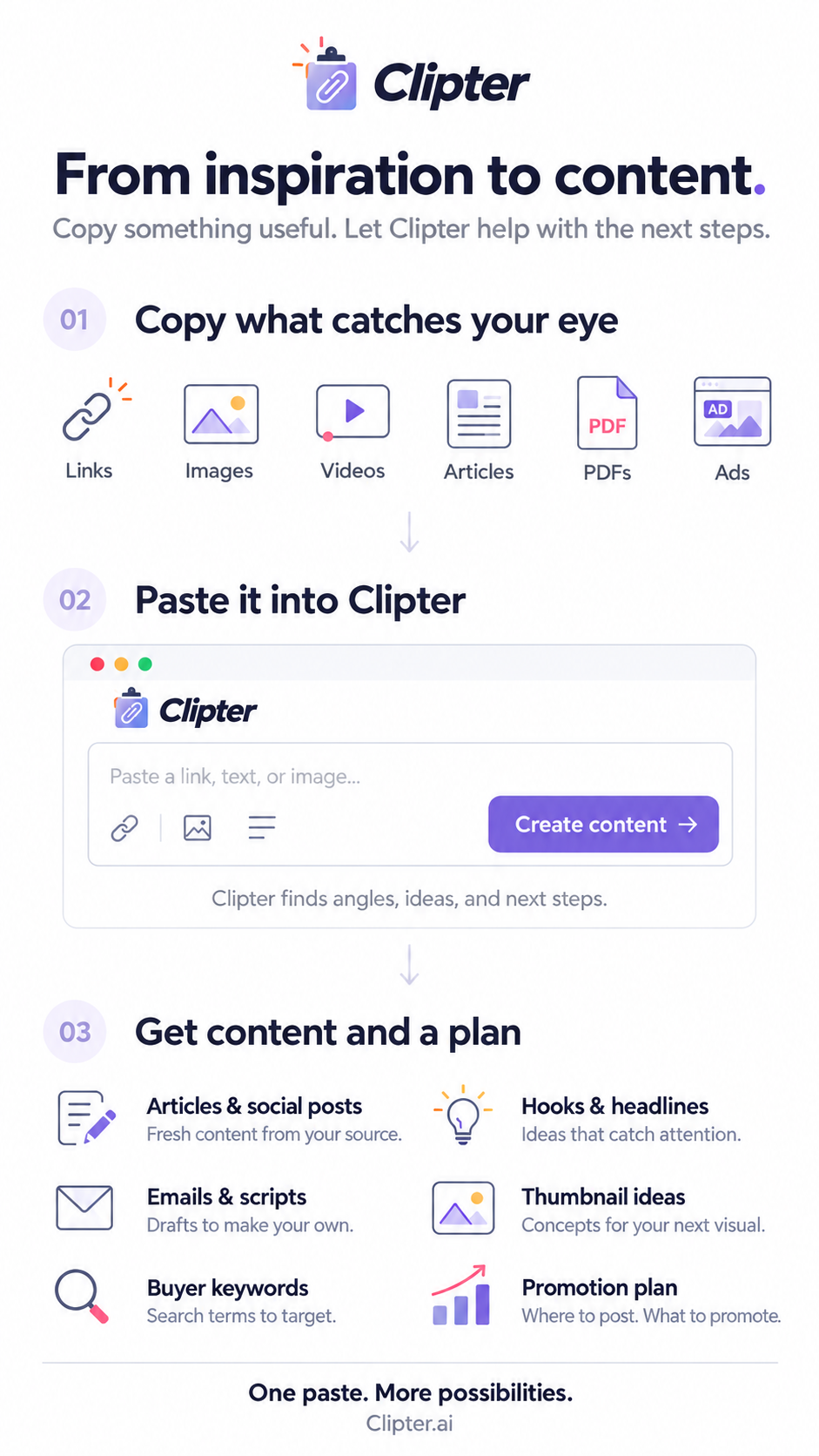
To eliminate this friction and give solo operators an unfair advantage, tools like Clipter were engineered specifically around the principles of direct-response content extraction.
Instead of forcing you to stare at a blinking cursor or prompting generic, hallucinated AI copy, Clipter automates the reverse-engineering process directly from proven market signals:
- Vision on Images & Infographic Dissection: Upload an image, an infographic, or a high-performing social thumbnail, and Clipter breaks down the psychological hooks, underlying angles, and hidden pain points that made that visual succeed in the feed.
- The Instant Glossary Generator: Feed the software your core offer or topic, and it immediately extracts up to 250 hyper-specific technical distinctions, terms, and buyer questions to fuel your educational content for months.
- The One-Click “Money” Button: Connect any content idea directly to vetted, high-paying affiliate programs and commercial monetization paths with a single click, ensuring you never create a post that lacks a profit mechanism.
- The PLR and Digital Product Matcher: Instantly discover customizable white-label assets, checklists, and guides that you can license, brand, and deploy as your One Big Thing in an afternoon.
- Stat Video Studio: Automatically transform cold data, numbers, and counter-intuitive industry truths into scroll-stopping short-form video scripts and dynamic reels without needing to show your face on camera.
By automating the research and extraction phases, you can build an entire month’s worth of targeted, commercial content in an hour or two, freeing up your energy to focus on high-level strategy and customer relationships.
Click Here To Get Clipter Before The Price Goes Up
Part 10: The Distinction Principle — Speaking the Language of Buyers
One of the most critical elements of direct-response marketing is understanding the power of commercial distinctions.
A distinction is a subtle nuance, a specific terminology, or an operational difference that is only recognized by someone who is actively immersed in a market. Beginners and casual tourists speak in broad, vague generalities. Serious buyers speak in distinctions.
The Cow in the Meadow Rule: If an ordinary city person drives past a field, they point out the window and say, “Look, cows!” But if a commercial dairy farmer drives past that exact same fence, they glance over and say, “That’s a herd of Holsteins in their second lactation cycle, and their pasture rotation is running two weeks late.” If you want to sell products to the dairy farmer, you cannot make content about generic ‘cows.’ You must speak the language of lactation cycles and pasture management.
When you make broad, generic content (“How to make money online,” “How to get in shape,” “How to save money”), you attract tire-kickers who have no commitment to investing in a solution. When you use specific commercial distinctions, you instantly signal to the market that you are an authority worth listening to.
Look at how distinctions transform ordinary content across various sectors:
| Broad, Low-Value Topic | Targeted Commercial Distinction | Underlying Buyer Intent |
|---|---|---|
| “Best walking shoes” | “Zero-drop vs. Rocker-sole for metatarsalgia relief” | Desperate to solve foot pain; ready to buy orthopedic shoes immediately. |
| “How to build an app” | “Supabase Row-Level Security rules for multi-tenant SaaS” | Active software builder looking for dev tools, templates, and hosting. |
| “Gardening tips” | “Open-pollinated heirloom seeds vs. F1 hybrid storage stability” | Serious food security prepper buying seed vaults and storage gear. |
| “Affiliate marketing advice” | “Cookie duration windows on high-ticket B2B affiliate networks” | Experienced marketer looking for premium software offers and tools. |
When you align your content around specific distinctions, you don’t need millions of views to build an empire. A simple video watched by 400 people who care deeply about a specific technical distinction will produce more high-margin sales than a generic comedy sketch viewed by 400,000 teenagers.
Your 7-Day Action Plan: Break the Treadmill Forever
You do not need another month of aimless content creation. You do not need to wake up tomorrow morning wondering what dance to perform for the algorithm. Here is the exact roadmap to transition your business into a direct-response powerhouse over the next seven days:
- Day 1: Identify Your Core Destination. Stop producing content for 24 hours. Decide on the single commercial engine that will power your business. Is it a high-ticket affiliate offer? A productized service? An interactive calculator? A specialized digital toolkit? Lock in the transformation.
- Day 2: Build the Bridge Asset. Create the direct-response lead magnet or utility that solves the first urgent problem for your prospect. Keep it lean, actionable, and laser-focused on a single outcome. If you don’t want to build one from scratch, acquire a premium white-label asset and customize it.
- Day 3: Map the Roadblock Matrix. Write down the top 10 specific obstacles, myths, technical mistakes, and bad advice that keep your prospect from achieving that outcome. These 10 roadblocks will form the foundation of your next 50 pieces of content.
- Day 4: Extract Your Niche Glossary. Isolate the 30 core terms, distinctions, and metrics that serious buyers in your space use when talking to each other. Plan a micro-educational breakdown for each term.
- Day 5: Script Your Direct-Response Hooks. Draft 10 clean, sharp hooks using the formula: Earn the Stop + Micro-Insight + Call to Action. Ensure every single hook is readable in one breath and names a specific commercial tension.
- Day 6: Set Up Your Conversion Pathways. Ensure your links, landing pages, and comment-automation triggers (e.g., “Comment BLUEPRINT to get the guide”) are fully functional. Test the user experience from the perspective of a brand-new prospect clicking from a mobile feed.
- Day 7: Launch Your Concentric Campaign. Publish your first sequence of direct-response posts. Do not check your view count every ten minutes. Watch your lead count, your email subscriptions, and your conversion tracking. Optimize your angles based on real commercial response rather than algorithm applause.
Stop Playing the Lottery — Build Something Real
Content is not the product. Content is not the business. Content is simply the delivery mechanism for an authentic, tangible asset that solves real problems for real people.
The internet does not need another exhausted creator churning out hollow inspirational platitudes, generic listicles, and frantic daily updates that lead nowhere. The world is awash in digital noise. What people are desperately searching for is clarity, utility, and direction.
When you build ONE big thing that matters, your entire relationship with marketing changes. You stop begging the algorithm for crumbs of attention. You stop living in terror of platform updates and shadowbans. You build a resilient, durable asset that gains equity, generates revenue, and works for you every single day of the week.
Before you open another blank social media box today, close your eyes, take a breath, and ask yourself the only question that matters:
“What is the one big thing I am building today that will get me paid tomorrow?”
Build the asset. Let it shape your marketing. Point every post toward that destination, and leave the content lottery behind for good.
Click Here To Get Clipter Before The Price Goes Up
.
.
.
.

Leave a Reply