$31 A Day – Secret To Passive Income
The $31-a-day idea is smaller on purpose
The video starts with a deliberately target: a small page that produces roughly $31 per day on average. Some days can be lower, some days can be higher. The important point is not the number. It is the asset behind it.
One useful page can keep bringing in visitors after it is published. But “takes less than two minutes to manage” refers to the ongoing maintenance of an existing asset—not the work required to find the problem, test the solution, build the page, earn trust, and keep the information current.
The expired-domains example
Expired domains are a clean example because the visitor is not looking for general inspiration. They are looking for a specific answer: where to find a name, how to research its history, whether its backlinks are relevant, or how to place a backorder.
That can become a focused page such as: “Expired domains with real traffic and relevant backlinks—updated daily.” The point is not to dump thousands of names on a page. The point is to filter a difficult search into a small, understandable next step.
- Start with the exact task. Use language people already use: expired domains, dropped domains, auction domains, domain backorders, traffic history, and backlink checks.
- Look for a cluster, not one magic phrase. A group of related searches tells you what the market actually wants and where the visitor is in the buying process.
- Make one narrow page. A useful page is tighter than “everything about domains.” It answers one job: finding traffic domains, researching auction domains, or comparing a domain tool.
- Show the natural next step. Demonstrate the research process, explain the filter, and only then recommend a relevant tool or service.
In the video, the expired-domain software example is used to explain a broader lesson: people searching for a problem-solution phrase are often much closer to action than people browsing a broad topic. The visitor does not need a hype page. They need the next useful action.
What this looks like outside the domain niche
This model travels well because software is often a direct answer to a direct problem. The page does not need to invent a new desire. It simply meets someone at the moment they are trying to make a file work, clean an image, fix audio, or finish a task.
- PDF: “How do I pull page 4 out of a 60-page PDF?”
- Audio: “How do I remove background noise from this recording?”
- Images: “How do I make this product photo have a clean white background?”
- Files: “How do I convert this file without wrecking the formatting?”
- Scheduling: “How do I let people book a time without email ping-pong?”
Every one of those can lead to a small, focused article, demo, tool, video, or landing page. The common thread is not the software category. It is the repeated job.
21 keyword ideas pulled with Keyword Sniffer
The snapshot below is from Keyword Sniffer inside Profit Scoop Elite. It shows a useful cross-section of simple software tasks: image editing, conversion, PDF work, audio, video, and screen recording.

The data below is transcribed from the supplied Keyword Sniffer screenshot. Volume, CPC, competition, keyword difficulty, and intent are tool-reported snapshots—not traffic guarantees or a combined market total.
| Keyword | Volume | CPC | Comp. | KD | Intent |
|---|---|---|---|---|---|
| remove background | 1,220,000 | $2.49 | 0.06 | 66 | Informational |
| background remover | 1,220,000 | $2.65 | 0.06 | 66 | Transactional |
| ai image generator | 823,000 | $3.16 | 0.47 | 69 | Transactional |
| mp3 converter | 550,000 | $3.18 | 0.01 | 37 | Transactional |
| text to speech | 301,000 | $2.10 | 0.22 | 94 | Informational |
| pdf editor | 246,000 | $5.10 | 0.66 | 66 | Transactional |
| ai video generator | 246,000 | $5.67 | 0.56 | 65 | Transactional |
| heic to jpg | 246,000 | $0.11 | 0.11 | 28 | Informational |
| pdf converter | 201,000 | $2.16 | 0.24 | 76 | Transactional |
| pdf to word | 201,000 | $1.44 | 0.40 | 64 | Informational |
| jpg to pdf | 201,000 | $1.07 | 0.24 | 52 | Informational |
| mp4 to mp3 | 201,000 | $0.44 | 0.03 | 13 | Informational |
| video editing software | 201,000 | $9.07 | 0.08 | 66 | Transactional |
| image resizer | 201,000 | $2.37 | 0.03 | 65 | Transactional |
| pdf to jpg | 165,000 | $0.75 | 0.38 | 60 | Informational |
| merge pdf | 165,000 | $0.90 | 0.31 | 51 | Informational |
| webp to png | 165,000 | $0.06 | 0.06 | 27 | Informational |
| screen recorder | 165,000 | $3.57 | 0.13 | 64 | Transactional |
| compress pdf | 135,000 | $0.90 | 0.35 | 62 | Informational |
| word to pdf | 110,000 | $1.02 | 0.14 | 47 | Informational |
| webp to jpg | 110,000 | $0.14 | 0.09 | 25 | Informational |
Want the Keyword Sniffer workflow?
I pulled this list using Keyword Sniffer inside the Profit Scoop Elite membership. Use it to spot problem-first searches, review intent, find supporting terms, and turn one practical question into a focused content idea.
How to turn one keyword into a page that earns its place
Do not choose a keyword because it looks impressive. Choose it because you can create a clear result for the person behind the search.
- Read the intent, then narrow the question. “PDF editor” is broad. “How to remove one page from a PDF without changing the rest” is a page you can actually build.
- Check the current search results and discussion. Look at what the visitor sees today, then look at communities and videos to find the friction: file size, privacy, pricing, formatting, speed, or a missing feature.
- Test the exact solution. Use a harmless sample file. If the tool cannot solve the task cleanly, do not build the page around it.
- Write the page around the task. Use a plain headline, show the process, explain who the tool is for, and put the recommendation after the answer—not before it.
- Disclose the relationship. If the link is tracked, say so plainly. If a program pays recurring commissions, verify the actual eligibility, customer plan, and duration before saying it does.
“Don’t start with an offer. Start with a task that repeats.”
That rule is what prevents the page from turning into a generic affiliate review. You are not trying to convince somebody to want a product. You are helping them complete the job they arrived to do.
Start with the first useful page
The real opportunity is not just expired domains, PDFs, audio, or image tools. It is the pattern: a repeated problem, a clear search, a useful answer, and a solution that naturally belongs next to it.
Start smaller than you think you need to. Make one page that solves one thing well. Learn what visitors ask, see which problems repeat, and then build the next page from proof instead of guesswork.
These Words Make Me Money Online – Every DAY!
The “Stupid Words” Strategy: How Simple Trigger Words Generated $167,102 in Year One and Over $17 Million in Affiliate Revenue
Join Ai Profit Scoop Elite And Get The New Keyword Tool
Back when affiliate marketing was still in its wild-west infancy, breaking into the business required scouring through overpriced manuals that promised secret formulas for instant internet riches. One of the very first physical guides purchased for this journey was a three-ring binder manual titled Nothing But ‘Net by Michael Campbell. That single binder cost nearly $100—an enormous sum for a beginner at the time. Yet, nestled within those pages was an insight so profoundly simple that it completely rewired how online commerce should be approached: stop competing with everyone for the exact same massive keywords, and start identifying the exact intent behind the words people type into search engines.
Most beginners make the fatal mistake of jumping headfirst into saturated, cutthroat niches. They chase terms like “make money online,” “weight loss,” or “car insurance” in their broadest forms, hoping that sheer traffic volume will magically translate into affiliate commissions. The reality is that broad traffic rarely converts, competition at the top is brutal, and chasing raw volume leads directly to burnout and empty bank accounts.
Instead of chasing broad terms, an alternate approach was engineered around what are affectionately called “stupid words”—or more formally, trigger words. These are basic, unassuming modifiers like calculate, generator, checklist, plan, vs, review, and how to. In year one of implementing this systematic approach as a full-time affiliate marketer, those modifiers produced exactly $167,102. In the years that followed, expanding and refining that single concept generated over $17,028,118 in tracked affiliate revenue.
Earnings Disclaimer: The income numbers, earnings examples, and historical dashboard figures referenced throughout this guide are historical results from specific affiliate campaigns. They are not typical, implied, or guaranteed. The vast majority of people who attempt to build an online business make little to no money because success requires disciplined market research, continuous testing, proper execution, and risk tolerance. Treat these examples as educational case studies demonstrating search engine mechanics, not as income guarantees.
To understand why these simple modifiers yield such massive commercial power, one must look directly at the underlying mechanics of search engines, how commercial intent is valued, and how unpaid organic clicks can be leveraged to generate high-ticket affiliate commissions.
1. The Mathematics of Search: Understanding the 10 Billion Daily Query Machine
Every single day, approximately 10,000,000,000 searches are processed across Google. To put that figure into perspective, that is roughly 8 million queries hitting search algorithms every single minute of every single day. Even with the emergence of artificial intelligence platforms, conversational chat interfaces, and large language models, the raw volume of human beings typing specific queries into search bars continues unabated.
Google itself is fundamentally in the business of selling words. It is not merely a search engine; it is a word-auctioning platform that generates upwards of $400 billion annually by connecting commercial intent with relevant advertisers. Every second of the day, tens of thousands of dollars change hands based entirely on which words are typed into a search box.
When you break down the economics of these 10 billion searches, two distinct camps emerge:
- The Pay-Per-Click Advertisers: Brands, service providers, and lead aggregators who pay Google anywhere from $1 to over $100 every time a single user clicks on a sponsored link.
- The Organic Content Publishers: Websites, authority hubs, review portals, and tool creators that capture unpaid organic search traffic positioned directly beside or beneath those sponsored results.
The secret that unlocks high-ticket affiliate revenue lies in recognizing that an advertiser’s willingness to bid astronomical amounts on paid clicks provides a direct window into the profitability of a niche. By tracking paid economics, smart affiliate marketers can position helpful, intent-matched organic pages right where high-value decisions are being made—without spending a single dime on advertising.
2. Ads Change the Economics: Why Cost-Per-Click (CPC) Is Your Market Compass
Many novice affiliate marketers look at Cost-Per-Click (CPC) data inside keyword research tools and assume it only matters if they are running paid advertising campaigns on Google Ads. That assumption is completely backwards. In organic SEO and affiliate marketing, CPC is not a cost you have to pay—it is an intelligence signal that proves a market has serious money behind it.
Advertisers do not bid $20, $50, or $100 per click out of charity. They bid high amounts because the lifetime value (LTV) of acquiring that customer is massive. When a single converted lead can generate thousands of dollars in revenue for a business, paying $50 for a click is an easy mathematical decision. For an affiliate marketer, discovering these high CPC clusters reveals exactly where high-ticket affiliate networks, pay-per-call offers, and high-payout lead generation programs reside.
High-Value Commercial Ad Themes
Consider the illustrative CPC ranges for high-value commercial search themes across competitive industries:
- Reverse Mortgage: $20 to $100+ per click. A homeowner exploring equity release represents a loan transaction worth tens of thousands of dollars to lenders.
- Accident Lawyer: $50 to $300+ per click. Personal injury settlements often involve five- to seven-figure sums, making legal leads some of the most expensive clicks on Earth.
- Business Loans: $20 to $100+ per click. Financial institutions aggressively bid for business owners seeking commercial capital or lines of credit.
- Car Insurance: $15 to $70+ per click. Recurring annual premiums create long-term policyholder value, justifying aggressive customer acquisition costs.
- Commercial Insurance: $20 to $100+ per click. Underwriting commercial liability policies yields high ongoing broker commissions.
- Payroll Software: $10 to $60+ per click. Enterprise software-as-a-service (SaaS) subscriptions produce recurring monthly revenue for years.
- Emergency Plumber: $13 to $25+ per click. Homeowners with burst pipes require immediate service, creating instant, high-urgency transactions.
Lower-Commercial Ad Themes
Contrast those commercial powerhouses with low-intent or hobby-driven search themes:
- Coloring pages (pennies per click)
- Easy crafts (under $1 per click)
- Quote of the day (virtually zero advertiser demand)
- Origami ideas (minimal monetization potential)
- Funny cat videos (high volume, micro-fractional ad spend)
- Free printables (predominantly hobbyist traffic seeking free assets)
If you build a website around “free printable coloring pages,” you might attract 50,000 visitors a month, but you will struggle to make enough money to cover your web hosting. Conversely, if you capture 300 highly targeted visitors looking for a specific financial or professional service calculation, those 300 visitors can easily generate several thousand dollars in affiliate commissions.
Join Ai Profit Scoop Elite And Get The New Keyword Tool
3. The 90% Free Clicks Reality: Capturing High-Ticket Value Without Paid Ads
A common misconception among beginner marketers is that because Google displays sponsored listings, AI overviews, and local map packs at the top of the search engine results page (SERP), organic traffic has lost its value. This belief is entirely divorced from reality.
While advertisers bid aggressively for sponsored listings, a massive portion of the overall search volume—estimated directionally around 90% of total clicks across the web—continues to flow into unpaid, organic results. Users are conditioned to scan past ads to find objective, independent, and comprehensive solutions to their exact problems.
When someone searches for a phrase like “reverse mortgage,” the top of the search results page features sponsored ads paid for by major financial brokerages. Beneath those ads sits an AI Overview summarizing eligibility requirements, followed by authoritative organic results from sources like Wikipedia, government portals, consumer advocacy groups, and specialized educational blogs.
Those organic websites are paying zero dollars for visitors who land on their pages. Yet, those visitors are worth $22, $30, or $50 per click according to market valuation. If your affiliate site provides a helpful, objective breakdown, an eligibility evaluation, or an interactive tool, you can capture that exact same high-value visitor completely for free.
The Core Arbitrage: You do not need to buy clicks to profit from high-CPC markets. You simply need to build helpful organic pages that target the specific problems high-value searchers are trying to solve.
4. Traffic Is Valued by Intent, Not the Source
One of the most transformative mental shifts an affiliate marketer can make is realizing that traffic is not an abstract metric, nor is it defined by the platform that delivers it. Traffic is valued strictly by human intent.
The source of the visitor is entirely secondary:
- A visitor arriving from a Google organic search result
- A visitor clicking a link in a YouTube video description
- A subscriber opening a recommendation inside an email newsletter
- A social media user reading a detailed post on Reddit or Facebook
- A direct referral from a companion website
If that individual has a pressing, legitimate problem, and your landing page addresses that problem directly, that traffic possesses commercial value. Conversely, if an audience of 500,000 people views an entertainment video with zero intent to take action, buy a product, or solve a financial dilemma, that massive audience has almost no commercial value.
The Intent Transformation Funnel
Human intent is not static; it can be strategically shaped and elevated. A visitor often starts with a broad personal circumstance before realizing that a specific financial or commercial product solves their situation.
Consider the following real-world intent-shifting progression:
- The Starting State (Low Commercial Intent): A retiree searches for “how to live on a fixed income.” At this moment, they are not searching for a loan, an insurance policy, or an investment strategy. They are experiencing financial stress and looking for budgetary guidance.
- The Value-Add Page (The Bridge): They land on your helpful, structured resource page titled “The Complete Checklist for Managing Cash Flow on a Fixed Income.” You provide genuine budgeting advice, debt-reduction tips, and grocery-saving strategies.
- The Intent Shift (The Pivot Point): Within that comprehensive guide, you introduce advanced options for seniors who own substantial equity in their homes: “If you are over 62 and own your home, you can eliminate monthly payments and unlock capital through a reverse mortgage. Use our calculator below to see what you qualify for.”
- The Action (High Commercial Intent): The searcher enters their parameters into a simple equity calculator embedded on your page. Once they see their potential payout, they click through to an affiliate partner or request a free quote.
What began as an informational query with zero commercial ad value was systematically transitioned into an inbound lead worth $60 to $720 in affiliate commissions on networks like OfferVault. You didn’t trick the user; you answered their initial question and provided a structured next step that legitimately addressed their underlying financial dilemma.
5. Search Intent Architecture: Every Word Is a Blueprint
Search engines categorize human inquiries into distinct psychological buckets. Every word attached to a search query acts as a clue revealing what task the user is attempting to accomplish. If your page does not match the precise format the searcher requires, they will immediately bounce back to Google, destroying your search rankings and eliminating your affiliate conversions.
1. Informational Intent
Query Patterns: “How to…”, “What is…”, “Steps to…”, “Why does…”
The Searcher’s Goal: The user wants to learn, diagnose, or understand something. They are gathering information rather than evaluating a purchase.
The Required Page Format: A clean, thoroughly documented step-by-step guide, an illustrated tutorial, or an educational FAQ. Do not attempt to hard-sell transactional products immediately; provide the exact diagnostic answer first.
2. Commercial Investigation Intent
Query Patterns: “Best…”, “Reviews”, “Top 10…”, “[Product A] vs [Product B]”
The Searcher’s Goal: The user knows what category of product or service they need, but they are weighing their options, comparing prices, and evaluating features.
The Required Page Format: An objective comparison matrix, pros-and-cons analysis, side-by-side feature breakdowns, and clear, unbiased recommendations with affiliate links to the top solutions.
3. Transactional Intent
Query Patterns: “Buy”, “Quote”, “Pricing”, “Discount”, “Calculator”
The Searcher’s Goal: The user is at or near the point of conversion. They want numbers, terms, pricing tables, or direct enrollment options.
The Required Page Format: An interactive calculator, an instant quote comparison tool, clear pricing breakdowns, and direct call-to-action buttons leading to checkout or application forms.
4. Navigational Intent
Query Patterns: “[Brand Name] login”, “[Software] portal”, “[Company] customer service”
The Searcher’s Goal: The user already knows the exact company they want to visit and is simply using Google as an address bar.
The Affiliate Implication: Avoid targeting pure navigational queries unless you are providing complementary utilities, user tutorials, or troubleshooting alternatives that bridge to competing options.
Join Ai Profit Scoop Elite And Get The New Keyword Tool
6. The Anatomy of “Trigger Words”: The Master List
Trigger words are functional linguistic modifiers. When appended to a core topic or seed keyword, they immediately strip away vagueness and expose the exact functional mechanism the searcher is hunting for. These are not “magic words” that trick search engines; they are idea starters that unlock low-competition, high-conversion niches.
Here is an exhaustive breakdown of the primary trigger words, how they operate psychologically, and how they monetize across real affiliate campaigns:
Trigger Word: “Calculate” / “Calculator”
Search Psychology: The user does not want to read an essay; they have specific numbers in hand and need a functional calculation to make a real-world decision.
Examples: “Calculate mortgage refinance savings,” “car loan payment calculator,” “dental implant cost calculator.”
How It Monetizes: Visitors using calculators are making purchasing or borrowing decisions. Once they compute their numbers, the natural next step is connecting with a lender, insurance provider, or financial professional. Placing an affiliate lead form or quote button immediately beneath the calculated output produces extraordinary conversion rates.
Trigger Word: “Generator”
Search Psychology: The searcher wants an automated output based on user inputs. They want speed, automation, and effortless asset generation.
Examples: “Business name generator,” “invoice generator,” “color palette generator.”
How It Monetizes: A user generating a business name requires domain registration, LLC formation services, web hosting, and logo design software—all of which carry lucrative recurring and CPA affiliate payouts.
Trigger Word: “Checklist”
Search Psychology: The searcher is overwhelmed by a complex, multi-step life event or project and needs a structured, organized roadmap to ensure nothing falls through the cracks.
Examples: “Moving out of state checklist,” “home inspection checklist,” “starting an LLC checklist.”
How It Monetizes: Every item on a checklist represents a distinct product or service recommendation. A moving checklist naturally bridges to moving truck rentals, packing supplies, utility transfer services, and storage units.
Trigger Word: “Plan”
Search Psychology: The searcher is looking for forward-looking operational architecture. They are committing to a long-term endeavor and require a structured blueprint.
Examples: “Retirement savings plan,” “business continuity plan,” “meal prep plan for diabetes.”
How It Monetizes: Plans naturally integrate specialized software tools, professional consulting offers, financial advisory lead generation, and recurring subscription memberships.
Trigger Word: “How To”
Search Psychology: The user is experiencing a specific hurdle or technical bottleneck and needs step-by-step guidance to achieve a desired outcome.
Examples: “How to start an LLC,” “how to lower credit card interest,” “how to fix a leaky pipe.”
How It Monetizes: The tutorial should thoroughly solve the problem, while seamlessly introducing products, tools, and professional services that make the execution faster, easier, or more reliable.
Trigger Word: “Best”
Search Psychology: The searcher has committed to purchasing within a product category but desires validation and expert curation to avoid making a costly mistake.
Examples: “Best home security systems,” “best project management software,” “best dental insurance for seniors.”
How It Monetizes: Clear “Top Pick,” “Best Value,” and “Editor’s Choice” recommendation badges tied directly to affiliate tracking links and side-by-side comparison tables.
Trigger Word: “Reviews”
Search Psychology: The consumer is deep in the consideration funnel, often holding a credit card in hand, seeking an honest third-party evaluation before finalizing checkout.
Examples: “[Brand] review,” “Trustpilot [Service] reviews,” “[Software] pricing and review.”
How It Monetizes: In-depth, authentic evaluations highlighting genuine strengths, weaknesses, pricing tiers, and direct discount codes or affiliate signup buttons.
Trigger Word: “Vs”
Search Psychology: The consumer has narrowed their buying decision down to two specific finalists and requires a granular feature-by-feature comparison to choose a winner.
Examples: “Zoom vs GoToWebinar,” “Shopify vs WooCommerce,” “Roth IRA vs Traditional IRA.”
How It Monetizes: These searchers are hours away from purchasing. Whichever tool wins the comparison, you provide an affiliate link for both, guaranteeing a conversion regardless of which option the user selects.
Trigger Word: “Cheapest”
Search Psychology: Price sensitivity is the primary constraint. The user is actively seeking budget-conscious alternatives, discount providers, or cost-saving hacks.
Examples: “Cheapest car insurance for new drivers,” “cheapest way to ship across the country.”
How It Monetizes: Low-cost lead generation aggregators, discount affiliate codes, and budget-friendly service networks that thrive on high-volume consumer signups.
Trigger Word: “Stop”
Search Psychology: The searcher is experiencing active, painful frustration, bleeding money, or suffering from an ongoing technical or behavioral problem.
Examples: “How to stop wage garnishment,” “how to stop a running toilet,” “stop spam calls on iPhone.”
How It Monetizes: Pain-relief solutions convert exceptionally well. Stopping wage garnishment links directly to debt-settlement attorneys and bankruptcy consultation offers paying hundreds of dollars per valid phone inquiry.
7. Real-World Case Studies: How Trigger Words Monetize Behind the Scenes
To see how this framework functions in the real world, examine three distinct case studies pulled directly from actual affiliate marketing campaigns.
Case Study 1: The “Cost of Braces” to Dental Insurance Funnel
Years ago, an investigation into the medical and dental search space revealed that terms like “dental insurance” were savagely competitive, dominated by massive insurance conglomerates with millions of dollars in marketing capital. Ranking an independent affiliate site for broad insurance queries was practically impossible.
However, running the seed topic through trigger-word modifiers uncovered a goldmine: “cost of braces” and “cost of full mouth dental implants.”
- The Searcher’s Reality: A parent or adult consumer discovers they need extensive dental work. They are shocked by the out-of-pocket costs and type “cost of braces” into Google.
- The Arbitrage: While “dental insurance” had extreme competition, “cost of braces” had far lower ranking difficulty, yet it attracted people who desperately needed to find a way to pay for expensive orthodontic work.
- The Solution: A comprehensive breakdown of out-of-pocket brace costs by state, followed by a detailed explanation: “How to cut orthodontic expenses by 40% to 60% using supplemental dental discount plans.”
- The Monetization: Direct affiliate links to dental insurance aggregators and discount dental plans. The site generated thousands of dollars per month by helping people solve an expense problem rather than pitching them cold insurance.
Case Study 2: The “AdSense” to Web Hosting Affiliate Campaign
When entering the digital marketing and blogging education vertical, broad terms like “make money online” and “start a blog” were saturated with established industry giants. Attempting to compete head-on was a losing proposition.
By analyzing beginner pain points, a specific trigger pattern emerged around the term “Google AdSense.” Beginners weren’t searching for abstract web architecture; they were asking “how to make money with AdSense” and looking for “AdSense calculators.”
- The Setup: Beginners who wanted to earn AdSense revenue needed an active website with self-hosted WordPress to get approved.
- The Value Asset: A detailed guide explaining how Google AdSense operates, featuring an interactive earnings estimator showing how many pageviews were required to make $100 a day.
- The Transition: Underneath the calculator, the implementation guide stated: “To get approved for AdSense and start earning, you must own your domain and hosting. Free blogging platforms are frequently rejected. Follow this 3-step setup guide to get your WordPress site live on professional hosting.”
- The Result: The campaign produced $28,865 across a 3,272-click sample, resulting in 293 qualified hosting signups. The payouts averaged $100 to $150 per referral, built entirely on top of visitors searching for basic AdSense monetization advice.
Case Study 3: The “Zoom vs GoToWebinar” SaaS Comparison
Software-as-a-Service (SaaS) affiliate marketing offers some of the highest recurring commissions in the digital economy. During the explosion of virtual meeting platforms, thousands of business owners searched for “Zoom vs GoToWebinar.”
- The Economics: Platforms like GoToWebinar historically paid up to $500 per qualified lead or high double-digit recurring cuts on monthly enterprise plans.
- The Intent: A business executive typing “Zoom vs GoToWebinar” is not researching the history of video conferencing. They have budget allocated and need to choose a platform for their company within the week.
- The Asset: An objective, clean comparison table breaking down attendee limits, pricing tiers, screen sharing capabilities, automated recording features, and CRM integrations.
- The Win-Win Monetization: Clear affiliate links were placed for both platforms. If the visitor selected Zoom, an affiliate commission was generated. If the visitor selected GoToWebinar, a high-tier enterprise lead commission was triggered. The page converted visitors into revenue regardless of which platform won the comparison.
8. The 6-Step Implementation Blueprint: Turning One Search into a Profitable Asset
To execute this strategy successfully, you must abandon guesswork and adhere to a strict, repeatable workflow. Below is the exact six-step framework required to take a simple trigger word and transform it into a revenue-generating digital asset.
Step 1: Identify a Real Problem
Every profitable campaign begins with a genuine task, pain point, constraint, or decision that real human beings are actively confronting. Do not invent products out of thin air; look for existing friction in daily life, finances, career, software usage, or home management.
Step 2: Attach a Functional Trigger Word
Take your core seed topic and systematically combine it with functional modifiers:
- [Topic] + Calculator
- [Topic] + Checklist
- [Topic] + Generator
- [Topic] + Plan
- How to fix + [Topic]
- [Option A] vs [Option B]
Step 3: Inspect the Live Search Results (SERP Analysis)
Before writing a single word of content or writing a single line of code, open an incognito browser window and manually inspect Google’s top results for that query. Ask yourself:
- What format is currently winning? Are the top results interactive tools, detailed written guides, YouTube video embeds, or forum discussions?
- Are the ranking pages actually answering the searcher’s core question, or are they bloated, outdated corporate pages that frustrate the user?
- Can you provide a cleaner, faster, more direct answer without making the user scroll through 2,000 words of useless fluff?
Step 4: Build the Best Functional Answer
Create the exact asset the searcher came for. If they searched for a checklist, give them a clean, downloadable, or interactive on-page checklist. If they searched for a calculator, build a functional, zero-friction calculation script using modern AI tools to code the HTML and JavaScript. Deliver immediate utility the moment the page loads.
Step 5: Integrate One Relevant, Natural Next Step
Monetization should never feel like a jarring, high-pressure sales pitch. It must function as the logical, helpful continuation of the task the user is completing:
- If they just calculated their home refinance savings, offer them a link to compare current lender rates from vetted financial networks.
- If they just completed a moving checklist, provide links to get free binding quotes from insured professional movers.
- If they just evaluated software choices, give them direct links to test free trials or claim exclusive discount codes.
Step 6: Measure Qualified Actions and Iterate
Track everything using granular affiliate sub-IDs and analytics. Focus on qualified metrics rather than vanity traffic numbers. Monitor your Click-Through Rate (CTR) from the page to the affiliate offer, your Earnings Per Click (EPC), and your conversion percentage. Optimize the layout, headline, and call-to-action based on real behavioural data.
Join Ai Profit Scoop Elite And Get The New Keyword Tool
9. The Keyword Tool Stack: Uncovering Untapped Arbitrage
Executing this strategy at scale requires the right tool stack to collect seed ideas, evaluate commercial metrics, and inspect competition. You do not need to purchase every tool on the market, but you must understand what each tool is designed to accomplish.
SpyFu
Primary Function: Historical advertising intelligence and commercial CPC tracking.
Why It Matters: SpyFu provides deep visibility into what advertisers have historically paid per click for specific search terms over years of tracking data. It reveals whether advertisers consistently bid on a keyword month after month, which confirms long-term profitability.
Ahrefs
Pricing: Professional tiers starting at $449/mo.
Primary Function: Enterprise backlink profiling, organic search traffic estimation, and domain history.
Why It Matters: Ahrefs excels at showing historical domain authority and ranking changes over time. It allows you to see which long-tail variations a specific URL ranks for, enabling you to uncover hundreds of secondary trigger terms driving traffic to a single page.
Semrush
Pricing: Entry plans starting around $119/mo.
Primary Function: Keyword discovery, competitive organic research, and search intent classification.
Why It Matters: Semrush provides built-in intent badges (Informational, Commercial, Transactional, Navigational), making it fast and easy to filter out thousands of raw keywords into distinct commercial buckets.
Google Ads Keyword Planner
Pricing: Free (with an active Google Ads account).
Primary Function: Direct data from Google’s internal ad auction system.
The Caveat: Keyword Planner is explicitly designed for advertisers buying paid traffic, not organic search publishers. Its competition metrics reflect ad bidder density, not SEO ranking difficulty. Use it to verify search volume ranges and top-of-page bid estimates, but do not rely on it to determine organic ranking competition.
The Keyword Sniffer Suite
Availability: Proprietary tool suite included exclusively inside AI Profit Scoop Elite.
Primary Function: Custom-engineered keyword filtering built specifically around Marcus Campbell’s affiliate marketing methodologies.
Key Modules:
- The Keyword Machine: Analyzes seed keywords and automatically appends high-converting trigger words, categorizing outputs by commercial intent.
- The Bulk List Checker: Processes hundreds of long-tail phrases simultaneously, pulling CPC estimates, search volume, and advertiser intent in a unified dashboard.
- The Idea Machine: Bridges informational problems to high-ticket affiliate verticals, showing you related CPA and pay-per-call offers matching specific search intents.
- The Glossary Method Tool: Extracts niche-specific jargon, technical terminology, and industry concepts to uncover untapped micro-niches that general tools completely miss.
10. The Golden Rules: Helpful First, Monetize Second
Building a multi-million-dollar affiliate marketing business over nearly three decades requires adhering to strict operational integrity. If you attempt to shortcut the search engines with spam or deceptive practices, your revenue will vanish as quickly as it appears. Keep these core rules pinned to your workspace:
1. Never Chase Volume Without a Useful Page Concept
A keyword with 100,000 monthly searches is completely worthless if you cannot deliver an asset that satisfies the user’s intent. Fifty dedicated visitors who get exactly what they need will generate vastly more revenue than 50,000 frustrated visitors who bounce off a broken page.
2. Eliminate Thin, Low-Effort Content
Do not create programmatic doorway pages that merely swap out city names or single keywords while delivering the exact same generic text. Search engines actively penalize low-effort content. Every page you publish must provide genuine utility, clear answers, or working computational tools.
3. Maintain Absolute Offer Relevance
Never redirect or manipulate a visitor into an unrelated high-paying offer simply because the commission payout is large. If a user is searching for “how to fix a running toilet,” do not send them to a reverse mortgage application. Connect them to a local emergency plumbing directory, a replacement valve kit, or a home repair service network. Trust and contextual relevance dictate conversion rates.
4. Do Not Permit AI to Fabricate Data or Factual Claims
Artificial intelligence is an extraordinary coding assistant, research accelerator, and drafting tool. However, LLMs are prone to hallucinations when citing statistics, medical advice, legal parameters, or financial figures. Always manually verify factual claims, interest rates, and regulatory details before publishing commercial content.
5. Treat Case Studies as Blueprints, Not Guarantees
Inspect successful campaigns to understand the underlying mechanics: the relationship between the trigger word, the visitor’s pain point, the on-page asset, and the affiliate monetization bridge. Master the framework, execute your own research, and make decisions based on live market evidence.
Summary: The Path Forward
The affiliate marketing landscape has evolved tremendously since the days of reading $100 physical manuals in three-ring binders. Yet, the foundational law of digital commerce remains completely unchanged:
Real Problem + Useful Trigger Word + Intent-Matched Page + Relevant Next Step = Sustainable Affiliate Revenue.
Every single day, 10 billion searches are submitted by human beings seeking answers, tools, checklists, comparisons, and solutions. Advertisers will continue to pour hundreds of billions of dollars into capturing those users. By leveraging simple trigger words, you can identify high-value pockets of commercial intent, bypass brutal broad-keyword competition, and build high-converting assets that generate predictable revenue for years to come.
Make Money Fast – Ai Business Ranked!
NEW KEYWORD TOOL – NOW IN AI PROFIT SCOOP ELITE
Fastest Ways To Make Money Online?
$5,000 in hours???
Not from watching another video. Not from opening another AI account. And not because AI lets you build something fast.
I watched a ton of videos on this topic. After making money online for more than 27 years, I want to show you the fastest way I believe someone can start getting results and build an online business with AI.
No BS.
No filler.
Just what I do daily that works for me, my students, and clients.
Important: You can build and launch a simple AI tool in one day. That does not guarantee customers, profit, or $5,000 in one day. The fast part is launching and testing a useful offer. The hard part is getting targeted attention, building trust, and converting visitors into sales.
First: What the Videos Said to Do
NEW KEYWORD TOOL – NOW IN AI PROFIT SCOOP ELITE
These are the 14 main ways to make money online that came up across the creator research. The grade is based on practical speed and difficulty for a beginner.
1. Sell a service that creates a result for a client — Grade: B
Creators: Alex Hormozi, Mark Tilbury, Graham Stephan, Dan Martell, Abu Lahya, Shane Hummus.
What they say: Find a painful problem a business already pays to solve. Sell the result, not the task.
Reality: You can get paid as soon as you close a client. But beginners often do not know how to fulfill the work or sell it. It becomes stronger if you are the salesperson and work with someone else who fulfills the service.
2. Use content to create distribution and leads — Grade: D
Creators: Alex Hormozi, Graham Stephan, Wendy Nolan, Shane Hummus, Money Talk With Leon, Mark Tilbury.
What they say: Make YouTube videos, TikToks, Instagram posts, emails, and community content to bring in leads.
Reality: “Just create content” is not a strategy. Without a keyword target, buyer intent, and an offer, beginners can post for years with very little payoff.
3. Create and sell digital products — Grade: D
Creators: Money Talk With Leon, Iman Gadzhi, Graham Stephan, Wendy Nolan.
What they say: Sell a guide, template, mini-course, playbook, or toolkit.
Reality: AI can help you make a product quickly, but making the product is not the money part. You still need expertise, credibility, traffic, and marketing.
4. Monetize attention with ads, sponsors, affiliate offers, and brand deals — Grade: C
Creators: Alex Hormozi, Graham Stephan, Wendy Nolan, Shane Hummus.
What they say: Build attention and stack revenue streams from ads, sponsors, affiliates, and deals.
Reality: Viral views do not automatically create buyers. Most views and clicks pay very little. Build an audience of people with a problem and buying intent.
5. Offer AI automation services to businesses — Grade: B
Creators: Mr Reis, Dan Martell, Abu Lahya.
What they say: Set up chatbots, AI receptionists, review-reply systems, and workflows for businesses.
Reality: This can work, but mass cold email is crowded. Attraction marketing works better: make a useful tool that lets businesses discover you because it solves a problem.
6. Edit or repurpose short-form video — Grade: D
Creators: Daniel Bitton, Dan Martell, Mark Tilbury.
What they say: Turn long videos into TikToks, Shorts, and Reels for creators and brands.
Reality: It requires editing skill, an understanding of hooks and pacing, and consistent client outreach.
NEW KEYWORD TOOL – NOW IN AI PROFIT SCOOP ELITE
7. Create a paid community, course, or mentorship — Grade: D
Creators: Wendy Nolan, Abu Lahya, Iman Gadzhi.
What they say: Sell education, access, accountability, and community.
Reality: You need a topic worth paying for, proof you can help, and ongoing delivery. Communities also have churn and moderation work.
8. Affiliate marketing — Grade: S
Creators: Wendy Nolan, Shane Hummus, Alex Hormozi.
What they say: Recommend someone else’s useful offer and earn a commission when a qualified buyer takes action.
Reality: This is the top tier because you do not have to create the product, ship inventory, or handle support. You still need targeted traffic and trust.
Do not confuse affiliate marketing with Master Resell Rights (MRR).
- MRR: You buy a product and the right to resell it. Thousands of people may be selling the same product, which can dilute its value.
- Affiliate marketing: You promote a reputable software tool, service, or lead offer and earn a commission without owning the product.
9. E-commerce, print-on-demand, or dropshipping — Grade: B with the right product / F- when generic
Creators: George McConnell, Mark Tilbury, Alex Hormozi.
What they say: Build a store, find a supplier, and earn the difference between the sale price and fulfillment cost.
Reality: This can work if you have the right product, margin, and traffic plan. Generic Shopify dropshipping is very competitive and ad costs can wipe out profit.
10. Self-publish books on Amazon KDP — Grade: C
Creators: Sean Dollwet, Alex Hormozi.
What they say: Use books for royalties, credibility, search visibility, and leads.
Reality: Amazon is crowded. Uploading an AI-written book and hoping it sells is not a traffic strategy. Build a targeted audience first.
NEW KEYWORD TOOL – NOW IN AI PROFIT SCOOP ELITE
11. Build a niche SaaS or subscription tool — Grade: A
Creators: Mr Reis, Dan Martell.
What they say: Solve one repeatable problem with software and charge monthly.
Reality: This has strong recurring-revenue potential. With AI, you can build a focused first version in hours and test demand before making it complicated.
12. Broker brand deals, creators, or UGC — Grade: D
Creators: Daniel Bitton, Dan Martell, Shane Hummus.
What they say: Match brands and creators, manage campaigns, and keep a margin.
Reality: Creators and brands receive a lot of pitches. It is hard to stand out without relationships, credibility, or a unique angle.
13. Make quick cash from resale, flipping, market research, or part-time work — Grade: B
Creator: Graham Stephan.
What they say: Flip items, sell unused items, do market research, or complete paid tasks.
Reality: This can produce immediate cash, but you are trading time for money. It is not the same as building a scalable online business.
14. Build or buy larger assets — Grade: D
Creators: Dan Martell, Shane Hummus.
What they say: Buy businesses, build enterprise software, own equity, or create a major personal brand.
Reality: These can create large long-term upside, but they require capital, skills, or years of execution. They are not a fast-cash solution for beginners.
The Fastest Way to Make Money With AI: Start With a TOOL
NEW KEYWORD TOOL – NOW IN AI PROFIT SCOOP ELITE
A tool gives somebody a faster, easier, or more profitable way to get a result.
The goal is not “build an AI tool.” The goal is to make a small result machine for a specific group of people.
Keyword problem → simple AI tool → clear offer → distribution → traffic data → sales → improved tool
Start with a problem people already search for, complain about, or pay someone to solve.
Use Trigger Words
Look for words that tell you someone wants a result now:
calculator, generator, creator, builder, template, estimator, checker
These words often signal useful search intent because the person is trying to do something, not just browse.
Make the Tool Specific
Too broad: AI business assistant.
Better: AI Google Review Reply Tool for Med Spas.
Too broad: AI content generator.
Better: AI 30-Day Instagram Reel Planner for Roofers.
Specific beats generic because the buyer feels understood.
Tool Examples and Offer Angles
Concrete Calculator
- Tool: A simple concrete slab or volume calculator.
- Unique angle: Add DIY pitfalls, pavers vs. concrete comparison, or cost-saving guidance.
- How it gets paid: A contractor referral, a pay-per-call lead offer, or a local concrete service.
Generator Size Calculator
- Tool: Enter appliances and receive a recommended generator size.
- Unique angle: Add hurricane-prep or installation-cost guidance.
- How it gets paid: Generator affiliate offer, installer referral, or lead-generation partnership.
Local Business Review-Reply Generator
- Tool: Paste a negative review and receive a professional response in the business’s voice.
- Unique angle: Target a vertical, such as med spas, restaurants, dentists, or plumbers.
- How it gets paid: Reputation-management setup, monthly retainer, or review software referral.
Quote or Invoice Generator
- Tool: Create a contractor quote, service proposal, or invoice from a few inputs.
- Unique angle: Make it specific to one trade or service type.
- How it gets paid: Proposal software referral, merchant-account referral, template upsell, or done-for-you service.
The 6-Step Same-Day Tool Launch Framework
Step 1: Start With a Problem
- What task wastes this person time every day?
- What costs them leads, appointments, or sales?
- What do they search when they are frustrated?
- What result could they get in minutes instead of hours?
Step 2: Check Keyword Demand Before Building
Do not make a random tool just because AI makes it easy. Check whether people search for the problem first.
Examples of high-intent searches:
- best contractor quote template
- roofing estimate calculator
- med spa review response examples
- cover letter generator for nurses
- generator size calculator
Step 3: Build One Useful Job the Same Day
- Pick one painful task.
- Ask for only the information needed.
- Give a clear and useful result.
- Make sure the tool is helpful even if the visitor does not buy anything.
- Add one feature that makes it different from generic tools.
Step 4: Decide How the Tool Gets Paid
- Affiliate offer: Earn a commission when users buy a related product or service.
- Qualified lead: Send a serious prospect to a provider for a lead fee.
- Done-for-you service: Use the tool as the lead-in to sell the completed work.
- Setup and retainer: Offer implementation plus ongoing management.
- Paid tool: Charge a subscription or one-time fee for access.
- Digital-product upgrade: Offer a template, guide, playbook, or checklist after the free result.
Step 5: Distribute the Tool Where the Buyer Already Is
- Press release: Lead with the problem, not “we launched an AI startup.”
- Video: Show the pain, show the tool, show the result, then invite people to try it.
- Fast SEO pages: Make pages around exact search phrases and related questions.
- Social and direct outreach: Share a helpful result, not a spammy software pitch.
- Forums and communities: Go where the buyer already talks about the problem and share something useful when rules allow.
Weak message: “Check out my new AI SaaS.”
Better message: “I noticed several unanswered reviews on your business profile. I made a free tool that drafts replies in your brand voice. Want me to run two of them through it for you?”
Step 6: Monitor Traffic, Behavior, and Sales Daily
- Which keywords bring people in?
- Which videos, posts, or communities send clicks?
- Do visitors complete the tool?
- Do they click the offer, book a call, or make a purchase?
- What do they ask for that could become the next feature or service?
Daily question: What happened today that proves people want this — or proves I need to change the offer?
NEW KEYWORD TOOL – NOW IN AI PROFIT SCOOP ELITE
The One-Line Formula
Find a keyword-based problem. Build a small AI tool that solves one painful task. Use the tool to create a clear offer. Distribute it where the buyer already is. Watch the data. Sell the result. Improve the tool.
Do not chase the next AI tool. Choose one problem. Build one tool. Make one offer. Get it in front of people. Get feedback. Get the first sale. Then build from there.
The first goal is not $5,000 in hours. The first goal is proof that a real person will pay for a real result.
500 Word Angle Sites Make HUGE Money
The Truth Behind “Easy Copy” Websites: How 500-Word Angle Pages Crush Generic Clones
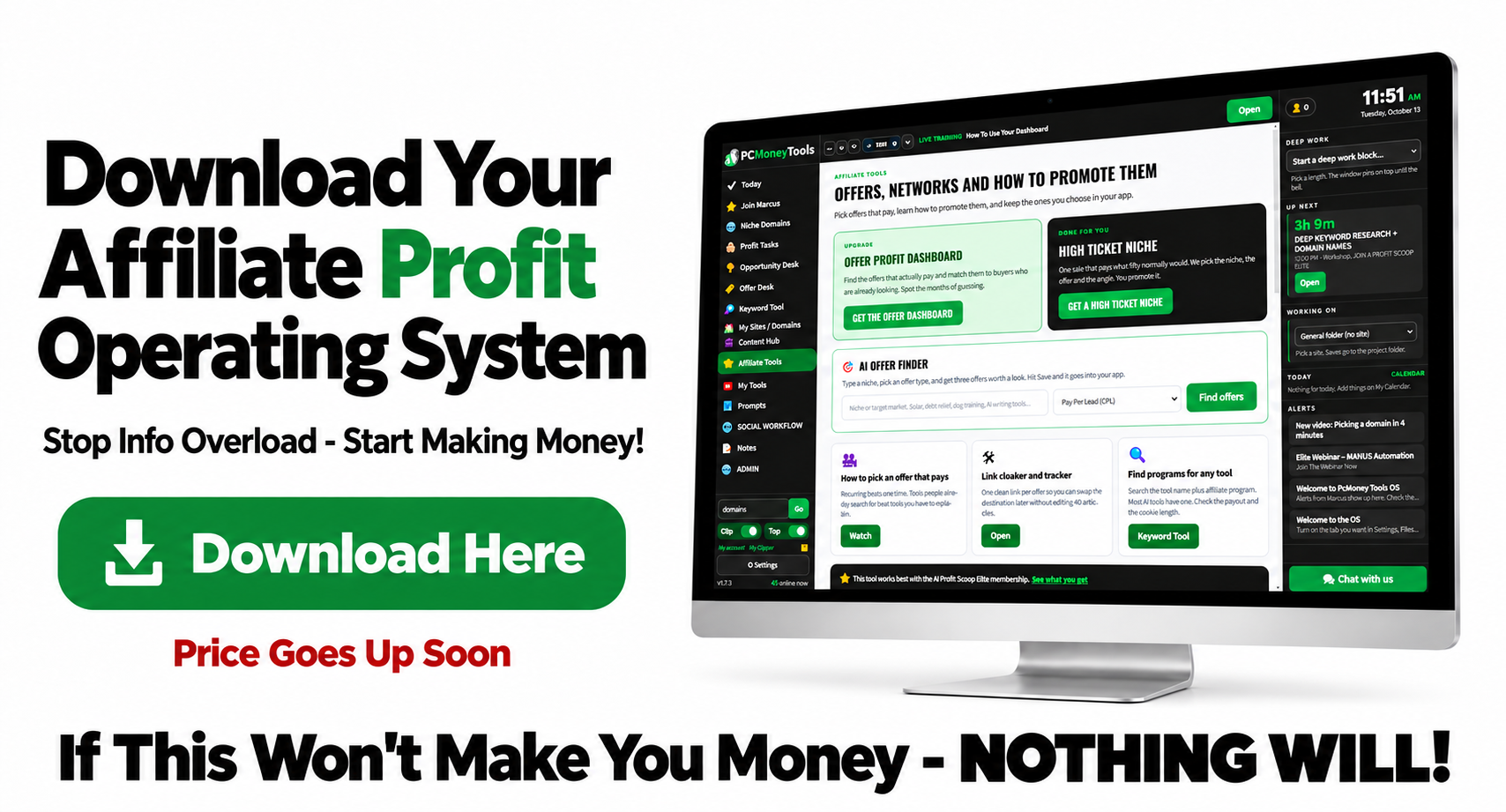
Download Marcus Profit Dashboard Here
Every single day, YouTube’s algorithm serves millions of aspiring entrepreneurs the exact same seductive pitch: “Find a boring utility website, copy it with AI in five minutes, and sit back while it generates $35,000 to $500,000 a month on complete autopilot.”
The videos follow an intoxicatingly familiar formula. A presenter opens their browser, reveals a laughably simple web page—perhaps an unscrambler for word games, a sleep cycle calculator, a basic IP address lookup tool, or an interactive spinning picker wheel—and displays third-party traffic estimates showing millions of visits. Then, they open ChatGPT or an AI code generator, type in a two-line prompt, copy the HTML into a WordPress site, slap on an AdSense banner, and declare that you now possess a turnkey, passive internet empire.
It sounds revolutionary. It feels accessible. And for 99.9% of the people who attempt it, it produces absolutely zero dollars.
Why? Because the surface of a website is not the business. The lines of JavaScript powering a basic calculator or a randomized picker wheel are practically worthless on their own. The true, defensible asset of those massive utility portals is not the software script—it is the accumulated mountain of backlinks, domain authority, organic rankings, brand equity, and entrenched user habits built over a decade or more. When you clone a generic tool, you are not stepping into a goldmine; you are launching a tiny rowboat into an ocean dominated by nuclear-powered battleships.
However, the underlying reality behind these web assets holds a massive, life-changing opportunity—provided you understand how online marketing actually functions. The real money on the internet does not come from building massive, generic utilities that capture broad, unmonetizable traffic. It comes from building tight, 500- to 1,000-word Angle Pages. By taking a specific person experiencing a recognizable moment of friction, giving them a rapid micro-result, and bridging them into a relevant, high-paying direct offer, a simple page receiving a trickle of targeted visitors can vastly outperform a generic clone getting hundreds of thousands of casual impressions.
Let us dismantle the viral “easy copy” claims, examine what the numbers actually reveal, and explore the exact blueprint for engineering high-converting Angle Pages that generate substantial profit.
Download Marcus Profit Dashboard Here
Deconstructing the Viral “Easy Copy” Claims vs. Traffic Reality
To understand why copying surface-level utilities fails, we must first separate stated video claims from observable traffic and monetization dynamics. The table below documents the public claims made across popular viral case studies alongside the third-party traffic reality required to sustain those numbers.
Video Claims, Stated Earnings, and Traffic Scale
- WordUnscrambler.me (Word Utility Tool): Video titles claim revenues between $3,000,000/year to $6,000,000/year. Observable traffic metrics show approximately 30.69 million total visits across a single 90-day tracking window, operating in an intensely saturated niche with deeply entrenched competitors.
- Calculator.net (Multi-Utility Portal): Frequently cited in montage overlays with claimed revenues of $825,000/month. Third-party metrics display a staggering 128.9 million total visits over three months (averaging roughly 42.97 million monthly visits).
- What Is My IP Address (IP Lookup Utility): Claimed earnings cited at $111,000/month. The site commands over 32.12 million visits across a 90-day period, supported by massive network infrastructure and top-tier organic rankings established over two decades.
- HeightComparison.com (Visual Measurement Utility): Publicly touted as earning $60,000/year. Traffic metrics show 6.883 million visits across three months, with peak single-month traffic exceeding 2.365 million visits.
- SleepCalculator.com (Basic Time Utility): Highlighted in case studies as producing $9,000/month. Underlying data shows approximately 4.389 million visits over a 90-day window, averaging roughly 1.4 million visitors every month.
- Yes No Picker Wheel (Interactive Decision Utility): Video presenter estimates revenue at approximately $50,000/month, driven by enormous viral social traffic and casual decision-making queries.
- Angel Match / Investor Hunt / Journalist Hunt (Database Tools): Pitched as a founder-built portfolio producing $32,000/month combined. Traffic tools show roughly 203,771 visits for AngelMatch.io and 69,750 visits for InvestorHunt.co, representing a highly specialized, B2B SaaS directory model rather than a passive ad site.
- Emoji Keyboard / Emoticon Generator: Claimed earnings of $2,500+/month on approximately 630,765 quarterly visits (roughly 210,000 monthly visits), competing against entrenched juggernauts commanding over 35 million visits.
The Core Reality Check: None of these revenue claims reflect verified first-party audits, profit margins, or ad-spend deductions. More importantly, every single one of these sites relies on immense distribution. If you clone Calculator.net or SleepCalculator.com, you do not receive their millions of visitors. You receive zero visitors.
When you look closely at these case studies, a startling mathematical truth appears: these massive, generic websites are generating an astonishingly low revenue per user. Consider the Sleep Calculator generating an estimated $9,000 a month on 1.4 million monthly visitors. That amounts to an effective earnings-per-click (or earnings-per-visitor) of roughly $0.0064—less than two-thirds of a single penny per person.
The entire business model of generic utility sites rests on high-volume programmatic advertising via networks like Google AdSense, Ezoic, or Mediavine. Programmatic display ads pay pennies because the intent of the visitor is almost completely detached from any commercial transaction. A person trying to unscramble seven letters for a game of Scrabble or checking what time to set their alarm clock is not looking to buy a premium product. They want an instantaneous answer, after which they close the tab.
If you build a generic site and somehow manage to claw your way to 10,000 visitors a month—an achievement that takes months of grueling SEO effort for a beginner—a display-ad monetization model at $0.006 per visitor will earn you roughly $60 to $90 for the entire month. You cannot scale a viable business on fractions of a cent unless you already own massive, institutional-grade distribution.
Download Marcus Profit Dashboard Here
The Mathematics of Intent: $0.006 vs. $20.00 Per Visitor
Let us contrast programmatic ad pennies with the mechanics of high-intent direct-response marketing. Years ago, Marcus Campbell tested the emoticon and smiley niche. At the time, millions of users were searching for emoticons, animated smileys, and avatar icons for messaging applications. Countless generic webmasters had built simple image directories and software lookup tools monetized exclusively with Google AdSense. Those webmasters were earning less than a penny per visitor, scraping together modest incomes while burning through massive server bandwidth.
Rather than cloning their generic directories, Marcus introduced a distinct marketing angle. Instead of targeting the generic query “free smileys,” he analyzed the emotional and practical state of the visitor. Who was looking for these graphics? Why did they want them? What specific job were they trying to accomplish?
By tailoring a series of tight 500-word angle pages around specific user desires—such as customizing social profiles, creating personalized avatars, or downloading specialized communication toolbars—he aligned the visitor’s immediate search with high-paying affiliate software downloads and lead-generation offers. While competitors were making $0.005 per click displaying banner ads, Marcus was averaging $0.20 to $1.00+ per visitor. That single strategic shift transformed a niche that paid others pocket change into a business that generated over $1.7 million.
Consider the stark mathematical contrast between a generic clone and an intentional angle site:
- The Generic Clone Approach: You attract 10,000 broad visitors searching for “sleep calculator.” They look at a digital clock, read an automated sentence telling them to sleep at 10:30 PM, ignore the banner ads cluttering the sidebar, and exit. At an average display RPM of $6.00 to $9.00, your monthly earnings total $60 to $90.
- The Intentional Angle Approach: You attract just 1,000 visitors searching for a specific problem: “Why do I wake up tired after 8 hours of sleep?” You provide a 500-word explanation detailing sleep cycle disruption, offer a simple 2-minute diagnostic checklist, and recommend a targeted solution—such as an ergonomic support pillow, a sleep-tracking wearable, or a specialized mattress trial paying a $150 to $400 affiliate commission. If just 2% of those 1,000 visitors purchase, you generate 20 sales. At an average $200 payout, your 1,000 visitors produce $4,000 in revenue.
That is an effective value of $4.00 per visitor compared to $0.006. You do not need millions of visitors when your page is engineered to solve a specific problem with a direct commercial bridge. You need a fraction of the traffic to generate life-changing income.
Download Marcus Profit Dashboard Here
What Truly Happens Behind “Easy Copy” Sites: What the Gurus Never Show
When you watch a video claiming that an AI tool cloned a six-figure website in ninety seconds, several critical business layers are deliberately omitted from the screen capture. If you intend to treat internet marketing as an enduring enterprise rather than an online lottery ticket, you must recognize what sits beneath the surface:
1. The Traffic Bottleneck
Creating a webpage is instantaneous; driving human attention to that webpage is the entire discipline of marketing. A generic tool has no organic search moat. It lacks domain age, authority, backlink profiles, brand search volume, and social indexing. Without an astronomical paid advertising budget or years of SEO momentum, a generic clone simply sits in digital isolation, indexed on page 40 of Google’s search results where no human eye will ever see it.
2. The Offer-Mismatch Fallacy
Many video tutorials advise viewers to “just slap some affiliate links on the page.” But affiliate marketing is not a game of random link placement. If a user visits an online calculator to determine their body mass index (BMI), placing a generic banner link for a luxury watch, an unrelated SaaS product, or a broad “make money online” course will yield a conversion rate hovering near absolute zero. An offer only converts when it represents the exact, logical next step in the visitor’s immediate thought process.
3. Content Homogenization and Low-Value AI Traps
Search engines and consumer algorithms do not reward generic, unedited AI output. When thousands of creators prompt ChatGPT with the exact same instructions to generate an article or tool, the internet is flooded with identical, bland, superficial text. Generic AI content lacks personal insight, real-world data, emotional resonance, and distinct perspective. As a result, search engines filter it out, ad networks reject it as “low-value content,” and users bounce within seconds.
4. The Legal and Practical Hazards of Pure Cloning
There is a vast difference between modeling an underlying business strategy and committing blatant copyright infringement. Marcus Campbell shares an eye-opening historical anecdote regarding a former preaching colleague who visited his home to learn affiliate marketing. Marcus generously explained his exact business model, showed his sites, and detailed his strategy.
The individual returned home, copied Marcus’s website code verbatim—so lazily that he actually left Marcus’s personal name and copyright information in the footer of the site—and launched it. Because the market was young and the angle was incredibly potent, the copied site went on to produce multiple seven figures. Yet, the lesson was not that blatant cloning is an ethical or sustainable business practice; the lesson was that the angle was the only reason the site functioned at all. The HTML markup was irrelevant. What converted was the psychological alignment between the search query and the offer.
Today, search engines, ad networks, and affiliate platforms possess sophisticated plagiarism detection algorithms. Blatantly scraping or cloning an existing platform will result in immediate DMCA takedowns, search de-indexing, and permanent affiliate network bans. You must never copy the surface of a website. Instead, you must reverse-engineer the underlying psychological dynamic: What problem did this site identify, and how can I solve a more specific variation of that problem with far greater relevance?
Download Marcus Profit Dashboard Here
The Little Angle Site Playbook: How 500-Word Pages Actually Make Money
An Angle Page is not an authoritative encyclopedia spanning hundreds of thousands of words. It is not an elaborate software portal requiring a team of full-stack developers. It is a razor-sharp, 500- to 1,000-word direct-response landing page designed around one specific person facing one specific point of friction.
The purpose of an Angle Page is not to rank for the most competitive keyword on the internet. Its purpose is to trigger an immediate, visceral reaction in the visitor: “This specific page was created for my exact situation right now.”
To construct a profitable Angle Page, you must follow the five core components of the Direct-Offer Architecture:
1. The Specific Person
Never write for a generalized demographic like “people who want to lose weight” or “people looking for web hosting.” Instead, identify a granular sub-segment operating under distinct real-world constraints:
- Instead of “fitness enthusiasts,” target “apartment renters who need silent cardio workouts that won’t disturb downstairs neighbors.”
- Instead of “people starting a website,” target “freelance wedding photographers building their first client portfolio.”
- Instead of “car buyers,” target “consumers reviewing a dealer quote to identify hidden, bogus dealer doc fees.”
2. The Stuck Moment
Identify the exact moment of decision, uncertainty, or hesitation your prospect is dealing with today. They are not looking for a philosophical lecture; they are stuck on a practical hurdle. They are asking: “Is this dealer fee legitimate?”, “What should I name my travel blog before I buy a domain?”, or “Why do I wake up exhausted even when I get eight hours of sleep?”
3. The Micro-Result
Before asking for a sale, an email address, or a credit card, deliver an instantaneous, consumable victory within two minutes of arrival. This micro-result can take several simple forms:
- A 5-point evaluation checklist.
- A simple 3-step decision worksheet.
- A short diagnostic quiz.
- A focused mini-calculator or formula.
- A curated list of verified ideas or starter templates.
The micro-result solves the immediate friction point and establishes profound direct-response trust. It proves that you understand their predicament and have the ability to solve it.
4. The Relevant Direct Offer
Once the visitor achieves their micro-result, the offer must appear not as an interruption or an intrusive commercial pitch, but as the mandatory, logical next step to complete their objective. If your page gives them a 10-point checklist for launching a food blog, the immediate, inescapable next requirement is reliable web hosting to put that blog online.
5. The Honest Bridge
Direct response copy succeeds on total transparency. Clearly explain why the recommendation belongs in front of them: “Now that you have mapped out your first ten recipes and verified your blog name, the next practical step is establishing your secure WordPress hosting so you can publish your first dish.”
The Golden Formula: Specific Audience + Urgent Stuck Moment + Instant Micro-Result + Logical Direct Offer = Maximum Revenue Per Click.
Download Marcus Profit Dashboard Here
Three In-Depth Case Studies: From Generic Utility to High-Profit Angle
To see this methodology in action, let us examine three distinct markets where generic websites generate pennies through display ads, and demonstrate how you can transform them into high-converting 500-word Angle Pages.
Case Study 1: The Sleep Calculator Pivot
The Generic Clone Approach: You attempt to build another clone of SleepCalculator.com. The site features an input box asking when you want to wake up, calculates 90-minute REM cycles, and displays suggested bedtimes. To make any meaningful money, you must compete directly with dominant web properties commanding over 4 million visits a month. If you fail to secure top-three Google rankings for broad keywords like “sleep calculator,” your site receives zero visitors and produces zero revenue.
The Keyword Data & Search Intent: When we examine search query data inside professional SEO tools, we discover that users typing sleep-related terms are frequently seeking solutions to a painful, daily physiological problem. Queries like “why do I wake up tired after 8 hours of sleep” generate over 3,400 to 5,700 exact monthly searches with a Keyword Difficulty (KD) score near zero.
The Angle Page Architecture:
- Target Audience: Working professionals who prioritize sleep duration but continually suffer from morning brain fog and exhaustion.
- Stuck Moment: They believe they are doing everything right by sleeping eight hours, yet they wake up groggy and fatigued.
- Micro-Result: A concise 500-word article explaining sleep inertia and REM cycle interruption, paired with an interactive 4-question “Morning Grogginess Diagnostic” that pinpoints whether their issue stems from cycle timing, light pollution, or sleep posture.
- The Direct Offer: Instead of generic AdSense banners paying $0.01, the page introduces high-converting, relevant affiliate partnerships:
- A sleep-tracking wearable app or trial.
- A specialized cooling or orthopedic pillow.
- High-end mattress affiliate programs (e.g., Purple Mattress or similar brands), which routinely pay $150 to $400+ per completed sale.
By capturing visitors at the precise moment they are diagnosing their fatigue, you convert a casual informational search into a high-ticket transaction.
Case Study 2: The Car Dealer “Doc Fee” Calculator
The Generic Clone Approach: A webmaster builds a generic “Auto Loan Calculator.” It contains standard fields for principal, interest rate, and loan term. The user calculates their monthly car payment and immediately leaves. The site is monetized with financial banner ads that pay $0.02 to $0.05 per click, leaving the site owner with negligible earnings.
The Keyword Data & Search Intent: A deeper dive into automotive search queries reveals intense consumer anxiety surrounding dealership transaction costs. Keywords like “what is a reasonable dealer doc fee” and “dealer doc fees by state” receive thousands of highly motivated monthly searches with virtually zero organic competition. In states like Florida, dealer doc fees can exceed $1,000, causing buyers acute stress right before signing paperwork.
The Angle Page Architecture:
- Target Audience: Active car shoppers sitting in a dealership showroom or reviewing a written purchase quote at home.
- Stuck Moment: The dealer has handed them a buyer’s order containing an unexpected $899 or $1,195 “dealer documentation/prep fee,” and the buyer wants to know if they are being scammed.
- Micro-Result: A simple “Dealer Fee Sanity Checker.” The user inputs their state and the quoted doc fee. The tool immediately displays the average legal fee in their state, flags excessive markups, and provides a downloadable 3-sentence negotiation script to challenge the fee.
- The Direct Offer:
- An independent auto-advocate consultation or contract audit service ($49 to $99).
- Direct auto refinancing and pre-approved loan comparison portals (paying $50 to $150 per completed application).
- Extended warranty and mechanical breakdown insurance quote engines that pay massive affiliate bounties.
A user searching for dealer fees is literally holding a pen, preparing to spend $30,000 to $50,000 on a vehicle. A page that saves them $800 in junk fees can effortlessly convert them into a customer for automotive financial services.
Download Marcus Profit Dashboard Here
Case Study 3: The “Start a Travel Blog” Web Hosting Engine
The Generic Clone Approach: An affiliate marketer creates a webpage targeting the broad keyword “best web hosting.” They list Bluehost, SiteGround, and HostGator, write generic feature comparisons, and pray for rankings. Because “best web hosting” is one of the most competitive commercial queries on the planet—with cost-per-click (CPC) bids exceeding $18.00 to $40.00+ per click—the beginner is utterly buried beneath billion-dollar media corporations and tech review conglomerates.
The Keyword Data & Search Intent: Beginners do not wake up in the morning desiring “web hosting.” Hosting is a boring, technical commodity. What beginners desire is an identity and a platform. Queries like “how to start a travel blog” or “how to start a food blog” command tens of thousands of monthly searches with far lower keyword difficulty than technical hosting terms.
The Angle Page Architecture:
- Target Audience: Aspiring travel writers, digital nomads, and vacationers who want to share their journeys and monetize their experiences.
- Stuck Moment: They have travel photos and trip ideas, but they are overwhelmed by technical jargon, domain configurations, and site setups.
- Micro-Result: A 500-word actionable roadmap titled “How to Launch a Travel Blog Before Your Next Trip.” The page includes:
- A 5-point “Pre-Departure Travel Blogger Checklist.”
- An interactive domain name idea generator where they can enter their name and travel style to see immediate, creative blog name suggestions.
- The Direct Offer: A seamless integration with a reliable web hosting platform. Once the user identifies their dream travel blog name via the interactive tool, the page prompts them to register the domain and initialize their WordPress setup via an affiliate link. Web hosting affiliate networks routinely pay $65 to $200+ per qualified sign-up.
By framing web hosting as the natural vehicle to fulfill their creative travel ambition rather than a dry technical purchase, the conversion rate skyrockets.
Download Marcus Profit Dashboard Here
Building the Value Layer with AI: The Step-by-Step Prompting Framework
Artificial Intelligence tools like ChatGPT, Claude, and Gemini should never be used to vomit generic 2,000-word articles that nobody reads. Instead, AI should be deployed as an agile direct-response copywriter and micro-utility developer. You can use AI to build the text, the interactive logic, and the micro-result in minutes.
The Travel Blog Hosting Prompt Sequence
To demonstrate how simple this process is, look at the exact prompt structure demonstrated by Marcus Campbell to build a high-converting advertorial Angle Page:
Sample ChatGPT Prompt:
“I am creating a simple advertorial selling web hosting to people searching for ‘how to start a travel blog.’ Write an easy, high-converting HTML landing page of 500 words or less. Include a practical ‘Before You Start’ checklist, an engaging section on selecting a travel blog focus, and an interactive domain search suggestion box that passes the user’s idea directly to an affiliate hosting link. Keep the tone encouraging, clear, and direct-response focused.”
Within seconds, the AI produces clean, structured HTML containing:
- An attention-grabbing headline: “Want to Be a Travel Blogger? Start With a Place to Tell Your Story.”
- An empathetic hook highlighting the excitement of traveling and documenting experiences.
- A four-step micro-checklist (choosing your focus, defining your audience, planning your first three posts, securing your digital home).
- An interactive HTML input box allowing the prospect to test domain concepts like “MarcusTravels.com” or “WeekendWanderer.com.”
- A bold, high-contrast call-to-action button directing the user to secure their hosting account and lock in their domain name.
This entire asset requires under 400 words of visible text. It loads instantly, functions flawlessly on mobile devices, eliminates confusing navigation menus, and funnels 100% of the visitor’s attention toward a single, high-paying conversion event.
The Five-Question Quality Audit for Angle Pages
Before publishing an Angle Page or driving a single click of traffic, put your concept through this rigorous five-part qualification test. If you cannot answer every question with precision, your angle is too broad and must be refined:
- Who is this page specifically designed for?
Weak: “People interested in cars.”
Strong: “Car buyers reviewing a dealership lease contract who suspect they are being charged an inflated doc fee.” - What exact decision or task are they trying to complete today?
Weak: “Learning about finances.”
Strong: “Determining whether to pay an $899 dealer fee or negotiate it off the final invoice.” - What immediate, useful micro-result does the page deliver in under two minutes?
Weak: “A comprehensive history of automotive financing legislation.”
Strong: “A state-by-state fee comparison matrix and a 3-sentence dealer pushback script.” - What exact commercial offer helps them execute the next logical step?
Weak: “A random banner ad for cheap auto insurance.”
Strong: “A flat-fee car buying concierge service or an independent lease-audit consultation.” - Would the page remain genuinely useful even if the visitor never clicks the offer?
Crucial Test: If the page only provides value when an affiliate link is clicked, it is thin spam. If the micro-result stands on its own as an authentic, helpful asset, search engines will respect it, users will appreciate it, and conversion rates will remain exceptionally high.
Keeping the Value Layer Tiny: Lightweight Formats That Convert
One of the most dangerous traps in internet marketing is overbuilding. Beginners often assume that to make money, they must spend six months coding a massive web platform, recording a 40-module video course, or writing an exhaustive 300-page digital book.
Direct response marketing proves the opposite: the simpler the value layer, the faster the visitor takes action. When a user arrives from a search engine, they do not have the time or patience to digest an overwhelming portal. They want immediate clarity.
Here are eight lightweight value formats that you can build in an afternoon to anchor your 500-word Angle Pages:
- The Single-Page Checklist: A concise, downloadable or on-page list of actionable steps required to complete a complex task (e.g., “The Complete Pre-Closing Mortgage Document Checklist”).
- The Decision Worksheet: A streamlined set of questions that helps the user narrow down multiple confusing options into a clear choice (e.g., “Sole Proprietorship vs. LLC: The 2-Minute Decision Sheet”).
- The Mini-Diagnostic Quiz: Three to five interactive questions that identify the prospect’s primary pain point and present the tailored solution.
- The Single-Formula Calculator: A lightweight JavaScript tool that computes one specific, high-intent equation (e.g., “Apartment Cardio Noise Estimator” or “Dealer Doc Fee Benchmark Calculator”).
- The Curated Prompt Builder: A targeted AI prompt template tailored to help professionals generate an instant business asset (e.g., “The 5-Minute Local Service Landing Page Prompt”).
- The Roadmap Planner: A structured outline that maps out the user’s first week or month in a new endeavor (e.g., “The First-10-Post Travel Blog Content Blueprint”).
- The Direct Comparison Table: A side-by-side evaluation of two or three leading solutions focused entirely on a specific user constraint (e.g., “Best Ergonomic Office Chairs for Lower Back Pain Under $300”).
- The Fill-in-the-Blank Template: A pre-written script, email, or layout that saves the user hours of manual drafting (e.g., “The Overdue Invoice Collection Script Template”).
Every single one of these formats can be generated with AI, formatted cleanly in basic HTML, and deployed on a standard WordPress installation in a matter of hours.
Download Marcus Profit Dashboard Here
The 90/10 Rule of Internet Marketing Success
In business, efficiency is everything. Marcus Campbell frequently highlights the 90/10 Rule of digital monetization:
The 90/10 Principle: In almost every marketing funnel, 90% of the creative and technical effort—designing elaborate logos, tweaking color palettes, writing endless informational blog posts, and setting up complicated social profiles—produces less than 10% of the revenue. Conversely, 10% of the activities—identifying the precise psychological angle, targeting high-intent traffic, and presenting an undeniably relevant direct offer—generates 90% of the money.
When you watch creators chase the latest shiny AI tool to duplicate a massive utility website, you are watching people spend 100% of their energy on the unproductive 90%. They obsess over the calculator script, the CSS layout, the database queries, and the server hosting. They completely ignore the 10% that actually dictates financial survival: traffic intent, psychological relevance, and commercial monetization.
Your objective as a direct-response affiliate marketer is to ruthlessly eliminate the non-essential waste. Strip away the bloated site architectures. Stop trying to outrank billion-dollar corporations for broad, one-word keywords that pay fractions of a penny. Focus your entire operational workflow on finding small, neglected pockets of urgent intent, building tight 500-word Angle Pages that provide immediate clarity, and earning substantial commissions by offering the tools that finish the job.
Download Marcus Profit Dashboard Here
Summary Blueprint: How to Launch Your First Profitable Angle Site
To put this entire strategy into practice today, follow this step-by-step implementation sequence:
- Identify an Established Market: Choose a broad, proven industry with massive commercial activity—such as real estate, web hosting, automotive purchasing, sleep and wellness, personal finance, or software tools.
- Uncover the Overlooked Angle: Use SEO research tools to bypass broad, generic keywords. Drill down into specific problem queries beginning with “how to,” “why do I,” “what is a reasonable,” or “best [product] for [specific constraint].”
- Define the Core Pitch in One Sentence: Complete this foundational positioning statement: “I help [specific person] achieve [specific outcome] when they are stuck on [specific problem].”
- Develop a 500-Word HTML Angle Page: Use AI to rapidly construct a lightweight, high-speed landing page containing an engaging headline, a clear empathetic hook, a 2-minute micro-result (checklist, calculator, or worksheet), and an honest direct bridge.
- Connect a High-Ticket or Direct Affiliate Offer: Choose an affiliate product, SaaS subscription, or lead-generation network that directly solves the problem diagnosed by your micro-result. Ensure the payout provides healthy margins (aim for $50 to $200+ per conversion).
- Test, Measure, and Scale: Track your visitors, click-through rates, and earnings-per-click. If a page earns strong returns, expand into related micro-angles within the same niche. If an angle underperforms, pivot the messaging or adjust the offer until the numbers align.
Stop chasing the illusion of passive copycat riches. Stop building generic websites for everyone, and start building intentional Angle Pages for someone. When you master the art of the angle, the internet stops being an impenetrable wall of competition and becomes an endless landscape of opportunity.
Download Marcus Profit Dashboard Here
One Link = Make Money Online???
Affiliate Marketing Building Blocks: From One Link to a Real Online Business
One Affiliate Link = Money???
Simple question: Can one affiliate link make money?
Short answer: Yes, it can. A person can see your link, click it, take an action that the affiliate program accepts, and you may earn a commission. You do not need a big website, a massive social following, or a complicated funnel before you can start.
Important reality check: a link is not a guaranteed income machine. Most people with affiliate links make little or nothing because they do not get the right people to a relevant offer, do not build enough helpful content, or do not keep improving from real data. This is a business. It takes work, honest recommendations, and consistent testing.
PcMoneyTools.com
FULL COURSE + ADD-ONS + PROMPTS + TOOLS + MORE
The Desktop Software is currently promoted as a $27 one-time purchase and includes a keyword tool, writing tools, prompts, organization features, and more. Always confirm the current offer and details on the site before you publish or recommend it.
The Big Idea: Build One Block at a Time
Do not try to build everything at once. You do not need to buy a bunch of software, launch ten social accounts, make a course, build a giant website, and learn every marketing tactic this week.
Start with the smallest block that can work. Then add the next block when you need the extra benefit it gives you.

- Block 1: Affiliate link. You now have a tracked way to earn when a qualified action happens.
- Block 2: Helpful sharing. You put the link in front of people who are already interested in the problem it solves.
- Block 3: Domain. You control a clean web address that people can remember.
- Block 4: Landing page or website. You have room to explain, answer questions, disclose, and test ideas.
- Block 5: Search and other traffic. Useful pages may attract visitors over time from Google, YouTube, social platforms, forums, direct links, and referrals.
- Block 6: Email list. You can follow up with people who gave you permission to hear from you.
- Block 7: Product you own. You can turn repeated questions into a useful template, tool, guide, workshop, or software product.
Ask these two questions at every step:
- What can I do with the block I have now?
- What does the next block let me do?
Block 1: The Affiliate Link
An affiliate link is a special link supplied by a company or affiliate network. It takes a visitor to a product or offer, and it includes tracking information so the program can tell that the visitor came from you.

Simple example:
https://company.com/product?ref=your-name
- https://company.com/product is where the person goes.
- ?ref=your-name is an example of the tracking part.
- The exact format varies by program. Use the link generated inside your own affiliate dashboard.
How the money flow works
- A person has a real question or problem.
- You create a useful answer, demo, comparison, checklist, or recommendation.
- They choose to click your affiliate link.
- The company or network tracks the visit according to its own rules.
- If a qualified action happens, the program may credit a commission to you.
A click is usually not a commission. The program may require a sale, a free trial, an application, a completed lead form, a phone call, a download, or another action. The program also decides when a commission is approved and when it is paid.
Common ways affiliate programs pay
- Sale / revenue share: You earn when a customer buys. The commission can be a percentage or a flat amount.
- CPA: Cost per action. You earn when the person completes a specific accepted action.
- CPL: Cost per lead. You may earn when a person submits a qualified form or request.
- Cost per call: Some offers pay for a qualified phone call.
- Recurring commission: Some programs pay again while an eligible customer keeps paying for a subscription. Read the exact terms. It is not automatic forever.
Cookie duration: why the timing matters
A cookie duration is the time window the affiliate program may use to connect a later action back to your link. One program may allow only a short period. Another may allow a longer period. Some programs have additional rules, exclusions, or attribution rules. Do not assume every click will be credited to you.
Affiliate disclosure: say it clearly
Tell people when you may earn from a recommendation. Put the disclosure where people can notice it before or near the recommendation. The U.S. FTC says disclosures should be clear and conspicuous; platform rules and laws may differ by location.
Simple disclosure examples:
- Affiliate link: I may earn a commission if you buy through this link, at no extra cost to you.
- Some links on this page are affiliate links. If you buy through them, I may earn a commission.
- I may be compensated if you use this link. I only recommend it because it may fit the situation described here.
Do not hide the relationship. A disclosure page by itself may not be enough when a recommendation appears elsewhere. Check the affiliate program’s rules, the platform’s rules, and the laws that apply to you.
Quick questions about one affiliate link
Can one affiliate link make money?
Yes. It can make money when a relevant person clicks, completes the program’s required action, and the action is approved. That does not mean it will make money without traffic, trust, or effort.
Can an affiliate link rank in Google?
A bare tracking URL is not the useful page you are trying to rank. Google generally discovers, understands, and shows pages. Create your own helpful page that answers a question, then use the affiliate link as a relevant next step.
Can you make passive income with just one affiliate link?
A piece of content can keep sending clicks after you publish it, which is why people call some affiliate income “passive.” But it is not hands-off or guaranteed. You still need to check the program, update old information, maintain links, follow rules, and keep attracting the right people.
Do I need a website before I share a link?
No. You can start with a properly disclosed link in a place where sharing is welcome. A website becomes useful when you want more control, more explanation, a clean brand, an email opt-in, search traffic, or a place to update old links.
First action checklist
- Pick one product you understand or can research responsibly.
- Read the program’s commission rules, link rules, payment timing, prohibited traffic methods, and disclosure requirements.
- Generate the link from your own dashboard.
- Click-test it in a private browser window if the program allows testing.
- Write one short disclosure you can use consistently.
- Create one useful answer for one person with one problem.
Glossary terms for this section
- Affiliate link: A special tracking link that can identify you as the source of a visitor.
- Affiliate program: The company system that gives you links and decides what commissions qualify.
- Affiliate network: A platform that can manage affiliate offers for many companies.
- Commission: The payment you may receive when the program accepts a qualified action.
- Qualified action: The exact event the program says counts, such as a sale, lead, trial, or call.
- Cookie duration: The tracking window a program may use after someone clicks your link.
- Disclosure: A clear statement that you may earn from a recommendation.
Block 2: Put the Link in Helpful Context
A link can live in a forum reply, a social post, a video description, an email, a resource page, a direct message, or your own website. The better question is not, “Where can I drop a link?” The better question is, “Where is someone already trying to solve the problem this product helps with?”

The simple content pattern
- Start with a helpful idea. Answer one small question.
- Show small proof. Use a demo, checklist, example, comparison, screenshot, or personal experience that you can honestly stand behind.
- Give a relevant next step. Offer the product, tool, page, guide, or resource only if it fits.
- Disclose. Make it clear that you may earn from the link.
Example: a beginner stand mixer post
- Hook: “Buying your first stand mixer? Check these four things before you pay for the biggest model.”
- Helpful idea: Explain bowl size, storage space, dough needs, and how often the person will use it.
- Small proof: Show a short comparison or demonstrate the exact feature you are talking about.
- Next step: “I put my beginner checklist and the option I would consider here: [YOUR LINK].”
- Disclosure: “Affiliate link — I may earn a commission if you buy.”
Places a link can work
- Forums and communities: Answer the question first. Follow the group rules. Add a link only when it is allowed and truly useful.
- Social media: Use posts, short videos, carousels, demos, lives, and profile links to teach one small thing.
- Video descriptions: Put the full context in the video and use the description for the next step, disclosure, and supporting resources.
- Email: Send useful content to people who asked for it. Do not scrape addresses or add people without permission.
- Your website: Use a landing page, guide, review, comparison, resource page, or tool to give the recommendation more context.
Four content angles that are easy to make
- Beginner question: “Do I need the expensive version?”
- Mistake to avoid: “Do not buy based only on the biggest number in the product description.”
- Quick checklist: “Four things to check before choosing [PRODUCT].”
- Simple comparison: “Which option is better for a beginner, and which is better for a heavy user?”
Best beginner rule: If you removed the affiliate link, would the post still help someone? If the answer is no, make the answer better before you publish it.
Do not spam. Do not post off-topic links, create fake accounts, buy followers, scrape emails, or ignore self-promotion rules. Spam may create a short burst of clicks, but it destroys trust and can get accounts, links, or programs shut down.
Glossary terms for this section
- Forum: An online community where people ask questions and share information.
- Hook: The first line or first seconds that make the right person want to continue.
- Caption: The text that goes with a social post or image.
- Carousel: A social post with several swipeable images or slides.
- Demo: A short showing of how something works or what it looks like in use.
- CTA: Short for call to action. It tells a person what to do next.
Block 3: Pick One Person, One Problem, and One Product
Most beginners make the same mistake: they try to promote everything to everyone. They see a hundred products and assume more products means more money. Usually it creates fragmented content, a confused audience, and no clear reason for anyone to trust you.
Focus is a superpower at the beginning.
- One person: Who are you trying to help?
- One problem: What are they trying to solve right now?
- One product or product category: What can help them solve it?
- One honest reason: Why could it be a good fit?
- One honest limit: Who is it not right for?
Fill-in-the-blank positioning statement:
“I help [SPECIFIC PERSON] who want to [SPECIFIC RESULT] without [SPECIFIC FRUSTRATION].”
Example: “I help new home bakers choose a first stand mixer without overspending or buying something too large for their kitchen.”
This sentence gives you a starting point for your videos, posts, pages, email lead magnet, search articles, and product ideas.
Congruence matters. If a person is reading a thread about training a dog, a random offer about unrelated software is out of place. If you first answer the dog-training question, then recommend a relevant product or resource with disclosure, the recommendation makes more sense.
Glossary terms for this section
- Audience: The specific group of people you want to help.
- Niche: A focused topic or group, such as first-time home bakers instead of everyone who cooks.
- Product category: A type of product, such as stand mixers, email tools, or beginner courses.
- Good fit: A person or situation the product is likely to help.
- Honest limit: A reason the product may not be right for someone.
Block 4: Add a Domain and Control the Front Door
A domain is the web address you control, such as yourguide.com. Buying a domain does not automatically create a website. It gives you a name that can point to a redirect, a landing page, a content site, or something you build later.

Think of a domain as the sign on the door. An affiliate URL can be long and hard to remember. Your own domain can create a cleaner path and give you more control if an affiliate program changes its links later.
Your three simplest domain choices
- Use a redirect. Your clean domain or short path sends visitors to an approved affiliate URL. This can work when your content already explains the product.
- Build one landing page. Use one page to explain an offer, answer objections, disclose the relationship, and direct the right person to the next step.
- Build a content site. Use WordPress or another content management system when you want several pages, a blog, search visibility, lead magnets, tools, and a growing library of answers.
Important redirect rules
- Read each affiliate program’s linking rules before using a redirect or link-cloaking method.
- Some programs may not allow certain redirects, URL shorteners, emails, paid ads, brand-name keywords, coupons, or other traffic methods.
- A redirect does not remove the need for a clear affiliate disclosure.
- A redirect is useful for a clean address. It is not the same as a helpful page that can answer a search question.
New domain, auction domain, or existing site?
New domain: A clean start. You choose the name, brand, topic, content, and structure. You also start with no audience, no history, and no built-in traffic.
Auction or expired domain: A previously owned name that may have relevant history, old links, or existing visitors. It can also have irrelevant history, spam, trademark issues, weak links, or problems you cannot see at first glance.
Existing content site or business: A purchase that may include a domain, content, brand, traffic, systems, customers, or social profiles. You must confirm exactly what is being sold and what rights transfer.
Five boring checks that can save serious trouble
- Topic and brand fit: Does the old name fit the audience you actually want to serve? Check for obvious trademark conflicts.
- History: Look at past versions of the site, old pages, and why the domain expired or the site is for sale.
- Real signals: Ask for real evidence of traffic, revenue, costs, audience, and conversion sources. Do not trust a single third-party score.
- Link and content quality: Look for real references and useful content, not obvious spam, copied content, paid-link patterns, or unrelated traffic.
- Transfer details: Confirm what changes hands: domain, hosting, content rights, analytics access, email subscribers, customer data, support obligations, and social accounts.
Why relevance matters: If a former garden-tools site becomes a better garden-tools resource, that can make sense to visitors. If an unrelated site becomes a thin affiliate site mainly to chase rankings, that can damage trust and violate Google’s spam policies.
Quick questions about domains
Does a new domain automatically rank?
No. A domain is an address, not a ranking button. Google may discover and process pages on a site, but it does not guarantee crawling, indexing, or ranking.
Can a redirect rank in Google?
A redirect sends people and search engines to another destination. It may be useful for a clean link, but it is not a replacement for a useful page of your own.
Are expired domains a shortcut?
Not a safe shortcut. Buy relevance and brand fit, not a fantasy that old age or old backlinks guarantee rankings. Rebuild for the same or a closely related audience with genuinely useful content.
Glossary terms for this section
- Domain: Your main web address, such as yourguide.com.
- URL: The full web address for a specific location, such as yourguide.com/tool.
- Registrar: The company where you register and renew a domain.
- Hosting: The online service that stores website files and makes them available on the internet.
- Redirect: A setting that sends one URL to another URL.
- Backlink: A link from another site to a page on your site.
- Due diligence: The checking you do before buying something so you know what is real and what you are receiving.
Block 5: Build a Simple Landing Page
A landing page is simply a page a person lands on. It can be a page about one product, a free guide, an email opt-in, a comparison, a tool, a thank-you page, or an offer. You do not need a huge funnel to use one.
Landing pages work because they give you more room than a single social post. You can explain the situation, make the right person feel understood, show why the product may help, answer honest objections, add your disclosure, and offer a next step.
Simple landing page structure
- Headline: Say what the page helps the visitor do.
- Who it is for: Help the right person recognize themselves.
- The problem: Show that you understand the frustration or goal.
- Useful answer: Explain the core information in clear language.
- Proof or example: Show a demo, checklist, comparison, or experience you can honestly support.
- Honest limits: Explain who should not choose this option.
- Next step: Give a clear action, such as “See current details,” “Get the checklist,” or “Compare the options.”
- Disclosure: Make the affiliate relationship clear near the recommendation.
Simple landing page outline to adapt
Headline: [PRODUCT] for [TYPE OF PERSON]: A Simple Beginner Guide
Affiliate disclosure: Some links on this page are affiliate links. If you buy through them, I may earn a commission at no extra cost to you.
Is this for you?
This is for [PERSON] who wants to [RESULT] without [COMMON FRUSTRATION].
What does it do?
In simple terms, [PRODUCT] helps you [MAIN JOB].
Why might it fit?
- It may help with [BENEFIT 1].
- It may be useful when [SITUATION].
- It may be easier for [TYPE OF USER].
It may not be right for you if:
- You need [DIFFERENT NEED].
- Your budget is [CONSTRAINT].
- You need [FEATURE / SERVICE] that this product does not provide.
Next step:
If this sounds like your situation, see the current details here: [AFFILIATE LINK].
Use different angles for the same offer
One product may solve several real problems. Instead of making one generic page, create useful pages that match the reason someone is searching or watching.
- “How to choose a [PRODUCT] for [SPECIFIC USE].”
- “Is [PRODUCT] worth it for [TYPE OF PERSON]?”
- “[PRODUCT] vs. [ALTERNATIVE]: what is the actual difference?”
- “How to solve [PROBLEM] without [COMMON FRUSTRATION].”
- “The beginner checklist before you buy [PRODUCT].”
Do not make dozens of thin pages that say almost the same thing. Make each page answer a different real question.
Glossary terms for this section
- Landing page: A focused page that gives a visitor one clear next step.
- Recommendation page: A landing page that helps someone decide whether one product fits.
- Headline: The main first line that says what the page is about.
- Objection: A reason someone may hesitate, such as price, fit, time, or risk.
- CTA: The button or sentence that tells the visitor what to do next.
- Conversion: When a visitor completes the action you wanted, such as clicking, opting in, or buying.
Block 6: Build Helpful Content and Get Search Traffic
SEO means search engine optimization. In plain English, it means making useful pages that people and search engines can understand. The goal is not to trick Google. The goal is to give a person the best useful answer for the exact problem they searched for.
Google uses automated systems to discover pages, process them, and choose results it believes are relevant and useful for a specific search. There is no one secret score, no honest guaranteed position, and no fixed timeline. A helpful page can still take time to be discovered, indexed, and shown.
Google basics in plain English
- Crawling: Google’s systems discover and visit pages.
- Indexing: Google tries to understand the content and may add information about it to its database.
- Ranking: For a specific search, Google chooses results it believes are relevant and useful. Rankings can change.
Google ranks pages, not a bare affiliate URL. Your job is to build a page worth showing to a person who asked a real question.
Find questions before you make content
Look for questions in:
- Google suggestions and related searches.
- Search results and the questions people ask in forums.
- Video comments, product reviews, social replies, and customer questions.
- Your own email replies, sales calls, chat messages, and support questions.
- Keyword tools, including the keyword tool inside PcMoneyTools if it fits your workflow.
Do not start by trying to rank for the biggest possible phrase. “Best home security cameras” may be hard because large established sites compete for it. A more focused question such as “security camera without monthly subscription for renters” may better match a specific person and a specific problem.
The helpful-content formula
- Start with the real question. What is the person trying to learn, compare, fix, or buy?
- Give the short answer early. Do not make the reader hunt for the main point.
- Explain with examples. Use simple steps, specific use cases, photos, screenshots, demos, or comparisons.
- Include honest limits. Show who this advice is not for.
- Give a relevant next step. Add a product recommendation only when it naturally helps.
Quick rank tips
- Make one page answer one real question. Do not try to answer everything in one vague page.
- Write a clear, accurate title. The title should explain what the page contains, not bait people with a promise you cannot support.
- Use natural language. Do not repeat the same keyword until the writing sounds strange. Keyword stuffing is not a long-term strategy.
- Use helpful headings. They make a page easier to scan for people and easier to understand for search engines.
- Add original value. Include real examples, clear explanations, a comparison, a process, or firsthand experience when you have it.
- Link related pages together. Use internal links that tell the visitor where they are going.
- Keep the page current. Update old facts, broken links, prices, and product details.
- Make the site easy to use. It should load reasonably, work on phones, and let people find the main answer without fighting pop-ups or clutter.
- Mark paid relationships properly. If you control the HTML, Google recommends using
rel="sponsored"for paid or affiliate-style outbound links. This does not replace a clear disclosure.
Quick questions about SEO
Can an affiliate page rank?
Yes, when it provides useful value beyond a copied product description. Build original context, answer the question, explain the fit, add examples, show limits, and make the next step relevant.
Will a domain name by itself rank?
No. A domain is not a magic ranking object. Individual pages need useful content, clear structure, and a chance to be discovered and understood.
How long does SEO take?
There is no honest fixed answer. You may see nothing at first. The practical approach is to publish helpful pages, watch what gets impressions and clicks, improve the pages that show early signs of interest, and keep building around real questions.
Do I need to write thousands of articles?
No. Start with a small set of genuinely useful pages that fit the same audience. A focused library is better than hundreds of disconnected pages with no useful purpose.
WordPress site structure for a beginner
- Home page: Who you help and what problems you cover.
- Start here page: A simple path for new visitors.
- One recommendation page: A clear decision guide for one relevant offer.
- Three answer articles: Three real questions your audience asks.
- About page: Who is behind the site and why you cover the topic.
- Disclosure page: Your affiliate relationship and how recommendations work.
- Privacy and contact pages: Important when you collect email addresses, use forms, or operate as a real business.
Glossary terms for this section
- WordPress: Website software that helps you create and edit pages and posts.
- SEO: Search engine optimization. Making pages easier for people and search engines to understand.
- Keyword: A word or phrase someone types into a search engine.
- Search intent: What a person really wants to do with their search: learn, compare, buy, or solve a problem.
- Organic traffic: Unpaid visitors who find you through search, links, or other natural discovery.
- Internal link: A link from one page on your site to another page on your site.
- Indexing: When a search engine processes a page and may store it in its database.
Block 7: Build an Email List With Permission
Social posts disappear. Search traffic can change. An email list gives you a direct way to help people again after they choose to hear from you. The important word is choose.

Do not build a list so you can blast links. Build a list so you can keep delivering useful help to people who asked for it.
How a simple email list works
- Someone reads a helpful post, watches a useful video, or visits a page.
- You offer a lead magnet that solves a quick first problem.
- The person opts in with clear permission.
- You deliver exactly what you promised.
- You send helpful follow-up content.
- When appropriate, you send them to a useful page or relevant offer with disclosure.
Lead magnet ideas
- Buyer checklist: “The 7 things to check before choosing your first [PRODUCT].”
- Quick starter plan: “A 20-minute setup checklist for [RESULT].”
- Template or swipe file: “Copy-and-paste questions to ask before hiring a [SERVICE].”
- Comparison worksheet: “Which option fits your situation?”
- Mini tool: A simple chooser, calculator, or quiz that helps a visitor decide what to consider.
- Content collection: A well-organized guide that collects your best tips, videos, checklists, or prompts in one place.
Your first five emails can be simple
- Deliver the resource. Thank the subscriber and give them exactly what they requested.
- Teach one useful idea. Help them get a quick win from the resource.
- Explain a common mistake. Show them how to avoid wasted time, money, or confusion.
- Answer a common question. Invite a reply so you learn what people need next.
- Make a relevant recommendation. If you send someone to an affiliate offer, explain why it fits, what its limits are, and disclose the relationship.
Permission and compliance
- Do not buy, scrape, or secretly add people to an email list.
- Tell people what they are signing up to receive.
- Use an email service provider that can record consent and handle unsubscribes.
- Use accurate sender information and subject lines.
- Include a valid postal address and a clear way to opt out when required.
- Honor unsubscribe requests promptly.
- Check the privacy, consent, and marketing laws that apply where you and your audience operate.
Glossary terms for this section
- Email list: A group of people who gave permission to hear from you by email.
- Subscriber: A person who joined your email list.
- Opt-in: The action of choosing to join a list and agree to receive messages.
- Lead magnet: A useful free resource that gives someone a reason to opt in.
- Email service provider: The tool that stores your list and sends your emails.
- Unsubscribe: The link or method a person uses to stop receiving marketing emails.
Block 8: Create a Product You Own
Affiliate marketing is useful because it teaches you what people are already trying to buy and where they get stuck. Over time, repeated questions can point to a useful resource or product you can create yourself.
Do not start by building a giant course just because people say courses make money. Start with the smallest useful solution to a real repeated problem.
Small first product ideas
- A checklist.
- A spreadsheet.
- A template.
- A prompt pack.
- A simple buyer guide.
- A workshop or short training.
- A small calculator or chooser tool.
- A small software utility.
For example, if people repeatedly ask how to choose a product, make a comparison worksheet. If they keep asking what to post, make a content-angle template. If they need help entering a specific piece of information, make a small guided tool.
Own the relationship, not just one link
A domain, useful content, email list, product, and customer relationship give you more choices than a single affiliate program. Programs can change commission rates, cookie rules, allowed traffic methods, links, products, and payment timing. Your own audience trust and useful assets are more durable.
Keep the offer honest
- Say exactly what the buyer receives.
- Explain who it is for and who it is not for.
- Do not make income claims or outcomes you cannot support.
- State the price, support terms, access terms, and refund policy clearly.
- Build something useful enough that you would be comfortable standing behind it after the sale.
Glossary terms for this section
- Offer: What you are asking someone to say yes to: a product, service, workshop, or solution.
- Digital product: Something delivered online, such as a guide, template, course, tool, or software.
- Template: A ready-to-use starting document or file someone can adapt.
- Workshop: A focused live or recorded teaching session.
- Customer: A person who buys your own product or service.
- Refund policy: The clear rules that explain when and how a buyer can request a refund.
Use AI as a Fast Helper, Not as the Expert
AI can help you brainstorm, organize ideas, create drafts, clean up writing, make outlines, create simple pages, and build small tools. It can also be wrong, generic, out of date, or extremely confident about something it made up.
Use AI for speed. Use your own judgment for truth.

The five-step AI workflow
- Give AI a clear job. State the audience, goal, product, tone, facts you know, and limits.
- Get a draft or ideas. Use AI to reduce blank-page time, not to invent expertise.
- Check it. Verify every claim, price, feature, rule, statistic, link, and product detail.
- Make it yours. Add your own examples, real experience, point of view, images, screenshots, and limits.
- Publish carefully and learn. Watch what people ask, click, save, or ignore. Improve from the data.
Prompt: find content ideas
I help [SPECIFIC AUDIENCE] who want to [SPECIFIC OUTCOME]. They are beginners and are confused about [SPECIFIC PROBLEM]. Give me 20 simple questions they may type into a search engine or ask on social media. Group them into: buying, using, comparing, and mistakes to avoid. Do not invent facts or recommend products yet.
Prompt: build an article outline
Create a plain-English outline for an article titled: "[TITLE]." Audience: [AUDIENCE]. Goal: answer the question clearly before mentioning any product. Include a short opening answer, 4 to 6 useful sections, examples, honest limits, who the advice is not for, and a neutral conclusion. Do not use hype, income claims, or invented facts.
Prompt: find objections before you make a page
My audience is [AUDIENCE]. I am considering a page about [PRODUCT OR SOLUTION]. List 15 honest questions or objections a careful buyer may have. Group them by cost, fit, setup, trust, alternatives, and limitations. Do not answer with product claims unless I provide them. Tell me what details I should verify with the company first.
Prompt: improve your own writing
Edit the draft below for clarity at about an eighth-grade reading level. Keep my meaning. Do not add facts, promises, product specifications, testimonials, or results that are not already in the draft. Show the revised version, then list every claim I should verify. [PASTE DRAFT]
AI safety checklist
- Verify prices, product features, policies, affiliate-program rules, and availability.
- Do not publish invented reviews, fake screenshots, fake testimonials, or unsupported claims.
- Do not let AI write a medical, legal, financial, or regulated recommendation without qualified review.
- Do not use AI to create thin pages that only exist to chase rankings.
- Read the final content out loud. If it sounds generic, overly certain, or unlike you, improve it.
Glossary terms for this section
- Prompt: The instructions and context you give an AI tool.
- Draft: A first version that still needs review and improvement.
- Context: The useful background that helps AI understand the audience, goal, voice, and limits.
- Fact check: Confirming a claim is accurate before you publish it.
- Hallucination: When AI gives information that is made up, mistaken, or unsupported.
Use AI to Build Tiny Useful Tools
Vibe coding means describing what you want in normal language and using AI to help create or change code. For a beginner, the best first project is small: a tool that helps the same person with the same problem you already talk about.
Good first tool ideas
- A buyer checklist.
- A simple chooser quiz with three to five questions.
- A comparison table.
- A budget calculator.
- A content-idea generator based on your niche.
- A setup worksheet.
- A simple prompt helper.
Make the tool useful even if there is no affiliate link. The link should be an optional next step, not the reason the tool exists.
Simple vibe-coding prompt
Build a simple, mobile-friendly one-page tool for [AUDIENCE]. The tool helps them [SMALL JOB]. Include: a clear headline, a short explanation, [NUMBER] simple inputs or checklist items, a helpful result or next-step section, a clearly marked place for an affiliate disclosure, and no sign-in, payment, tracking, or collection of personal data. Use plain English and accessible labels. Keep the design clean and easy to test.
Test before you publish
- Phone test: Does it work on a small screen?
- Click test: Do buttons and links work?
- Truth test: Are all claims accurate and not misleading?
- Disclosure test: Can a visitor see the affiliate relationship before acting on it?
- Helpful test: Would the tool still help someone if there were no affiliate link?
- Privacy test: Are you collecting any information? If yes, what do you collect, why, where is it stored, and what policy applies?
Glossary terms for this section
- Vibe coding: Describing a small web tool or page in normal language and using AI to help build the code.
- Code: Instructions that tell a website or tool how to work.
- Input: Something a visitor enters or selects, such as a number, answer, or checkbox.
- Mobile-friendly: Designed to work well on a phone as well as a computer.
- User test: Watching a real person try a page or tool so you can see what is confusing.
- Accessibility: Making a page or tool easier for more people to use, including people using keyboards or assistive technology.
Your First 30 Days: Build Small, Publish, Listen, Improve
You do not need to unlock every block on day one. Use the smallest block that is appropriate for where you are now. The goal is not to look busy. The goal is to make a real improvement every week.
Week 1: Pick the lane and set the foundation
- Choose one audience, one problem, and one product category.
- Find one affiliate program and read its terms.
- Create one disclosure statement.
- Write down 20 questions your audience may ask.
- Create one helpful answer or short demo.
- If you are serious about the topic, consider registering a relevant domain.
Week 2: Build one clear path
- Publish one helpful social post, video, forum answer, or article.
- Create one simple landing page, guide, or clean approved redirect.
- Make sure your affiliate disclosure is clear.
- Click-test every link.
- Write down what people ask or where they get confused.
Week 3: Publish useful content
- Publish three helpful pieces of content around the same audience and problem.
- Turn one piece into a fuller guide or article on your site.
- Link related content together.
- Make one optional lead magnet if you are ready to build a list.
Week 4: Improve from the evidence
- Look at what was viewed, clicked, saved, replied to, or ignored.
- Fix unclear wording, broken links, weak explanations, missing disclosures, or confusing calls to action.
- Create one answer based on the best question you received.
- Build one small checklist, worksheet, template, or tool if it solves a repeated problem.
Keep a tiny scorecard
- Content published: What useful assets did you make this week?
- Questions collected: What are people actually asking?
- Clicks: If your program reports them, are people interested in the next step?
- Sign-ups: Are people choosing to get your guide or emails?
- Sales or qualified actions: Are the right people taking the action?
- Problems found: What needs to be fixed or explained better?
- Next experiment: What one small thing will you test next?
Build small. Publish. Listen. Improve. Repeat.
Final Cheat Sheet
- Help a real person with a real problem.
- Start with one affiliate link that is generated from your own affiliate account.
- Recommend only products that genuinely fit and that you can discuss truthfully.
- Tell people clearly when you may earn a commission.
- Share where people expect useful help: communities, social posts, videos, your site, and permission-based email.
- Do not spam.
- Use a domain, redirect, page, or WordPress site only as much as you need right now.
- Build your own page before relying on a bare affiliate link for long-term traffic.
- Google can rank helpful pages. It does not guarantee rankings for a domain name, a redirect, or a bare tracking link.
- Choose a new, auction, or existing site based on relevance and real evidence, not a promise of instant rankings.
- Build an email list with a useful lead magnet and clear permission.
- Use repeated questions to guide your first product or tool.
- Use AI for speed, then check every claim with your own judgment.
- Keep the business simple enough to understand: person, problem, helpful answer, next step, data, improvement.
Sources and Important Rules
This training is educational and is not legal, tax, privacy, financial, medical, or income advice. Follow the rules, platform policies, affiliate-program terms, disclosure requirements, privacy rules, and marketing laws that apply to you and your audience.
- FTC: Disclosures 101 for Social Media Influencers
- Google Search Central: How Google Search Works
- Google Search Central: SEO Starter Guide
- Google Search Central: Spam Policies
- Google Search Central: Qualify Outbound Links
- FTC: CAN-SPAM Act Compliance Guide
Next step: Choose one person, one problem, and one product. Then publish one genuinely useful answer this week.
Use This To Make Money Daily
CLICK HERE TO GET THE MONEY DASHBOAD
AI Money Dashboard: Simple Notes, Daily Plan & Focus Checklist
The short version: AI is useful when it helps you complete the few actions that create real business movement—publishing an offer, getting attention, following up, and improving conversion. It is not a substitute for choosing a customer problem, doing the work consistently, or building trust.
The Core Idea: Do the Work That Moves the Business Forward
It is easy to mistake activity for progress. Watching another video, testing another AI tool, reorganizing a website, checking statistics, or redesigning a logo can feel productive. But those tasks do not automatically create leads, clicks, customers, or revenue.
The better question is:
What is the next small action that helps a real person find, understand, trust, or buy from this business?
That action is the “money move.” A dashboard is meant to make the next money move visible, easy to start, and easy to repeat.
1. Separate Busy Work From Money Work
Busy work can be necessary, but it is not the first priority when you need traction. It includes work that keeps you occupied without directly improving reach, response, leads, or sales.
- Changing colors, fonts, or logos again.
- Opening new accounts or buying another course before using what you have.
- Researching endlessly instead of publishing or contacting people.
- Refreshing analytics without making a decision from the data.
- Starting a new site, niche, or project before the current one has a fair chance.
Money work is the activity that creates a measurable business opportunity. Examples include:
- Publishing a helpful page, article, video, or offer.
- Improving a page so visitors can clearly understand the next step.
- Sending a useful email or follow-up to an opted-in audience.
- Promoting a relevant resource where the right people can discover it.
- Talking to a prospective customer or responding to a real buying question.
- Testing a clear call to action, then tracking the response.
Use a simple filter before adding something to today’s list: Will this reasonably help create a lead, click, customer conversation, sale, or useful learning signal this week? If not, park it in your notes and return to the priority.
CLICK HERE TO GET THE MONEY DASHBOAD
2. Find the Small Share of Work That Creates Most of the Results
In most businesses, a relatively small group of actions produces the largest share of useful results. Your job is not to do everything; it is to identify and protect those actions.
- Review the last two weeks of work.
- List the actions that produced an actual lead, click, reply, sale, or meaningful lesson.
- Circle the two or three actions that mattered most.
- Schedule one of those actions before lower-value tasks each day.
- Repeat until you have enough data to improve the process.
For a content-led business, this may mean publishing one useful resource, distributing it to a relevant audience, and reviewing the resulting clicks. For a service business, it may mean making follow-ups, sending proposals, and delivering excellent work. The exact task changes; the principle does not.
3. Cut First, Then Automate
Automation cannot rescue an unfocused process. Before handing a task to AI or software, decide whether the task belongs in the workflow at all.
- Cut: Remove steps that do not serve the customer or the business goal.
- Clarify: Write down the few steps that do work.
- Standardize: Use the same basic checklist, prompt, template, or naming system.
- Automate the repeatable parts: Use AI for first drafts, idea organization, outlines, summaries, checklists, and routine research support.
- Keep human judgment: You still choose the market, check facts, protect your reputation, and decide what is actually helpful.
A useful rule is the Rule of Three: do something once and simply complete it; do it twice and write down the steps; do it three times and consider a template, shortcut, or automation.
4. Build a Plan You Can Open Every Morning
Motivation is unreliable. A visible operating plan reduces the time spent asking, “What should I work on?” The goal is one place that holds your current priority, key links, tasks, and reminders.
Your daily dashboard or operating page should answer five questions in under a minute:
- What is my one most important move today?
- What is the smallest next step to start it?
- Where are the tools and links I need?
- What needs follow-up or has a deadline?
- What did I complete yesterday?
Keep the dashboard practical. It should help you start work, not become another project to redesign.
5. The One-Move Rule
Choose one primary action for the day that supports one active business goal. Do not make the dashboard a list of fifty priorities.
Examples of a good one-move statement:
- “Publish the comparison article and add a clear, honest call to action.”
- “Send the weekly helpful email to my subscribers.”
- “Create and publish one short video that answers a buyer’s question.”
- “Follow up with five qualified leads who already asked for information.”
- “Fix the broken link and simplify the sign-up step on the offer page.”
A good one move is specific, achievable in the available time, and connected to a real business objective. It is not “work on my business” or “learn AI.”
CLICK HERE TO GET THE MONEY DASHBOAD
6. A Simple 30–60 Minute Daily Operating Routine
- Open the dashboard (2 minutes): Read the one move and remove unrelated tabs or distractions.
- Complete the money move (20–40 minutes): Focus on the action that creates the next opportunity.
- Distribute or follow up (5–10 minutes): Send the email, share the resource appropriately, reply to the lead, or publish the page.
- Record the result (3–5 minutes): Note what was done, the link or asset involved, and any response signal.
- Set tomorrow’s move (2 minutes): Make the next action obvious before closing the day.
If you have more time, add a second focused block only after the first move is complete. Keep it on the same goal rather than jumping to a new project.
7. Daily Checklist
- Open the dashboard and read today’s one move.
- Complete one focused work block before checking low-priority messages or feeds.
- Publish, promote, follow up, or make the offer visible in an appropriate way.
- Check that the important page, link, or form works.
- Record one meaningful result: a page published, reply received, click, lead, sale, or lesson.
- Write tomorrow’s one move.
- Put new ideas in a parking-lot note rather than changing direction mid-task.
8. Using AI Well
AI can make the repeatable parts of the work faster. It is especially useful for:
- Turning a customer question into a clear outline.
- Creating first drafts, headlines, summaries, and email variations.
- Organizing notes, research themes, and checklists.
- Generating a structured traffic or content plan to review and adapt.
- Creating reusable templates for tasks you perform repeatedly.
AI should not be used as an excuse to publish unreviewed material, make promises you cannot support, copy competitors, or avoid learning what customers actually need. Review the output, verify factual claims, write in a real voice, and make the final decisions yourself.
9. What the PcMoney Tools OS Dashboard Is Designed to Organize
CLICK HERE TO GET THE MONEY DASHBOAD
According to the official product page, PcMoney Tools OS is a desktop dashboard intended to keep the working parts of an online business in one place. The page describes the following components:
- One Move Today: a prominent daily action so you know where to begin.
- Daily checklist and streaks: a visual way to mark completed work and support consistency.
- Money tools: quick access to tools described as Niche Finder, Domain Grabber, Article Writer, and Traffic Plan.
- My Sites tracker: a place to organize sites, WordPress, hosting and registrar information, and renewal reminders.
- Live-call calendar and alerts: reminders for scheduled calls.
- Saved links and logins: an option to keep frequently used links and login references in one place on the user’s computer.
- Points, leaderboard, and weekly draw: participation features described on the product page.
The practical value is not having more tools. It is reducing friction so the right tool and the next action are available without hunting through tabs, bookmarks, sticky notes, or forgotten logins.
10. Keep the Business Simple
New tools and new income ideas can be useful, but they become a problem when they repeatedly reset your progress. Choose a focused lane long enough to gather feedback:
- One audience or customer problem.
- One primary offer or way to help.
- One main website, channel, or lead source to improve first.
- One repeatable daily action.
- One simple way to measure whether the action is working.
Build depth before adding complexity. A useful question for every new idea is: Does this help the current goal get more qualified attention, more trust, or a clearer conversion path this week? If the answer is no, save the idea for later.
11. Weekly Review Questions
- What did I publish, promote, send, or follow up on this week?
- Which action created the most useful response?
- Where did people get confused or drop off?
- What can I remove, simplify, or template next week?
- What is the one move that deserves priority on Monday?
Weekly review turns a checklist into an operating system. It helps you keep the good parts, remove friction, and avoid repeating effort that does not produce a useful outcome.
Big Takeaway
Learning gives you options. Consistent, customer-focused action creates results.
Use AI and a dashboard to make your workflow lighter, clearer, and easier to repeat. Put the most valuable action first, complete it before the noise takes over, and build momentum with small, honest steps.
CLICK HERE TO GET THE MONEY DASHBOAD
How to Turn Short Videos Into a Real Business: A Strategy-First Playbook
How to Turn Short Videos Into a Real Business: A Strategy-First Playbook
PREORDER MARCUS’ NEW VIDEO SOFTWARE AND SAVE $200
JUST $97 ONE TIME 🙂 ORDER NOW AND MAKE VIDEOS THAT PROFIT

JUST $97 ONE TIME 🙂 ORDER NOW AND MAKE VIDEOS THAT PROFIT
The opportunity is real, but the payout story is incomplete
Start with the business model before you make the video
Use three repeatable video types
PREORDER MARCUS’ NEW VIDEO SOFTWARE AND SAVE $200
JUST $97 ONE TIME 🙂 ORDER NOW AND MAKE VIDEOS THAT PROFIT
1. Hook + list + call to action
2. One fact, chart, or different viewpoint
3. How-to micro tutorial
The three formats are intentionally simple. Repetition is an advantage when the audience can quickly recognize what the channel helps them do. The content becomes systematic rather than random.
GET HELP EVERY WEEK IN
AI PROFIT SCOOP ELITE
GET HELP EVERY WEEK IN
AI PROFIT SCOOP ELITE
AI should help you find patterns, not counterfeit content
The important word is original. AI can make research faster. It cannot replace point of view, source verification, audience judgment, narration, or a real demonstration. Platforms also emphasize original and authentic content in their monetization programs. TikTok explicitly excludes copied videos, lightly modified content, looping visuals, and text-only uploads from its Creator Rewards definition of original content.
JUST $97 ONE TIME 🙂 ORDER NOW AND MAKE VIDEOS THAT PROFIT
Build a content database instead of a pile of ideas
|
Field
|
What to record
|
Why it matters
|
|
Audience segment
|
The exact person the video serves
|
Keeps the content specific
|
|
Trigger moment
|
When the person begins looking for an answer
|
Improves hooks and timing
|
|
Exact question
|
The language the audience actually uses
|
Makes the video feel relevant
|
|
Claim
|
The point the video will make
|
Identifies what needs proof
|
|
Proof source
|
Study, guideline, product page, official policy, or demonstration
|
Prevents invented facts
|
|
Format
|
List, fact/chart, or micro tutorial
|
Speeds production
|
|
Visual proof
|
Screenshot, chart, screen recording, original footage, or simple animation
|
Gives the viewer a reason to believe
|
|
Next step
|
Another video, website guide, email signup, service, or disclosed offer
|
Connects attention to the business
|
|
Result
|
Views, hold rate, comments, saves, clicks, and conversion signal
|
Enables learning rather than guessing
|
A worked example: build a sleep-content niche without making medical claims
Make disclosure part of the creative, not a footnote
Use trends to choose a question, not to prove a claim
PREORDER MARCUS’ NEW VIDEO SOFTWARE AND SAVE $200
JUST $97 ONE TIME 🙂 ORDER NOW AND MAKE VIDEOS THAT PROFIT
Choose the lightest production tool that preserves the value
Run a 30-day learning sprint
|
Week
|
Focus
|
Output
|
What to learn
|
|
1
|
Map one audience and one recurring problem
|
10 to 15 sourced topic records
|
Which questions are specific, repeatable, and safe to address?
|
|
2
|
Test all three video structures
|
6 to 9 short videos
|
Which hooks earn attention and which videos generate saves or thoughtful comments?
|
|
3
|
Improve the best two topic clusters
|
6 to 9 follow-up videos plus one useful website guide
|
Which proof points and calls to action create qualified clicks?
|
|
4
|
Build the owned destination
|
A resource page, email signup, and transparent offer page
|
Can the content move the right viewers from a feed to a useful next step?
|
The goal is an owned system, not a rented audience
Start with one question
That is how a 30-second video becomes more than a clip. It becomes part of a business.
JUST $97 ONE TIME 🙂 ORDER NOW AND MAKE VIDEOS THAT PROFIT
$3,000,000 WITHOUT PHONE CALLS???
FRIDAY 3PM EST
30 Second Videos = HUGE PROFITS???

MONDAY VIDEO 3PM EST!