1,000 Ai Images —> $1M Business???
Get Clipter Now And Be Locked In At $27 A Month For LIFE!!!
USE COUPON CODE VY2DFCRW
Get Clipter Now And Be Locked In At $27 A Month For LIFE!!!
USE COUPON CODE VY2DFCRW
Can You Really Make Money Creating 1,000 AI Images?
You have seen the headlines. The YouTube thumbnails. The TikToks. The Twitter threads. Everyone is claiming that AI generated images are the new gold rush. Just press a button, get some images, and boom, you are rich.
The honest truth? The idea is not wrong. The execution is.
Most people posting AI images online are making nothing, and the reason is simple. They think the image is the business. It is not. The image is the attention device. Once you understand that one thing, everything about how you create and use AI images changes.
This is the full breakdown of the system I walked through on the recent live training. If you want to watch the whole thing, the replay is here.
And the tool that runs this entire machine is Clipter, which you can lock in at a preorder rate below.
This is a preorder deal. The price goes up once the launch is complete.
Get Clipter Now And Be Locked In At $27 A Month For LIFE!!!
USE COUPON CODE VY2DFCRW
The #1 Fundamental Mistake Everyone Makes
Most people make a beautiful AI image, post it to Etsy, Redbubble, or social media, get a few likes, and then wonder why they made no money.
Here is why. The image was never supposed to be the product. The image is the hook. It stops the scroll. It triggers curiosity. It earns you two seconds of someone’s attention. What you do with those two seconds is where the money lives.
When you stop treating the image as the finish line and start treating it as the front door, the whole game opens up. The image is just the thing that gets the right person to stop and look. The business is everything that happens after.
Why Most People Fail At This
Before we get into the right way, let us be clear about why the common approach falls flat:
- Stock sites are flooded with AI images, so you are competing against an ocean of sameness.
- Print on demand platforms like Etsy are oversaturated, and the buyers there are bargain hunting.
- Pinterest traffic without a targeted offer and email capture is just a vanity metric. Pretty pins, empty bank account.
- A thousand random thumbnails with no video strategy will never rank and never convert.
- AI images alone do not build trust, authority, or a relationship with your audience.
That last point is the big one. Trust is what makes people buy. A random image cannot build trust on its own. A system of helpful, connected content can.
The Two Questions You Must Answer First
Before you create a single image, answer these two questions:
- What are the images about?
- What are the images for?
Without answers to these, you are just adding noise to an already crowded internet. “About” gives you your topic and your audience. “For” gives you your next step, the opt in, the click, the sale. If you cannot answer both in one sentence, you are not ready to hit generate yet.
This is exactly the kind of thinking Clipter is built to do for you. Drop an image or an idea in, and it tells you what the thing is about, what type of content it is, and where it could lead. It removes the guesswork from those two questions.
The Sideways Content Strategy
Think of your big topic like a giant report or a long sales letter. Instead of publishing it all in one place, you tip it on its side and break it into thousands of small, individually valuable pieces. Think baseball cards.
The Baseball Card Concept
A baseball card fits a massive amount of data onto a tiny two by three inch card. Each card stands alone and has value on its own. That is exactly what your AI images should be. Small, standalone pieces of value that each tell a story and each point somewhere useful.
A Real Example: The Dropshipping Niche
Instead of one big “Top 10 Dropshipping Products” post, you create 1,000 individual infographic cards. Each one shows a picture of the product, the cost on Amazon, how to source it, what the profit would look like, and a couple of related products.
Each card stands alone. Each card has value. Each card drives traffic back to your offer. One big post becomes a thousand seeds planted across the internet.
That is exactly what Clipter does. Locked at $27 a month for life with code VY2DFCRW
Get Clipter Now And Be Locked In At $27 A Month For LIFE!!!
USE COUPON CODE VY2DFCRW
Real Businesses That Built Empires With Images
This is not theory. These are real companies that used images and infographics as their starting point, not their end product:
- Mint built a massive finance app almost entirely through infographics with a tiny ad budget.
- Visual Capitalist turns data and stats into charts and graphics that make people think and click.
- Pinch of Yum grew their food blog to six figures a month using recipe images.
- BuzzFeed built a media empire on shareable image based content.
- Canva grew by showing people what was possible with visual content.
- The Pioneer Woman started with recipe images and ended up in grocery stores nationwide.
- NerdWallet used infographics to build a company that reached over a billion dollars in value.
- Zillow works because people want to see the house. The image is the product hook.
The lesson is the same across all of them. Every one of these businesses used images as the starting point, not the end product. The image opened the door. The system behind it built the company.
The Four Step Sequence That Drives Money
Every piece of content you create should follow this sequence:
Step 1: Attention
The image stops the scroll. It earns the first two seconds. This is your hook, and nothing else matters if you skip it.
Step 2: Interest
The content pulls them in and makes them want more. They are curious now, leaning forward instead of scrolling past.
Step 3: Intent
The content matches what they were already looking for. This is the most important step. You are not creating demand. You are meeting it. When your image lines up with a search someone is already making, you win.
Step 4: Action
What do you want them to do next? Opt in? Click a link? Buy something? Every image needs a next step, or it is just decoration.
When you think this way, 1,000 AI images stop being 1,000 random posts. They become 1,000 planted seeds across different platforms, each one engineered to move someone from a scroll to a sale.
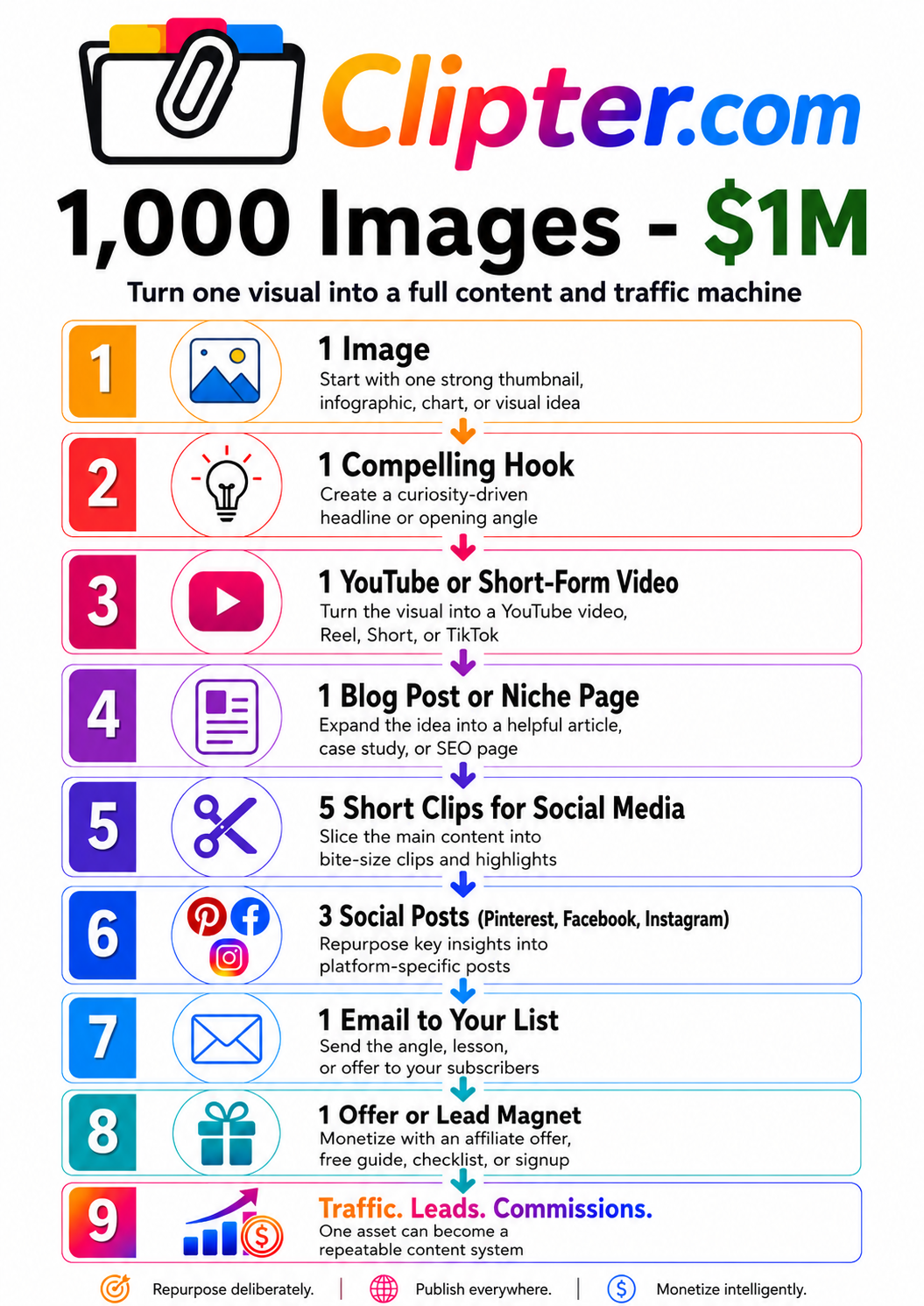
One Image Into a Full Business: The Content Machine
Here is what one single image can become when you treat it as a content seed:
- The Image. The compelling hook that stops the scroll on social media.
- The Thumbnail. Designed specifically to get video clicks. This is not the same as the infographic.
- The Video. A YouTube, TikTok, or short form video based on the image topic.
- The Blog Post. Long form content tied to keywords people are actually searching for.
- 5 Short Clips. Pulled from the video for Instagram, Facebook, and Pinterest.
- 5 Social Posts. Each one links back to the blog post.
- The Email. Send the blog post to your mailing list.
- The Offer or Lead Magnet. The thing that actually makes you money.
The result when done correctly is traffic, leads, and commissions. Now multiply that by 1,000 images. Even if only 5 percent gain traction, that is 50 content winners driving traffic and sales around the clock.
This is the part that breaks most people. Turning one image into eight assets sounds like a full day of work. With Clipter, you drop the image in and it generates the notes, the checklist, the blog post outline, and the next steps for you. The content machine that used to take hours now takes minutes.
Get Clipter Now And Be Locked In At $27 A Month For LIFE!!!
USE COUPON CODE VY2DFCRW
You Are a Content Harvester, Not a Content Creator
Forget the pressure of being original every single day. That pressure is what burns people out and makes them quit. Your real job is simpler:
- Go out and find things that already exist.
- Think about them in a different way.
- Wrap them in a compelling visual.
- Put them in front of the right audience.
The internet is overflowing with great ideas buried in the wrong format. Boring data sheets. Dry reports. Dense articles nobody reads. Your job is to find them and make them visual, shareable, and valuable.
Put on your niche goggles. View everything through the lens of your niche. When news breaks, when fresh data comes out, when something interesting happens, ask yourself how it fits into your content bucket and how you can position it for your audience. Once you train your brain to do this, you will never run out of ideas again.
Clipter is the dumping ground for all of it. See something interesting, save it, and pull from it later when you are ready to create. It becomes your private idea bank that never runs dry.
Build Your Foundation First
Before you start making images, get these four things in place.
1. Your Niche
Pick something specific that already has buyers, keywords, and affiliate offers attached to it. Do not be “the make money online guy.” Be the person who explains what others refuse to explain. Niche down until it almost feels too narrow, then go a little narrower.
2. Your Offer
Find one main offer to build around. The people who really make it are the ones who go deep on one specific thing. Even Jeff Bezos started as just the book guy. What is your one thing?
3. Match Image Intent to Buyer Intent
A luxury money image gets attention, but a title like “7 Hidden Wi-Fi Risks at the Airport” converts better because the intent is crystal clear. Specifics win. Vague gets ignored. Clear gets clicked.
4. Your Pages and Mailing List
Set up landing pages. Build your email list. This is the engine that turns traffic into money over and over again. Your list is the only traffic you truly own, so protect it and feed it.
Types of AI Images That Serve a Real Marketing Purpose
Not all images are equal. These are the ones that actually do a job:
- Thumbnails. For YouTube, blog headers, Facebook, and email headers.
- Infographics. Step by step, comparison, timeline, stats, and explainer styles.
- Social Post Images. Built to stop the scroll and drive to your content.
- Hero Images. For the top of blog posts and landing pages.
- Lead Magnet Covers. Make your free offer look professional and worth grabbing.
- Offer and Affiliate Images. Promote a specific product or service.
- Retargeting Images. Bring back people who already visited your site.
- Niche Brand Images. Build your identity and authority in your space.
Base Everything on Data, Not Hope
The single thing that separates people who build something from people who spin their wheels for months and quit is this. They look at the data.
- Use tools like Ahrefs to find keywords people are actually searching for.
- Use tools like SimilarWeb to see where traffic is really going.
- Use tools like ChatGPT and Clipter to dissect ideas and find what works.
Search data is what is inside the mind of the customer. Even as AI changes search, the customer still wants what the customer wants. That never changes.
When you find a keyword with lower competition, you give yourself the best chance at every step in the sequence. Do not make images you hope will work. Make images based on what people are already looking for. Hope is not a strategy. Data is.
Real World Example: The Dropshipping Pinterest Test
- Posted 200 product infographic images on Pinterest, each showing a different dropshipping product with cost, source, and profit data.
- Each image linked to a simple opt in page that said “Download the full report of crazy products that make money.”
- People opted in. The mailing list grew. Products were sold.
- Result: a few thousand dollars from 200 images, a built mailing list, and a content machine that kept running.
The key was that every image was helpful and stood alone. Each one could be sent to the mailing list every few days for a year without feeling like spam, because each one was genuinely useful on its own.
Real World Example: The Paint Colors Niche
A student took a simple idea and used AI to create paint swatch infographics based on color psychology data. For example:
- “Green plus Red equals Hectic. If you want to focus, use this instead.”
- “Beige plus Green equals Calm. Perfect for your TV room.”
That single video became the top viewed video on his channel. The end game was driving people to an affiliate offer that paid 30 dollars per lead for people who wanted their house painted.
The full funnel looked like this: Infographic, then Video Thumbnail, then Video, then Blog Post, then Email List, then Affiliate Offer with partners like Home Depot and local painters. One idea, fully harvested.
The Math: How 1,000 Images Can Build a Business
- 1,000 images posted strategically.
- Each image averages 10 visitors to your site, which is 10,000 visitors.
- If 7 percent of visitors opt in, that is 700 new email subscribers.
- If 5 percent of images gain real traction, that is 50 content winners driving ongoing traffic.
- Each content winner promotes your offer around the clock.
This is not a get rich quick scheme. It is a compounding content machine that gets stronger over time as you learn what works and what does not. The first hundred images teach you. The next nine hundred pay you.
How Clipter Fits Into All of This
Clipter is the tool built specifically to run this entire system for you. Here is what it does:
- Dissect any image or idea. Drop an image in and Clipter breaks it down. What it is, what type of content it is, what the higher level topic is, and how to get more of it.
- Generate notes, checklists, and glossaries from any piece of content in seconds.
- Plan your content calendar. Save ideas to your planner and schedule them out. That idea becomes Wednesday’s content with one click.
- Turn infographics into blog posts. Use the built in AI to expand any image into a full written piece.
- Use it as your idea dumping ground. Save everything interesting you find, then pull from it when you are ready to create.
- Think Like Marcus button. Applies a proven content framework to your ideas automatically.
Clipter is the content factory that makes the whole system work faster and smarter. Everything in this post, the harvesting, the four step sequence, the one image into eight assets, it all runs through Clipter.
Key Takeaways
- The image is the attention device, not the product.
- AI images alone do not make money. The system behind them does.
- Base everything on data, not hope.
- Every image needs a next step. Opt in, blog post, video, or offer.
- You are a content harvester. Find what already works and make it visual.
- Build your mailing list. It is the only traffic you truly own.
- Deliberately promote your content. Do not just pray the algorithm shows it.
- A smart person learns from their mistakes. A wise person learns from the mistakes of others.
Clipter breaks down every idea, builds your content planner, and generates hooks, checklists, glossaries, blog posts, and more, all powered by AI.
Get Clipter Now And Be Locked In At $27 A Month For LIFE!!!
USE COUPON CODE VY2DFCRW
This is a preorder deal. The price goes up once the launch is complete. Lock in your rate now and never pay more.
Disclaimer: Results are not typical, implied, or guaranteed. The average person attempting any business venture makes little to no money. Your results depend on your effort, your market, and many factors outside of anyone’s control.
Get Clipter Now And Be Locked In At $27 A Month For LIFE!!!
USE COUPON CODE VY2DFCRW
.
.
.
.